
工具化

Search documents
中方:个别国家不应将能源、关键矿产问题泛安全化、政治化、工具化
中国能源报· 2026-03-06 11:07
Group 1 - The core viewpoint emphasizes the absolute sovereignty of nations over their natural resources, urging the international community to respect this principle [1][2] - The global energy transition and rising demand for critical minerals are creating tensions in supply and demand, necessitating international cooperation to build stable and resilient resource supply chains [1][2] - The current geopolitical situation, particularly in the Middle East, poses risks to global economic stability, and there is a call for immediate cessation of military actions to prevent further escalation [1][2] Group 2 - There is a strong advocacy for developing countries to fully utilize their resource endowments to promote economic development and benefit their populations [2] - The importance of open cooperation and mutual benefit in global mineral cooperation is highlighted, rejecting any attempts to politicize or militarize energy and mineral issues [2][3] - China is identified as the largest producer, consumer, and trader of mineral products, committed to compliant mining, open trade, and mutual cooperation, aiming to enhance dialogue and communication with more countries [2][3]

关税不能成为地缘政治工具
Jing Ji Ri Bao· 2026-01-14 22:10
Group 1 - The U.S. has announced a 25% tariff on any country engaging in commercial activities with Iran, using tariffs as a geopolitical pressure tool, which could create new risks for the international community and undermine confidence in global economic stability [1][2] - Engaging in normal commercial exchanges is a sovereign right of nations based on their development stage and resource endowments, and should not be dictated by one country through unilateral policies [1] - The U.S. approach of using domestic law to impose tariffs on countries based on their trade relations with specific nations contradicts principles of sovereign equality and non-interference established by international law [1][2] Group 2 - Historical evidence shows that weaponizing tariffs does not resolve issues but rather disrupts international governance and creates chaos, leading to increased global trade costs and instability in supply chains [2] - The Chinese stance on tariffs and trade is clear: there are no winners in trade wars, and politicizing tariffs is detrimental to all parties involved [2] - The global economic recovery is fragile, and countries should value the cooperative environment; the U.S. should prioritize rules and responsibilities in international trade [2]
基金经理,路越走越窄了
虎嗅APP· 2026-01-12 00:10
Core Viewpoint - The article discusses the contrasting performance and investor preferences between actively managed equity funds and ETFs in the context of a strong stock market in 2025, highlighting the challenges faced by active fund managers despite some impressive returns [4][5][6]. Group 1: Performance of Active Equity Funds - In 2025, the average annual return of actively managed equity funds reached 31.14%, a significant improvement compared to the previous four years [5]. - Over 70 funds achieved annual returns exceeding 100%, with the top-performing fund, managed by Ren Jie, yielding 233.69%, surpassing the previous record set by Wang Yawei in 2007 [5][6]. - Despite these gains, investor confidence in active equity funds remains low, as evidenced by a 5.7% quarter-over-quarter decline in overall fund shares in Q3 2025 [5][6]. Group 2: ETF Growth and Investor Preferences - ETFs saw a substantial growth of over 2 trillion yuan in 2025, reaching a total size of 6 trillion yuan, with stock ETFs alone accounting for 3.8 trillion yuan [6]. - The preference for ETFs over actively managed funds is evident, as even high-performing active funds did not attract significant inflows, with some funds having less than 10 million yuan in size despite impressive returns [6][7]. - The article emphasizes that the growth in active equity fund sizes is primarily due to net asset value increases rather than new subscriptions from investors [5][6]. Group 3: Investment Strategies and Market Dynamics - Active fund managers are increasingly focusing on niche sectors, particularly in technology and AI, to differentiate themselves from ETFs [9][14]. - The concentration of top-performing funds in specific sectors, such as communication and AI, has led to a high degree of overlap in holdings, making it difficult for investors to distinguish between different funds [16][19]. - The article notes that while active managers have the potential for higher returns through deep research and sector focus, many struggle to maintain consistent performance over time [32][33]. Group 4: Challenges Faced by Active Fund Managers - Many active fund managers face challenges in outperforming ETFs, particularly in sectors where ETFs have strong performance, such as communication [17][18]. - The article highlights that the strategies employed by many active managers are becoming increasingly homogenized, leading to a lack of differentiation in performance [16][19]. - The potential for active managers to capture excess returns is limited by their inability to adapt quickly to changing market conditions, particularly when sectors experience downturns [25][26].

中国ETF总规模首破6万亿元!谁是2025年的胜者?
Xin Lang Cai Jing· 2025-12-28 07:01
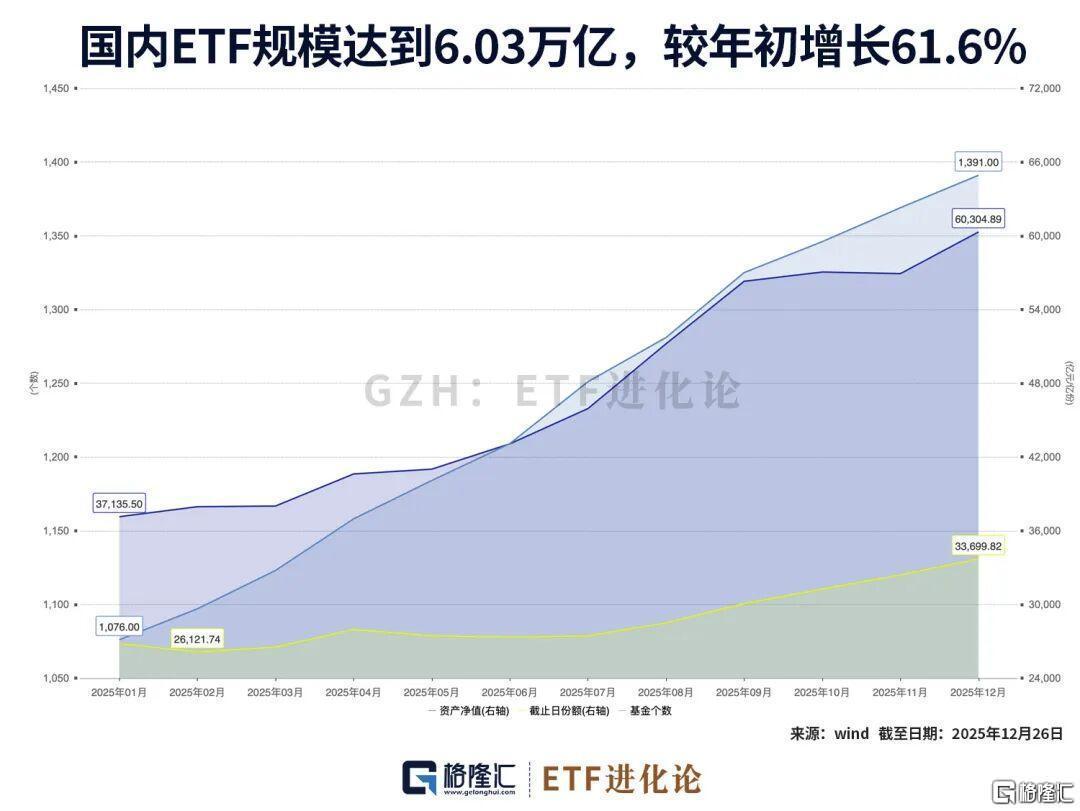
Core Insights - The Chinese capital market is entering an "ETF era" by 2025, with the total market size of ETFs reaching 6 trillion yuan, a 61.6% increase in just one year [1][3][4] Market Growth - The ETF market has shown rapid growth, breaking through 4 trillion, 5 trillion, and 6 trillion yuan in quick succession within 2025, indicating a clear acceleration in growth [3][4] - Historical data shows that the ETF market grew from 1 trillion yuan in 2020 to 2 trillion in 2023, and 3 trillion in 2024, culminating in a significant leap in 2025 [4] Market Structure Changes - The growth in ETF size has transformed the market landscape, making ETFs a key component of the public fund system, with 1,381 ETFs in total, including 7 flagship ETFs exceeding 100 billion yuan [5][9] - The Huatai-PB CSI 300 ETF leads the market with a size of 427.07 billion yuan, followed by other major ETFs from E Fund, Huaxia, and others [5][7] Fund Inflows - In 2025, 50 ETFs saw net inflows exceeding 10 billion yuan, with the Hong Kong Stock Connect Internet ETF attracting the most at 57.07 billion yuan, followed by the Gold ETF with 41.70 billion yuan [17][19] - Bond ETFs also saw significant inflows, with the Short-term Bond ETF and 30-Year Treasury Bond ETF attracting 35.05 billion yuan and 22.35 billion yuan, respectively [17] Competitive Landscape - The top three fund companies dominate the ETF market, holding 41% of the market share, while the top ten companies account for 75% [21] - The "ETF billion club" expanded from 12 to 16 members in 2025, with new entrants including Huitianfu, Haifutong, and Penghua [21] Global Context - The domestic ETF market is approximately one-fourth the size of the U.S. market, indicating that the long-term trend of indexation in China is just beginning [27]
年内新发基金数创近三年新高,“小而多”取代“造爆款”
2 1 Shi Ji Jing Ji Bao Dao· 2025-11-11 12:56
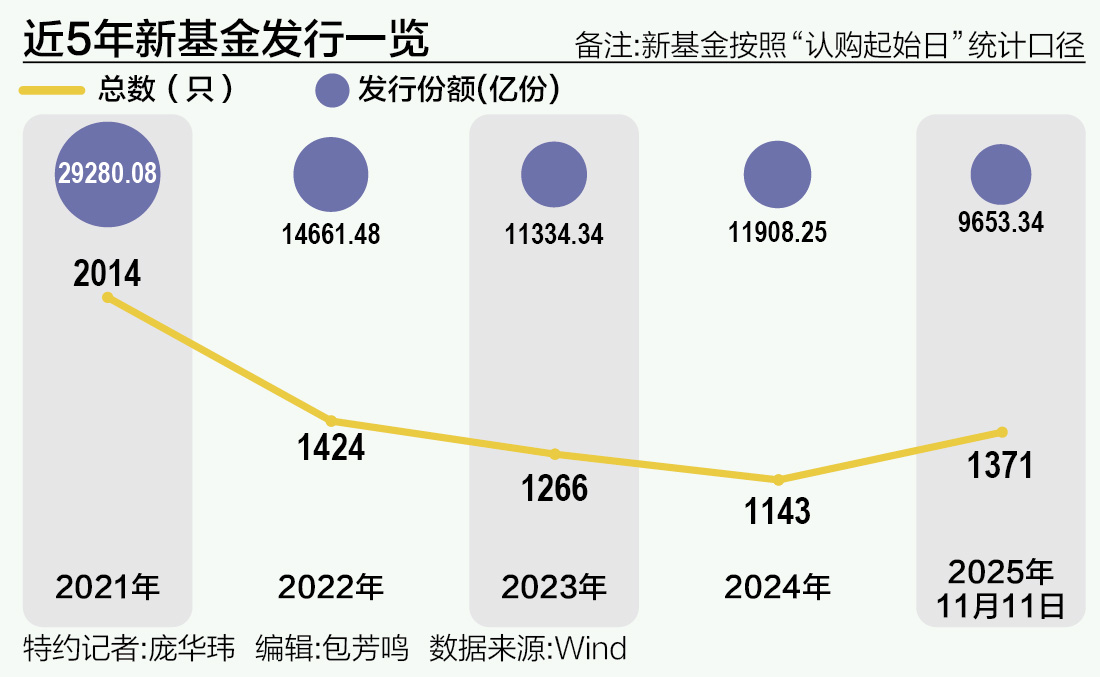
Core Insights - The public fund issuance market has seen a significant increase in the number of new funds, reaching 1,371 by November 11, marking a three-year high, while the average fundraising scale has decreased to 782 million yuan [1][2][4] - The market is shifting from a reliance on star fund managers and blockbuster products to a more diversified approach characterized by "tool-oriented, segmented, and institutionalized" strategies [1][4] Fund Issuance Trends - The number of new public funds issued this year has surpassed previous years, with 1,371 new funds compared to 1,266 in 2023 and 1,143 in 2024, nearing the 2022 total of 1,424 [2] - The average fundraising scale for new funds has dropped significantly, with a total issuance scale of approximately 9,653 billion yuan, the lowest since 2019 [4][5] Fund Types and Strategies - A notable trend is the rise of initiated funds, with 334 new funds launched in this format, accounting for about 25% of new funds, primarily in the equity category [4] - The issuance strategy has shifted to "broad net" rather than "creating blockbuster funds," with companies focusing on low-cost, efficient tool products to meet changing market demands [4][5] Market Dynamics - The stock market's recovery has led to a stronger focus on equity funds, with 761 new equity funds issued, a record high, and accounting for 37% of total new fund issuance [6][7] - Conversely, bond funds have seen a significant decline, with only 247 new bond funds issued, the lowest in nearly a decade, reflecting a stark contrast to the equity market's performance [8][9] Future Outlook - The market is expected to maintain a structure where equity funds dominate, particularly index funds due to their cost advantages, while bond fund issuance is anticipated to remain stable [10]
今天为啥V型反弹?
表舅是养基大户· 2025-11-03 13:33
Group 1 - The technology sector experienced a significant drop last week, leading to concerns about fund managers potentially facing salary cuts due to underperformance against benchmarks, prompting further declines on Monday [1] - The market saw a V-shaped rebound after an initial decline, with the ChiNext and STAR Market indices recovering, indicating a possible shift in investor sentiment [1] - The largest ETF in the market, the CSI 300 ETF, recorded a net inflow of 5 billion, raising questions about the motivations behind such a large investment during a downturn [1] Group 2 - New tax regulations on gold purchases are expected to increase costs for consumers, which may negatively impact demand in the short term, while benefiting gold ETFs and paper gold products [4] - Major banks like ICBC and CCB temporarily suspended their paper gold businesses to align with the new regulations, although ICBC resumed operations shortly after [4] - Gold stocks and related ETFs faced significant declines, with gold stocks dropping over 4% during the trading session [4] Group 3 - The storage chip sector saw a rebound, with major South Korean companies like SK Hynix and Samsung experiencing significant stock price increases, which contributed to the overall market recovery [9] - The influx of southbound capital into Hong Kong stocks coincided with the A-share market's recovery, indicating a positive sentiment shift among investors [9] Group 4 - The new public fund performance benchmark regulations are expected to enhance transparency and accountability in fund reporting, which could lead to a more competitive environment for fund managers [14] - Ant Group's wealth management platform has been evolving, with the introduction of standardized analysis metrics for funds, enhancing the investment experience for users [17][21] - The platform's focus on transparency and tool-based investment strategies is likely to increase user engagement and retention, positioning it as a leading player in the fund distribution market [26] Group 5 - Recommendations for Ant Group include enhancing asset allocation perspectives to guide investors towards a more diversified investment approach, moving beyond single-product thinking [27] - Other fund distribution institutions are encouraged to improve user experience through a combination of online and offline services, particularly in the context of financial technology advancements [27]

商务部回应Tiktok问题:绝不会以牺牲原则立场、企业利益和国际公平正义为代价寻求达成任何协议
Di Yi Cai Jing· 2025-09-18 07:36
Core Viewpoint - The Chinese government emphasizes its consistent stance against the politicization and weaponization of technology and trade issues, particularly regarding TikTok, while advocating for a fair business environment for Chinese companies in the U.S. [1] Summary by Relevant Sections - **Meeting Context**: A meeting between Chinese and U.S. economic and trade teams took place in Madrid from September 14 to 15, focusing on resolving TikTok-related issues and promoting economic cooperation [1]. - **Chinese Government's Position**: The Chinese government opposes the politicization of technology and trade, asserting that it will not compromise principles or corporate interests for any agreement [1]. - **Support for Business Negotiations**: The Chinese government respects the will of enterprises and supports equal business negotiations based on market principles [1]. - **Regulatory Framework**: The Chinese government will legally review matters related to TikTok's technology exports, intellectual property, and usage rights [1]. - **Call for Fair Treatment**: The Chinese government urges the U.S. to provide an open, fair, just, and non-discriminatory business environment for Chinese companies, including TikTok, to ensure stable and sustainable development of Sino-U.S. economic relations [1].
李成钢:中国绝不会以牺牲原则立场、企业利益和国际公平正义为代价 寻求达成任何协议
Xin Hua She· 2025-09-15 15:18
Core Viewpoint - The Chinese Ministry of Commerce, represented by Li Chenggang, firmly opposes the politicization and weaponization of technology and trade issues regarding TikTok, emphasizing that no agreement will be pursued at the expense of principles, corporate interests, or international fairness and justice [1] Group 1 - The Chinese government will resolutely safeguard national interests and the legitimate rights of Chinese enterprises, conducting technology export approvals in accordance with laws and regulations [1] - The Chinese government fully respects the will of enterprises and supports them in conducting equal business negotiations based on market principles [1]
公募行业演进新范式:“赛道化”“工具化”渐成风尚 基金经理主动“缩圈”
Zhong Guo Jing Ji Wang· 2025-09-08 00:47
Core Viewpoint - The trend of "track-oriented" and "tool-oriented" active equity funds is emerging in the public fund industry, driven by industry competition, customer demand, and market conditions [1][2][3] Group 1: Industry Trends - Active equity funds are increasingly adopting "track-oriented" and "tool-oriented" strategies, focusing on specific sectors such as innovative pharmaceuticals, robotics, computing power, semiconductors, and low-altitude economy [2][3] - In the second half of the year, 34 out of 68 newly established mixed funds had clear themes like "technology," "healthcare," and "consumption," accounting for 50% of the total [2] - The rapid growth of active equity funds since 2019 has led to a focus on core sectors, with fund managers increasingly concentrating their portfolios on specific industries [4][15] Group 2: Market Dynamics - The "track-oriented" trend is a response to significant industry competition, where smaller fund companies find it challenging to compete with larger firms in broad market selections [3][6] - Customer demand has shifted from product-oriented to client-needs-oriented, with investors preferring products with clear strategies and investment directions [3][6] - The current market environment, characterized by structural trends, presents opportunities for excess returns in specific sectors, leading to a consensus among funds to focus on niche industries [3][6] Group 3: Fund Manager Strategies - Fund managers are transitioning from a broad investment approach to a more focused strategy, enhancing the sharpness of their investment styles [5][6] - The shift towards "track-oriented" products requires fund managers to narrow their focus, allowing for deeper understanding and identification of mispriced opportunities [6][8] - The trend does not signify the end of "all-round" fund managers, as the market still requires diverse capabilities among fund managers [6][7] Group 4: Research and Evaluation Requirements - The new "track-oriented" and "tool-oriented" strategies necessitate a more sophisticated research and evaluation framework within fund companies [8][10] - A multi-dimensional evaluation system is needed to assess the performance of "sharp" fund managers and tool-oriented products, as traditional metrics may not accurately reflect their capabilities [10][11] - Fund companies must adapt their assessment criteria to align with the specific characteristics of "track-oriented" products, focusing on long-term excess returns and risk management [10][11] Group 5: Investor Considerations - Investors are advised to avoid over-concentration in single-track investments and to adopt a diversified asset allocation strategy [12][20] - The rise of "track-oriented" funds increases the need for investors to have strong asset allocation skills and timing abilities [12][20] - Fund companies are encouraged to enhance investor education to help clients understand the risks and characteristics of these products [12][19]
外交部:中方一贯反对将科技和经贸问题政治化、工具化、武器化
Zhong Guo Xin Wen Wang· 2025-09-05 09:04
Core Viewpoint - The Chinese Ministry of Foreign Affairs opposes the politicization, instrumentalization, and weaponization of technology and trade issues, stating that such practices are detrimental to all parties involved [1]. Group 1 - The spokesperson, Guo Jia Kun, responded to a question regarding Anthropic's decision to stop providing AI services to Chinese-controlled companies, indicating a lack of specific knowledge about the situation [1]. - The statement emphasizes China's consistent stance against the politicization of technology and trade matters [1].