超宽禁带(UWBG)半导体

Search documents
超越SiC?功率器件市场,跑出一匹黑马
3 6 Ke· 2025-11-14 03:45
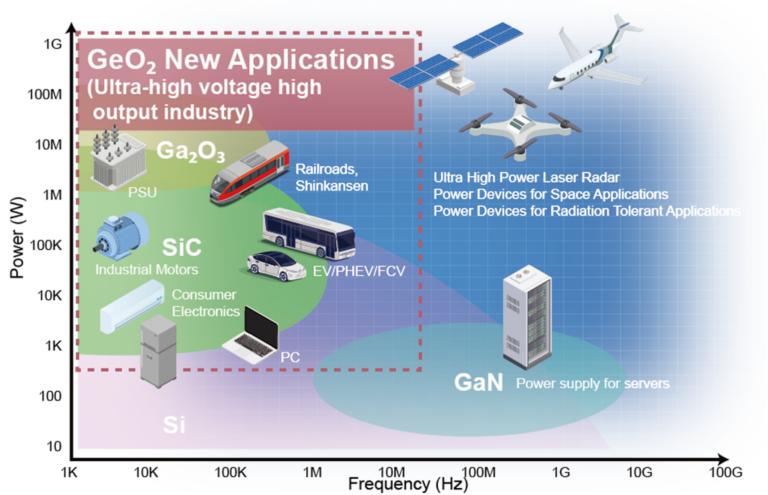
Core Insights - The semiconductor industry is witnessing a shift from traditional silicon (Si) to advanced materials like silicon carbide (SiC) and gallium nitride (GaN), with a new contender, r-GeO2, emerging as a potential game-changer in the ultra-wide bandgap (UWBG) semiconductor space [1][2][24] - Patentix Corporation has successfully grown the first bulk crystal of r-GeO2 using the FZ method, achieving a size of 5 mm and a bandgap of 4.68 eV, which surpasses both SiC and GaN [1][5] - The commercialization of UWBG semiconductors is highly anticipated due to increasing demands from electric vehicles (EVs), AI data centers, and energy efficiency needs [1][24] Group 1: r-GeO2 Breakthrough - Patentix has developed r-GeO2, which has a theoretical capability for both p-type and n-type doping, making it suitable for next-generation high-performance MOSFETs [4][10] - The company aims to produce high-quality bulk substrates with minimal crystal defects to maximize the potential of r-GeO2 [4][10] - The successful growth of r-GeO2 crystals marks a significant advancement in UWBG materials, positioning it as a strong competitor in the power semiconductor market [1][2][24] Group 2: Ga2O3 Developments - Ga2O3 is recognized for its superior properties, including a bandgap of approximately 4.8 eV and a breakdown electric field of 8 MV/cm, making it a promising candidate for high-voltage power devices [11][12] - Japan has a strong foundation in Ga2O3 research, with companies like Novel Crystal Technology (NCT) achieving significant milestones in developing high-performance Ga2O3 MOSFETs [15][17] - Chinese companies are also making strides in Ga2O3, with Hangzhou Garen Semiconductor announcing the world's first 8-inch Ga2O3 single crystal, marking a significant advancement in substrate technology [18][19][20] Group 3: Industry Competition and Future Outlook - The competition in the UWBG semiconductor market is intensifying, with Japan leading in technology accumulation while China is rapidly advancing in industrialization [24] - The potential for Ga2O3 to replace existing materials in high-voltage applications is strong, despite challenges such as thermal conductivity and cost [24] - The industry is moving towards a new era of materials, with both r-GeO2 and Ga2O3 poised to play crucial roles in the future of power semiconductors [24]

超越SiC?功率器件市场,跑出一匹黑马!
半导体行业观察· 2025-11-14 01:44
Group 1 - The core viewpoint of the articles is that ultra-wide bandgap (UWBG) materials, particularly germanium dioxide (GeO₂) and gallium oxide (Ga₂O₃), are emerging as key players in the power semiconductor industry, with significant potential for commercialization driven by trends in electric vehicles, AI data centers, and energy efficiency demands [2][30]. Group 2 - Patentix Corporation has achieved a breakthrough by successfully growing the first bulk crystal of rutile-type GeO₂ using the FZ method, with a size of 5 mm and a bandgap of 4.68 eV, which is significantly higher than that of silicon carbide (SiC) and gallium nitride (GaN) [2][6]. - GeO₂ is positioned as a competitive UWBG semiconductor due to its high power potential, suitability for both p-type and n-type doping, and the availability of low-cost bulk crystals [3][5]. - The company aims to produce half-inch GeO₂ substrates and develop ultra-high-performance power devices that traditional semiconductor materials cannot achieve [12][30]. Group 3 - Ga₂O₃ is recognized for its superior performance compared to GaN and is seen as a promising material for high-voltage power devices, with a bandgap of approximately 4.8 eV and a breakdown field strength of 8 MV/cm [14][15]. - Japan has a strong foundation in Ga₂O₃ research, with significant advancements made by companies like Novel Crystal Technology (NCT), which has developed a vertical Ga₂O₃ MOSFET with a power quality factor of 1.23 GW/cm², significantly enhancing the performance of Ga₂O₃ transistors [19][20]. - Chinese companies are also making strides in the Ga₂O₃ sector, with Hangzhou Garen Semiconductor achieving the world's first 8-inch Ga₂O₃ single crystal, marking a significant advancement in substrate technology [22][25]. Group 4 - The competition in the Ga₂O₃ market is intensifying, with Japan leading in technology accumulation while China is rapidly advancing in industrialization, indicating a potential shift in the global semiconductor landscape [30].