
跨境数据流动治理

Search documents
独家解读:关于TikTok方案,几个关键信息
Jin Shi Shu Ju· 2025-09-22 12:42
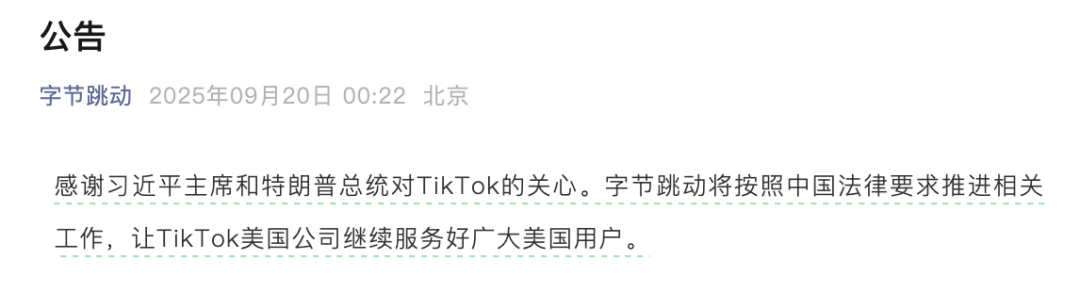
Core Points - The core development is the agreement reached between China and the U.S. regarding TikTok's operations in the U.S., which includes a framework for data security and investment barriers [1][3][10] Group 1: Agreement Details - The framework agreement allows for the establishment of a U.S. joint venture for TikTok's data security operations, with ByteDance retaining the largest single shareholder position [3][9] - TikTok's U.S. data security company (USDS) will be responsible for user data storage, content security, and software checks, while ByteDance will continue to operate its commercial activities through its U.S. subsidiary [3][4][10] - The algorithm remains owned by ByteDance, which will grant USDS the usage rights, subject to approval from the Chinese Ministry of Commerce [5][6][9] Group 2: Implications and Future Outlook - The agreement is seen as a recognition of TikTok's existing business model in the U.S. and aims to balance national security concerns with corporate interests [9][10] - The TikTok framework may serve as a model for other Chinese companies navigating geopolitical challenges, potentially influencing cross-border data governance practices globally [10]
沈逸独家解读:关于TikTok方案,几个关键信息
Guan Cha Zhe Wang· 2025-09-22 04:26
Core Viewpoint - The recent US-China economic talks in Madrid resulted in a basic framework consensus regarding TikTok's operations and investment barriers, with both sides expressing a commitment to resolving the TikTok issue and promoting economic cooperation [1][10]. Group 1: TikTok Operations and Framework Agreement - The framework agreement reached in Madrid has been confirmed at the highest levels and is now moving towards signing, approval, and execution stages [3]. - TikTok's US operations will be managed by a newly formed US joint venture, TikTok US Data Security (USDS), which will be responsible for data security and content safety, while ByteDance retains majority ownership [4][6]. - The algorithm for TikTok will remain under ByteDance's ownership, with usage rights granted to USDS, subject to approval from the Chinese Ministry of Commerce [7][8]. Group 2: Implications for Chinese Enterprises - The TikTok agreement reflects a broader strategy for Chinese companies to navigate geopolitical challenges while ensuring compliance with local laws and protecting national interests [11]. - The model established by TikTok USDS may serve as a reference for future cross-border data governance and could facilitate the entry of US companies into China under similar frameworks [11].

完善制度规范强化跨境数据流动治理
Jing Ji Ri Bao· 2025-08-14 22:08
Core Insights - The opening of the first cross-border data corridor "E Data Express" in the capital highlights the growing importance of cross-border data flow governance in the rapidly developing digital economy [1] - Data flow is identified as a fundamental and strategic resource in the digital age, with an average profit growth contribution of 10% across industries, and up to 32% in sectors like digital platforms and finance [1] - The Ministry of Commerce's report indicates that a 10% increase in data flow can lead to a 0.2% GDP growth, with global contributions from data flow expected to reach $11 trillion by 2025 [1] Summary by Sections Cross-Border Data Flow Governance - The establishment of a high-efficiency and secure mechanism for cross-border data flow is emphasized, ensuring the protection of important data and personal information [1] - Current legal frameworks for data protection and cross-border flow in China are noted to be largely established, but there are still gaps in the governance system [2] International Cooperation and Rule-Making - China actively participates in the formulation of international rules for cross-border data flow, showcasing its major country stance through initiatives like the "Global Data Security Initiative" and "Global AI Governance Initiative" [2] - Bilateral agreements, such as the memorandum with Germany on data flow cooperation, and discussions with Singapore on common standards, are part of China's strategy to enhance international collaboration [2] Legislative and Institutional Improvements - Recommendations include improving domestic legislation to fill legal gaps and ensure alignment with the digital economy's development [3] - The need for a comprehensive legal system that integrates existing laws and addresses the latest demands in international digital trade governance is highlighted [3] Enhancing International Collaboration - Strengthening cooperation with Asia-Pacific countries in e-commerce and new digital business models is crucial for expanding the governance of cross-border data flow [4] - Establishing a dialogue platform for data governance among countries and exploring cooperation mechanisms in specific areas like electronic bills and invoices are suggested [4]