转让定价

Search documents
南非税务署引进预约定价机制强化跨国企业税收监管
Shang Wu Bu Wang Zhan· 2026-01-17 17:52
Core Viewpoint - The South African Revenue Service (SARS) is implementing an Advance Pricing Arrangement (APA) system to enhance the regulation of transfer pricing among multinational enterprises, aiming to provide tax certainty and attract foreign investment [1][2]. Group 1: Implementation of APA - SARS will start accepting APA applications from multinational companies as early as June, following the recruitment of specialized personnel to manage the program [1]. - The APA system is designed to establish binding agreements between multinational enterprises and tax authorities regarding transfer pricing methods for transactions between related entities [1]. Group 2: Objectives and Benefits - The introduction of the APA system aligns with recommendations from the Davis Tax Committee, aiming to provide tax certainty for transfer pricing and reduce disputes and double taxation risks [1]. - The initiative is seen as a positive development for multinational enterprises, particularly for complex high-value transactions, enhancing the predictability of tax treatment [1]. Group 3: Regulatory Environment - SARS emphasizes a commitment to responsible public revenue management while taking decisive action against intentional or ongoing violations, thereby creating a predictable regulatory environment for cross-border investments [2]. - The establishment of a stable and transparent tax environment is crucial for South Africa, a developing country seeking to attract foreign investment and prevent tax base erosion through unfair transactions [1].
【安永税务】巴西并购——税务尽职调查并非例行公事
Sou Hu Cai Jing· 2025-12-22 13:13
Core Insights - Brazil, as the largest economy in Latin America, continues to attract strategic and financial investors due to its vast domestic market, rich natural resources, and strategic location in the Southern Hemisphere [1] - The country is undergoing significant tax reforms, including a comprehensive consumption tax reform that aligns with OECD standards, necessitating forward-looking financial and tax due diligence [1][3] Regulatory Environment - The merger and acquisition process in Brazil is more complex compared to jurisdictions like the US or Europe, requiring extensive documentation, additional regulatory approvals, and longer approval timelines [2] - Specific industries such as media, healthcare, and aviation have restrictions on foreign ownership or require special permits, impacting transaction structures and timelines [2] Tax Due Diligence - Tax due diligence (TDD) is critical in Brazil's evolving tax landscape, with three major structural reforms directly affecting valuation models and transaction agreements [3] - The transition from a fragmented VAT system to a dual VAT system (CBS/IBS) is set to begin in 2026, with significant implications for profit margins and working capital [3][10] Transfer Pricing and Global Minimum Tax - Starting January 1, 2024, Brazil will adopt OECD's arm's length principle for transfer pricing, expanding the scope to include services, intangible assets, and financial transactions [4] - The implementation of a qualified domestic minimum top-up tax (QDMTT) from January 1, 2025, will require companies with revenues exceeding €750 million to model effective tax rates and prepare compliance documentation [4] Employment Tax Risks - The Brazilian Supreme Court has paused litigation regarding the legality of hiring through personal service companies (PJs), which poses significant investment risks for industries reliant on contractors [8] - Potential liabilities related to employment taxes could arise if the court's final ruling is unfavorable, impacting cost structures and compliance obligations [8][15] Legal and Judicial Uncertainty - Court rulings can significantly affect tax treatment outcomes, necessitating careful evaluation of each tax dispute to determine refund eligibility and audit risks [7] - The dynamic nature of the CBS/IBS tax framework highlights the need for flexible pricing models and renegotiation clauses in sale and purchase agreements [7] Industry-Specific Considerations - In the consumer and retail sector, traditional pricing models based on ICMS-ST must be adjusted to comply with new CBS/IBS regulations [11] - The technology and digital industries must address historical risks and outdated contract structures while ensuring compliance with OECD transfer pricing rules [13] - The telecommunications sector will benefit from unified taxation rules under CBS/IBS, but transitional risks remain [14] Conclusion - Brazil's market presents attractive investment opportunities, but success hinges on the ability to navigate complex information and incorporate tax reforms, legal uncertainties, and employment tax risks into pricing considerations [17] - Effective tax due diligence is now a strategic tool that transforms complex situations into clear judgments, supporting decision-making processes [17]
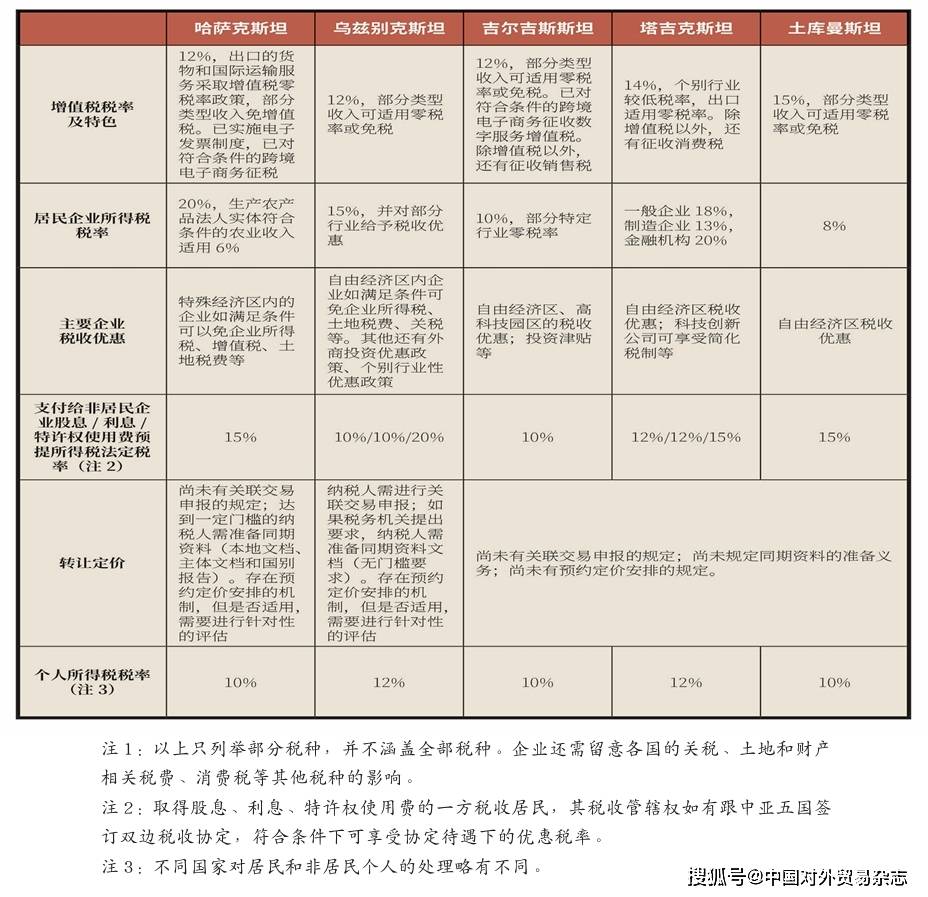
中亚五国的税收环境及税收风险
Sou Hu Cai Jing· 2025-11-18 12:09
Core Insights - Central Asian countries are actively promoting economic diversification strategies, resulting in distinct industrial structures, with Chinese enterprises focusing on investments in energy, infrastructure, agricultural processing, manufacturing, and services [1] Tax Environment Overview - The tax environment for Chinese enterprises in Central Asian countries is complex, with variations in tax types, rates, and incentives across nations [2] - Kazakhstan has a VAT rate of 12%, with certain exports and international transport services exempted; Uzbekistan also has a 12% VAT rate with specific exemptions [2] - Corporate income tax rates vary, with Kazakhstan at 20%, Uzbekistan at 15%, and Kyrgyzstan at 10% for certain sectors [2] Common Tax Risks - Tax reforms and lack of clarity create uncertainty; Kazakhstan's new tax law will take effect on January 1, 2026, and transfer pricing rules will also be updated [3] - There is a risk of differing interpretations of tax laws by tax authorities, leading to uncertainty in enforcement [3][4] Permanent Establishment Risks - Chinese enterprises involved in infrastructure and engineering projects face scrutiny regarding whether they create a permanent establishment in the host country, which could lead to local tax obligations [5] - In Kazakhstan, local entities are considered tax agents responsible for withholding taxes on payments to unregistered foreign suppliers [5] Utilizing Tax Treaties - China has signed tax treaties with Central Asian countries, allowing for reduced withholding tax rates on dividends, interest, and royalties under certain conditions [6] - Kazakhstan has strict scrutiny for treaty benefits, particularly regarding the "beneficial owner" concept, while Uzbekistan has recently introduced this concept [6] Transfer Pricing Risks - Transfer pricing practices vary significantly across Central Asian countries, with Kazakhstan and Uzbekistan having more developed frameworks compared to others [7] - Kazakhstan has stringent compliance checks, especially for transactions in the oil, gas, and mining sectors [7] Customs Duties and Tax Recommendations - Customs duties differ significantly among Central Asian countries, with Kazakhstan's average most-favored-nation tariff rate at 5.6% for 2024 [9] - Companies are advised to assess compliance costs and utilize tax incentives effectively when planning cross-border transactions [9]

企业出海启示录:拉丁美洲投资在即,您的企业是否已做好避开暗礁的万全之策?
Sou Hu Cai Jing· 2025-10-20 02:11
Group 1 - The core challenge of expanding into the Latin American market includes navigating complex tax environments and supply chain issues, which can significantly impact global supply chain efficiency and profitability [2] - Companies face specific dilemmas such as designing holding structures, pricing internal transactions, and optimizing supply chains while managing tax planning [2] - KPMG offers comprehensive tax solutions to empower global supply chains for businesses entering the Latin American market [3] Group 2 - KPMG provides actionable recommendations for designing efficient holding structures by comparing the advantages and disadvantages of direct and indirect investments [4] - The firm emphasizes the importance of optimizing transfer pricing strategies to effectively manage tax risks and ensure compliance [5] - KPMG integrates tax considerations into supply chain optimization from the outset, helping companies achieve cost reduction, efficiency, and compliance [6]