轻资本发展

Search documents
自营理财逆势压降,中小银行提速差异化发展
Xin Lang Cai Jing· 2026-01-23 10:03
Core Insights - The banking wealth management market is expanding, while banks without wealth management subsidiaries are systematically reducing their self-managed wealth management scale [1][2][3] - Recent reports from four small banks indicate a significant decline in their self-managed wealth management products, reflecting a broader industry trend influenced by regulatory guidance [2][10] Group 1: Market Trends - Four small banks reported a combined reduction of over 7 billion yuan in self-managed wealth management products, with total scale dropping from 31.87 billion yuan at the end of 2024 to 24.52 billion yuan by the end of 2025 [2][9] - The regulatory environment encourages banks to establish wealth management subsidiaries, leading to a focus on reducing self-managed wealth management and transitioning to agency sales [10][11] - By mid-2025, banks without wealth management subsidiaries had a self-managed wealth management scale of only 3.19 trillion yuan, accounting for about 10% of the total, with a year-on-year decline exceeding 24% [10] Group 2: Industry Growth - The overall scale of the banking wealth management industry reached a historical peak of 34 trillion yuan by November 2025, increasing by over 4 trillion yuan since the beginning of the year [4][12] - As of the end of the third quarter of 2025, there were 181 banks and 32 wealth management companies with active products, totaling 43,900 products and a scale of 32.13 trillion yuan, marking a year-on-year increase of 9.42% [12][13] - Fixed income products dominate the wealth management market, with a scale of 31.21 trillion yuan, representing 97.14% of the total [13] Group 3: Future Outlook - The market is expected to continue a "stronger gets stronger, weaker must transform" dynamic, with a projected increase in wealth management scale to over 36 trillion yuan in 2026 [6][14] - Wealth management subsidiaries are anticipated to leverage professional research and product innovation to expand into high-value categories such as ESG and retirement planning [14] - Small banks are advised to focus on differentiated and light-capital development paths, enhancing customer service and product offerings to avoid homogenization in competition [7][15]
中信银行行长芦苇:我们已经摒弃了规模情结,更专注高质量增长
2 1 Shi Ji Jing Ji Bao Dao· 2025-08-28 06:12
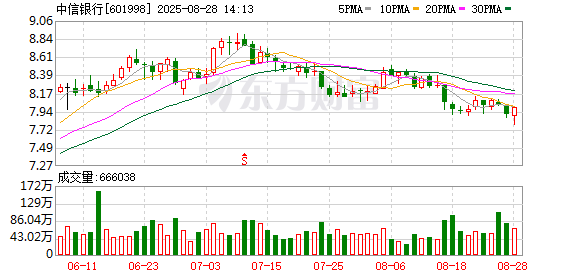
Core Viewpoint - CITIC Bank has shifted its focus from "scale obsession" to a balanced growth strategy emphasizing both efficiency and quality, which underpins its financial performance [2][4]. Financial Performance - As of mid-2025, CITIC Bank's total assets reached 9.86 trillion yuan, a 3.42% increase from the end of the previous year [2]. - The net profit attributable to shareholders was 36.478 billion yuan, reflecting a year-on-year growth of 2.78% [2]. - Operating revenue slightly declined to 105.762 billion yuan, down 2.99% year-on-year [2]. - The net interest margin stood at 1.63%, a decrease of 14 basis points, yet it remains 21 basis points above the industry average [2]. - The non-performing loan ratio was stable at 1.16%, consistent with the previous year-end and first quarter [2]. Operational Strategy - The bank emphasizes a "steady, balanced, and sustainable" approach, showcasing resilience and the ability to withstand shocks [2]. - Profit growth is supported by cost control measures, with effective reductions in funding, operational, and risk costs [2][5]. Risk Management - CITIC Bank has maintained stable risk indicators, with a continuous decline in non-performing loan ratios over the past six years and an increase in the provision coverage ratio over the last four years [3][5]. - The bank prioritizes risk management as a core competency, ensuring that growth is achieved without compromising risk resilience [5]. Growth Quality - The bank has achieved reasonable and quality growth, with off-balance sheet financing growing faster than on-balance sheet assets [4]. - The growth in general loans outpaced total loan and asset growth, while deposit growth exceeded total liability growth [4]. Customer and Asset Structure - The bank's revenue contribution structure is balanced, with corporate, retail, and financial market businesses contributing 40%, 40%, and 20% respectively [6]. - The bank has increased its focus on retail loans and asset under management (AUM), achieving a strong position in the industry [6]. - The bank's loan distribution strategy emphasizes increasing loans to the real economy, with general loans making up 56.6% of total assets, a 1.3 percentage point increase from the previous year [6]. Future Outlook - For the second half of the year, CITIC Bank plans to enhance revenue generation through asset management, interest margin stability, and non-interest income growth [8]. - The bank aims to improve asset allocation, focusing on high-quality projects and optimizing its loan structure [8]. - Efforts will be made to increase non-interest income by promoting wealth management and financial market services [8].