
ESG理财产品

Search documents
政策研究报告:为什么需要ESG-理念、实践与趋势
Guoyuan Securities· 2026-03-06 06:24
Group 1: ESG Overview - ESG stands for Environment, Social, and Governance, focusing on non-financial performance to identify long-term value and risks[8] - The China Securities Regulatory Commission (CSRC) aims to enhance corporate governance through the "Regulations on the Supervision and Administration of Listed Companies" by the end of 2025[8] - ESG policies are crucial for promoting sustainable business practices, especially when short-term financial impacts are uncertain[8] Group 2: Market Trends and Data - ESG disclosure rates are increasing annually, with the CSI 300 companies leading the trend, and overall ESG ratings for listed companies are on the rise[8] - By the end of 2024, there were 5,404 signatories to the UN Principles for Responsible Investment (PRI), but the annual growth rate has slowed to 6.78%[15] - Companies with higher ESG ratings tend to have lower annualized stock volatility, indicating potentially more stable returns and lower risks[49] Group 3: Investment Efficiency - Companies with better ESG performance often exhibit higher Return on Invested Capital (ROIC), with A-rated companies averaging 6.76% ROIC compared to lower-rated firms[36] - ESG performance can mitigate information asymmetry, enhancing investment efficiency by improving access to capital and reducing financing constraints[33] - The average annualized volatility for companies rated "CCC~C" is approximately 52%, suggesting a correlation between ESG ratings and risk levels[52]
理念、实践与趋势:为什么需要ESG
Guoyuan Securities· 2026-03-06 03:24
Group 1: ESG Overview - ESG stands for Environment, Social, and Governance, focusing on non-financial performance to identify long-term value and risks[8] - The Chinese regulatory framework for ESG is evolving, with the 2025 draft of the "Regulations on the Supervision and Administration of Listed Companies" marking a significant step towards systematic governance[8] - ESG policies are crucial for promoting sustainable business practices, with the government supporting green standards and information disclosure systems[8] Group 2: Market Trends and Data - The ESG disclosure rate among listed companies is increasing annually, with the CSI 300 companies leading this trend[8] - By 2024, 5,404 institutions had signed the UN PRI, but the annual growth rate of new signatories has declined from 33.94% in 2020 to 6.78% in 2024[15] - Companies with higher ESG ratings tend to exhibit lower annualized stock volatility, indicating potentially more stable returns and reduced risks[49] Group 3: Investment Efficiency - Companies are motivated to improve ESG performance as it enhances reputation, attracts investment, and optimizes resource allocation[32] - Higher ESG ratings correlate positively with Return on Invested Capital (ROIC), suggesting that better ESG performance leads to improved investment efficiency[36] - The average ROIC for A-rated companies is 6.7552%, while C-rated companies average only 0.8443%, highlighting the financial benefits of strong ESG practices[39] Group 4: Policy and Regulatory Support - The Chinese government is actively promoting ESG through various policies, including mandatory disclosure requirements and governance standards[21] - The 2025 amendments to the "Management Measures for Information Disclosure of Listed Companies" elevate ESG disclosure from voluntary to mandatory, enhancing regulatory enforcement[22] - Central enterprises are expected to lead by example in ESG practices, influencing private companies to adopt similar standards[28]
自营理财逆势压降,中小银行提速差异化发展
Xin Lang Cai Jing· 2026-01-23 10:03
Core Insights - The banking wealth management market is expanding, while banks without wealth management subsidiaries are systematically reducing their self-managed wealth management scale [1][2][3] - Recent reports from four small banks indicate a significant decline in their self-managed wealth management products, reflecting a broader industry trend influenced by regulatory guidance [2][10] Group 1: Market Trends - Four small banks reported a combined reduction of over 7 billion yuan in self-managed wealth management products, with total scale dropping from 31.87 billion yuan at the end of 2024 to 24.52 billion yuan by the end of 2025 [2][9] - The regulatory environment encourages banks to establish wealth management subsidiaries, leading to a focus on reducing self-managed wealth management and transitioning to agency sales [10][11] - By mid-2025, banks without wealth management subsidiaries had a self-managed wealth management scale of only 3.19 trillion yuan, accounting for about 10% of the total, with a year-on-year decline exceeding 24% [10] Group 2: Industry Growth - The overall scale of the banking wealth management industry reached a historical peak of 34 trillion yuan by November 2025, increasing by over 4 trillion yuan since the beginning of the year [4][12] - As of the end of the third quarter of 2025, there were 181 banks and 32 wealth management companies with active products, totaling 43,900 products and a scale of 32.13 trillion yuan, marking a year-on-year increase of 9.42% [12][13] - Fixed income products dominate the wealth management market, with a scale of 31.21 trillion yuan, representing 97.14% of the total [13] Group 3: Future Outlook - The market is expected to continue a "stronger gets stronger, weaker must transform" dynamic, with a projected increase in wealth management scale to over 36 trillion yuan in 2026 [6][14] - Wealth management subsidiaries are anticipated to leverage professional research and product innovation to expand into high-value categories such as ESG and retirement planning [14] - Small banks are advised to focus on differentiated and light-capital development paths, enhancing customer service and product offerings to avoid homogenization in competition [7][15]
以创新实践诠释金融温度 中信银行交出高质量发展答卷
和讯· 2025-12-09 09:18
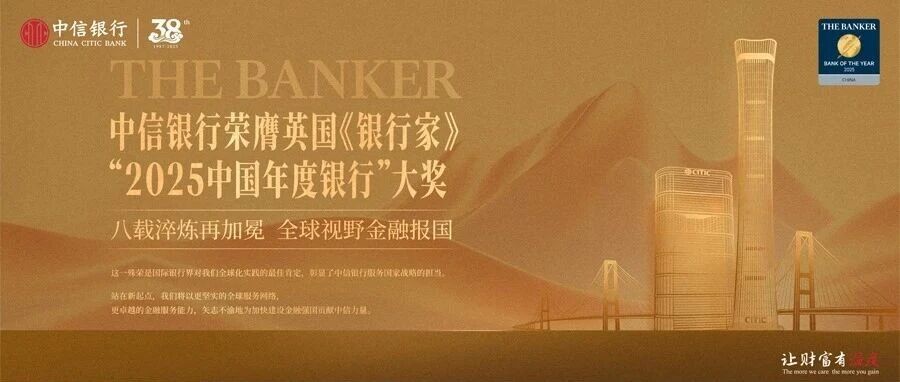
Core Viewpoint - CITIC Bank was awarded "Bank of the Year China 2025" by The Banker magazine, highlighting its exceptional brand building and comprehensive service matrix that meets customer needs across various sectors [1] Group 1: Brand Activities and Value Communication - CITIC Bank emphasizes its core value of "Wealth with Warmth" through brand activities, including the "信·新" forum focused on financial empowerment for consumption [2] - The bank's continuous engagement in sports and cultural events enhances brand recognition and emotional connection with the audience, showcasing its commitment to the "financial for the people" philosophy [3] Group 2: Business Layout and Performance - CITIC Bank maintains a robust performance across its three main business segments: retail, corporate, and financial markets, ensuring balanced development in quality, efficiency, and scale [5] - In retail banking, CITIC Bank focuses on wealth management, achieving a retail AUM of 5.26 trillion yuan and a year-on-year growth of 13.59% in wealth management income [5][6] - The corporate banking segment has seen a general corporate loan balance of 2.974 trillion yuan, with a year-on-year increase of 10.99%, particularly in manufacturing and private sector loans [6] Group 3: Social Responsibility and ESG Initiatives - CITIC Bank integrates ESG principles into its brand practices, engaging in various charitable activities and educational support programs to assist underprivileged groups [7] - The bank has been recognized for its contributions to rural revitalization and green finance, being the only commercial bank rated "Excellent" in the 2024 rural revitalization assessment [9] - CITIC Bank's brand value reached $16.95 billion, marking a 27.23% increase, and it achieved an upgrade to AAA in the latest ESG ratings by MSCI [9]


以创新实践诠释金融温度 中信银行交出高质量发展答卷
Zhong Guo Jing Ji Wang· 2025-12-08 03:24
Core Insights - CITIC Bank has been recognized for its exceptional brand building practices amidst profound changes in the financial industry, focusing on a comprehensive product and service matrix that spans retail, corporate, and financial markets [1] - The bank's brand philosophy of "making wealth warm" is integrated into product innovation, customer service, and social responsibility, establishing a differentiated and sustainable brand competitiveness [1] Brand Activities and Value Communication - CITIC Bank continues to promote its core value of "making wealth warm" through brand activities, exemplified by the successful hosting of the third "Xin·New" brand high-quality development forum [2] - The forum released the "China Residents' Pension Wealth Management Development Report (2025)" to explore the integration of financial product innovation and pension services, aiming to provide insights for the development of pension finance in China [2] - The bank's vice president emphasized the importance of value creation and the pursuit of a differentiated financial brand to contribute to high-quality financial development and modernization in China [2] Brand Engagement and Emotional Connection - CITIC Bank has engaged in various brand activities over the years, including supporting the China Open Tennis Tournament and launching photography competitions, which enhance brand aesthetics and emotional connections with the audience [3] - The systematic layout of brand activities has effectively increased brand awareness and reputation while translating the "finance for the people" concept into tangible service experiences [3] Business Development and Performance - CITIC Bank has implemented a collaborative approach across its three main business segments: retail finance, corporate business, and financial markets, focusing on customer-centric and cross-segment integrated financial services [4] - In retail finance, the bank aims to be a leading wealth management institution, with retail assets under management (AUM) reaching 5.26 trillion yuan, and a year-on-year growth of 13.59% in wealth management income [4] - The corporate business has seen a general corporate loan balance of 2.974 trillion yuan, an increase of 294.61 billion yuan or 10.99% year-on-year, with significant growth in loans to manufacturing and emerging industries [5] Social Responsibility and ESG Integration - CITIC Bank integrates ESG principles into its brand practices, engaging in various charitable activities and support for vulnerable groups, showcasing a responsible corporate image [7] - The bank has initiated educational support programs and medical assistance projects, demonstrating its commitment to social welfare and community support [7] - In rural revitalization, CITIC Bank has focused on directing financial resources to key areas such as agriculture and rural infrastructure, receiving recognition for its efforts in supporting rural development [8] Brand Value and Future Outlook - According to Brand Finance, CITIC Bank's brand value reached 16.95 billion USD, a year-on-year increase of 27.23%, making it the fastest-growing bank brand in mainland China [9] - The bank has achieved an upgrade in its ESG rating from A to AAA, reflecting its commitment to high-quality development and social responsibility [9] - Looking ahead, CITIC Bank aims to maintain strategic focus and continue contributing to the modernization of China's financial landscape while upholding its values of responsibility and warmth [9]
绿色金融赋能低碳转型
Xin Hua Ri Bao· 2025-12-03 23:00
Core Insights - The low-carbon transition has become a central strategy for economic and social development in the context of global efforts to combat climate change and promote sustainability [1] - Financial institutions and enterprises are key players in this transition, creating multi-dimensional cooperation spaces that inject strong momentum into the comprehensive green transformation of the economy and society [1] Group 1: Mechanisms of Low-Carbon Transition and Financial Integration - The strategic collaboration between financial institutions and enterprises transcends traditional financing boundaries, forming new cooperative relationships that encompass full value chain services and risk co-governance [2] - Enterprises are shifting from passive participants to proactive innovators seeking green transformation, driven by a scientific climate rule system and the evolving importance of ESG factors as key financial indicators [2] - The financing accessibility for green low-carbon enterprises has significantly improved, with a trend towards longer credit term structures [2] Group 2: Financial Institutions' Role and Policy Guidance - Financial institutions are responding to national policies by integrating green finance into their strategic core, with a clear directive to increase the proportion of green finance in their business scale by 2027 [2] - The implementation of the "Guidelines for Environmental Information Disclosure by Financial Institutions" requires enhanced environmental risk quantification management capabilities, ensuring that funds are directed towards genuine low-carbon projects [4] Group 3: Corporate Perspective on Low-Carbon Transition - Traditional high-energy-consuming enterprises need substantial capital for technological upgrades and comprehensive operational reforms to reduce carbon emissions and achieve green production [3] - Many small and medium-sized enterprises are increasingly adopting digital and intelligent methods to enhance energy efficiency and develop green products, necessitating significant financial support from banks [3] Group 4: Win-Win Cooperation between Banks and Enterprises - The win-win scenario in low-carbon transition is characterized by risk-sharing and benefit-sharing, where banks conduct strict evaluations of low-carbon projects while establishing long-term partnerships with enterprises [4] - Financial institutions can leverage data management and innovative mechanisms to build risk assurance systems, enhancing their understanding of enterprises' operational conditions and transition progress [4] Group 5: Strategic Synergy and Ecosystem Building - Banks should deepen cooperation with enterprises to understand changes in business models and industry characteristics, providing comprehensive services that combine financing and intelligence [5] - Establishing regular high-level communication mechanisms can help avoid misunderstandings and risks due to information asymmetry, particularly regarding climate policy changes [5] Group 6: Financial Innovation and Industrial Upgrading - Financial institutions can support sustainable development through green credit and ESG investment products, which can lower financing costs and enhance social reputation for enterprises [6] - Selective funding support for low-carbon initiatives promotes industrial structure optimization and economic development, while also addressing financing challenges for enterprises [7] - Supply chain finance exemplifies the cooperation model, where banks provide financing to small and medium-sized enterprises within the supply chain, ensuring stability and efficiency [7] Group 7: Enhancing Corporate Vitality and Innovation Potential - Financial institutions are willing to support enterprises' research and innovation activities, becoming risk-sharing partners that drive technological progress and result transformation [7] - By leveraging their expertise, banks can improve enterprises' financial operations and decision-making processes, ultimately enhancing their competitiveness [7]
五载匠心筑梦,万亿新篇启航:华夏理财以“七大特征”构建差异化竞争力 书写金融“五篇大文章”
Zheng Quan Ri Bao Wang· 2025-09-26 01:20
Core Insights - The equity market has shown strong recovery over the past year, with equity-based financial products performing well, particularly the "Tiangong" series products from Huaxia Wealth Management [1] - Huaxia Wealth Management has established a "Wealth Management Factory" 2.0 model, focusing on customized production and a dual emphasis on products and services [2][3] - The company has achieved a product management scale exceeding one trillion yuan, marking a significant milestone and a foundation for future growth [4][5] Group 1: Product and Service Development - The "Wealth Management Factory" model emphasizes research-driven investment, credit evaluation, strategy production, asset creation, product assembly, and unified quality control [2] - The transition from version 1.0 to 2.0 of the "Wealth Management Factory" highlights a shift towards customer-centric and channel-centric operations, enhancing service delivery and client engagement [2][3] - Huaxia Wealth Management has diversified its product offerings across seven categories, including cash management, fixed income, equity, mixed assets, and ESG, catering to various risk preferences and investment horizons [3] Group 2: Growth and Market Position - The company has expanded its sales network through collaboration with Huaxia Bank and external distribution channels, achieving a 60% share of external and direct sales [4] - The rapid growth in product management scale has been attributed to proactive channel development, with over ten million clients served [4] - Huaxia Wealth Management aims to leverage its scale to enhance product yield competitiveness and improve client experience, focusing on three dimensions: products, channels, and clients [5] Group 3: Strategic Initiatives - The "Tiangong" series of passive index financial products aligns with national strategic priorities, offering a diverse range of investment options and competitive fee structures [6] - The company has actively engaged in green finance, issuing over 32 billion yuan in ESG financial products and integrating ESG principles into its business operations [7] - Huaxia Wealth Management is committed to enhancing its research capabilities and contributing to the preservation and appreciation of residents' wealth, while supporting the high-quality development of the economy [8]
华夏理财“品牌向上”启新章:见证“理财工厂”成行业发展新标杆
Zheng Quan Shi Bao Wang· 2025-09-26 01:05
Core Insights - The equity market has shown strong recovery momentum over the past year, with equity-based wealth management products performing well, particularly the "Tiangong" series products from Huaxia Wealth Management [1] - Huaxia Wealth Management has established a "Wealth Management Factory" 2.0 model, emphasizing customized production and a customer-centric approach, enhancing service capabilities and product offerings [2][3] Group 1: Product and Service Development - The "Wealth Management Factory" model has evolved from version 1.0 to 2.0, focusing on customized production, standardized processes, and digital transformation, while integrating ESG principles [2] - Huaxia Wealth Management has developed a diversified product system covering cash management, fixed income, equity, mixed assets, and ESG, catering to various risk preferences and investment horizons [3] Group 2: Growth and Scale - Huaxia Wealth Management's product management scale surpassed 1 trillion yuan by June 2025, achieving significant growth since its inception, with a focus on high-quality development and stable growth [4][5] - The company aims to enhance its competitive edge by focusing on product performance, channel development, and customer experience, leveraging market opportunities from the exit of small and medium-sized banks from self-managed wealth management [5] Group 3: Strategic Initiatives - The "Tiangong" series of passive index wealth management products was launched in 2023, focusing on key national industrial policies and providing a comprehensive range of index products [6] - Huaxia Wealth Management actively promotes ESG investment principles, having issued over 32 billion yuan in ESG products and integrating ESG strategies into its business operations [7] Group 4: Future Vision - As the company approaches its five-year anniversary, it plans to enhance its "Wealth Management Factory" model, strengthen research capabilities, and contribute to the preservation and appreciation of residents' wealth [8]
践行“投资·向善”,共议ESG与高校基金会资产管理新路径——2025复旦管院·兴动ESG大讲堂成功举办
Zheng Quan Shi Bao Wang· 2025-09-24 03:24
Core Insights - The forum "Investment for Good" focused on ESG investment, asset management for university foundations, and asset allocation strategies, highlighting the importance of collaboration between asset management institutions and university foundations [1][2][3] Group 1: ESG Investment - ESG investment is recognized as a crucial force for promoting economic, environmental, and social development, representing both an innovative investment philosophy and a deep exploration of future development models [2] - The establishment of a comprehensive ESG product system in fixed income and the creation of multi-asset strategies reflect the growing emphasis on ESG products in the asset management industry [2] Group 2: University Foundations - University foundations are characterized by long-term investment horizons, public attributes, and liquidity requirements, necessitating a strategic approach to asset management [2][3] - The shift towards "asset allocation + entrusted management" signifies a professionalization journey for university foundations, emphasizing the need for strategic support and a fault-tolerant mechanism [2] Group 3: Investment Strategies - The discussion highlighted the need for university foundations to transition from direct investments to enhanced external cooperation and resource sharing, as well as from single asset investments to diversified allocations [4] - The importance of systematic decision-making over experiential judgment in investment strategies was emphasized, aiming to improve professional management capabilities [4] Group 4: Market Insights - Multi-asset allocation is viewed as an effective strategy to navigate high-volatility markets, with a focus on controlling portfolio volatility and optimizing risk-return profiles [4][5] - The current equity market environment is driven by declining risk-free rates, enhancing the attractiveness of equity assets compared to bonds, despite some concerns about localized bubbles in certain sectors [5]
践行“投资·向善”,共议ESG与高校基金会资产管理新路径——2025复旦管院·兴动ESG大讲堂举办
Zhong Guo Jin Rong Xin Xi Wang· 2025-09-23 12:14
Core Viewpoint - The forum "Investment for Good" focused on ESG investment, asset management of university foundations, and asset allocation, emphasizing the importance of collaboration between asset management institutions and university foundations to foster long-term growth and value creation [1][2]. Group 1: ESG Investment - ESG investment is recognized as a crucial force for promoting economic, environmental, and social development, representing an innovative investment philosophy and a deep exploration of future development models [3]. - The establishment of a comprehensive ESG product system in fixed income and the creation of multi-asset and equity products highlight the commitment of financial institutions to ESG investment [3]. Group 2: University Foundations - University foundations are transitioning from direct investments to enhanced external cooperation and resource sharing, indicating a shift towards diversified asset allocation and systematic decision-making in investment strategies [2]. - The characteristics of university foundation investments include long-term focus, low-risk preference, and liquidity constraints, which necessitate a tailored approach to investment management [2]. Group 3: Collaboration and Innovation - The collaboration between asset management firms and university foundations aims to deepen understanding and cooperation, fostering a supportive environment for professional management and investment growth [1][2]. - The discussions highlighted the need for strategic support and the establishment of error tolerance mechanisms to drive innovation in investment practices within university foundations [2].