
违反群众纪律

Search documents
集体决定违规摊派如何定性处理
Zhong Yang Ji Wei Guo Jia Jian Wei Wang Zhan· 2026-01-21 00:23
Core Viewpoint - The actions of the A Town Party Committee and its officials, including the requirement for winning bidders to donate to a local charity, are characterized as violations of party discipline and improper fundraising practices, which adversely affect the relationship between the party and the public [2][3][8]. Group 1: Actions and Implications - A Town's decision to require donations from winning bidders is deemed a collective violation of discipline, categorized as improper fundraising that burdens the public [3][6]. - The actions of Li and Wang, who facilitated this requirement, are viewed as violations of work discipline and public discipline, with Wang's modifications to the funding approval process being a critical element of this misconduct [2][7][8]. - The total amount donated by over 30 companies through the local charity to the district charity reached 3 million yuan by June 2025, indicating the scale of the improper fundraising [1]. Group 2: Legal and Disciplinary Framework - The requirement for donations does not constitute a crime of unit bribery, as the funds were directed to a charity rather than being received by A Town, lacking the necessary intent and action for such a charge [4][5]. - The collective decision-making process of the A Town Party Committee aligns with the provisions of the disciplinary regulations, which hold the leadership accountable for collective misconduct [6][8]. - Wang's actions, which included modifying the funding approval process and urging companies to donate, are classified as violations of both work discipline and public discipline, reflecting the serious nature of the misconduct [7][8].
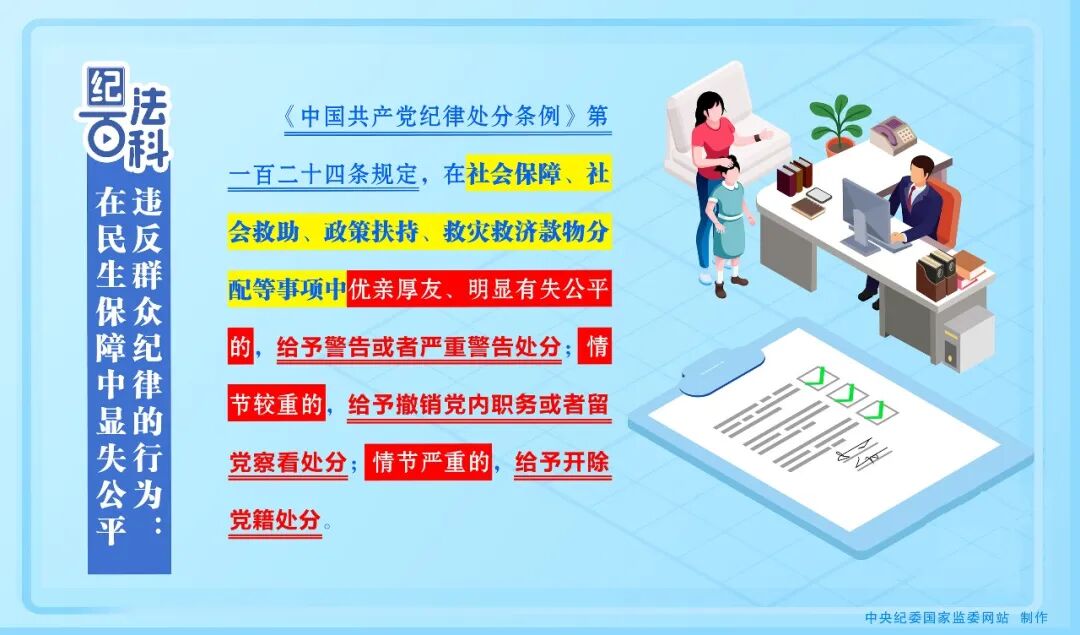
违反群众纪律的行为:在民生保障中显失公平
Xin Lang Cai Jing· 2026-01-04 12:25
Core Points - The article emphasizes the importance of fairness in the distribution of social security, social assistance, policy support, and disaster relief funds, as outlined in the Disciplinary Regulations of the Communist Party of China [2][10] - It highlights that unfair practices, such as favoritism and significant deviations from policy execution, undermine public trust and the effectiveness of welfare policies [4][11] Group 1: Definitions and Importance - Social security includes a series of laws and measures aimed at ensuring the basic survival and living needs of social members, contributing to social stability, fair distribution, and economic development [3][10] - Social assistance refers to the support provided to citizens facing life difficulties, ensuring their minimum living needs [4][10] - Policy support involves financial and social benefits provided by the state to assist specific groups or encourage certain initiatives [4][10] - Disaster relief is the assistance given to those affected by disasters or other hardships, crucial for the basic living conditions of vulnerable populations [4][10] Group 2: Regulations and Issues - The Rural Grassroots Cadres' Integrity Regulations prohibit the abuse of power and favoritism in public service and social assistance distribution [5][12] - There are reported cases of party members and officials distributing aid unfairly, prioritizing friends and relatives over those in genuine need, which damages the credibility of welfare policies [6][13] Group 3: Case Studies and Warnings - Numerous cases of misconduct have been reported, such as officials favoring relatives in disaster fund distributions and manipulating poverty assistance programs for personal gain [7][14] - The article stresses the necessity for party members and officials to adhere strictly to policies and maintain fairness in their dealings to ensure the effective implementation of welfare policies [6][14]

公职人员帮企业催收欠款后部分截留如何定性
Zhong Yang Ji Wei Guo Jia Jian Wei Wang Zhan· 2025-06-25 00:34
Core Viewpoint - The establishment of a new type of government-business relationship is crucial for regulating market order and promoting the healthy development of business entities, while some public officials' misconduct severely damages the business environment and public trust [1] Group 1: Case Overview - A case involving Qian, a public official, and Yang, a company representative, highlights the misuse of power in collecting overdue fees for water quality and radiation medical testing services [2] - Qian helped collect a total of 55,000 yuan in overdue fees, retaining 25,000 yuan as a "hardship fee" for himself [2] Group 2: Behavioral Analysis - Three viewpoints exist regarding Qian's actions: 1. His actions violated work discipline as he intervened in economic disputes without authority [3] 2. He harmed public interests by withholding funds from the public, violating community discipline [3] 3. His actions constituted bribery, as he used his position to benefit Yang while retaining part of the fees, which aligns with the definition of bribery under criminal law [3][6] Group 3: Implications for Governance - Qian's behavior should not be simplistically categorized as a violation of work discipline, as it fundamentally undermines the integrity of public service and the relationship between the party and the public [4][5] - The analysis suggests that Qian's actions reflect a deeper issue of corruption and the need for stricter enforcement of disciplinary measures against public officials [6]
准确定性对群众反映强烈问题消极处理的行为
Zhong Yang Ji Wei Guo Jia Jian Wei Wang Zhan· 2025-05-21 00:00
Group 1 - The article emphasizes the importance of implementing the Central Eight Regulations to strengthen the party's governance and maintain public trust, while acknowledging the persistent issues of formalism and bureaucratism among party members and officials [1] - A case study involving a party member, Fan, highlights the failure to enforce environmental regulations despite multiple complaints from the public regarding pollution from a local sand washing factory, illustrating a lack of accountability and effective action [2][3] - There are differing opinions on how to classify Fan's actions, with one view suggesting a violation of work discipline and another advocating for a classification of formalism and bureaucratism due to neglecting public interests [3][4] Group 2 - The distinction between violations of public discipline and work discipline is crucial, as public discipline directly relates to the party's connection with the people and the protection of their interests [4][5] - The criteria for determining violations of public discipline include the nature of the work, subjective awareness of the issues, objective performance, and the impact on public sentiment and interests [5][6] - Fan's behavior is characterized as formalism and bureaucratism, as he failed to take substantive action in response to public complaints, reflecting a distorted sense of responsibility and a lack of genuine engagement with community concerns [6][7]