
退休收入规划

Search documents
Social Security Trust Fund Expected To Be Depleted by 2032: How Big the Benefit Cuts Could Be If Congress Does Nothing
Yahoo Finance· 2026-02-21 13:36
Core Insights - The Congressional Budget Office projects that the Social Security Old-Age and Survivors Insurance trust fund will deplete by 2032, leading to potential benefit cuts of 7% for the remainder of that year and 28% from 2033 to 2036, equating to a reduction of approximately $145 to $580 per month for average beneficiaries [1][3]. Group 1: Financial Projections - The trust fund's income sources include payroll taxes, income taxes on benefits, and interest, with a projected decline in balance from $2.19 trillion in 2023 to $0 by 2032 [3]. - Starting in 2027, benefit payments are expected to exceed income, resulting in a gradual depletion of the trust fund [3]. Group 2: Impact on Beneficiaries - If Congress does not intervene, beneficiaries could face significant cuts, receiving only about 93% of benefits in part of 2032 and approximately 72% in 2033 and beyond [3]. Group 3: Recommendations for Retirees - Financial advisors suggest retirees reassess their investment strategies to balance growth and stability, emphasizing the importance of smart tax planning to mitigate the impact of potential cuts [5]. - Retirees are encouraged to reduce reliance on Social Security in the coming years [4]. Group 4: Guidance for Younger Workers - Younger workers should view Social Security as a component of retirement income rather than the foundation, advocating for early and consistent saving through retirement plans and maintaining diversified investment portfolios [6].
Can’t Live on $2k a Month in Social Security? Add These ETFs to Your Retirement Portfolio
Yahoo Finance· 2026-02-01 12:26
Core Insights - Many individuals underestimate the amount of Social Security benefits, with the average monthly benefit currently at $2,071, which may not suffice for a comfortable lifestyle in retirement [2][4]. Investment Opportunities - To enhance retirement income beyond Social Security, individuals are encouraged to consider exchange-traded funds (ETFs) as a viable investment option [4]. ETF Options - **Vanguard High Dividend Yield ETF (VYM)**: - Invests in a diversified portfolio of U.S. stocks with higher-than-average dividend yields across various industries, focusing on companies with consistent dividend payouts [5][6]. - Offers moderate risk due to its stable earnings and low expense ratio, allowing investors to retain more of their returns [6]. - **Schwab U.S. Dividend Equity ETF (SCHD)**: - Tracks the Dow Jones U.S. Dividend 100 Index, emphasizing companies with strong financials and stable dividend payouts [7][8]. - Also presents a moderate-risk profile and features a low expense ratio, minimizing the impact of fees on returns [8]. - **BND (Vanguard Total Bond Market ETF)**: - Provides lower volatility through investments in investment-grade bonds, serving as a complement to equity-focused ETFs for steady income [9].
CPF vs REITs: Which Builds a Stronger Retirement Income Stream in 2026?
The Smart Investor· 2026-01-15 03:30
Core Insights - The article discusses the role of Singapore's Central Provident Fund (CPF) and Real Estate Investment Trusts (REITs) as retirement income tools, highlighting the need for a combination of both to address rising living costs and inflation [1][14]. CPF as a Retirement Income Tool - CPF is a low-risk, government-backed scheme designed to provide predictable retirement income, with current interest rates of 2.5% for the Ordinary Account and 4% for the Special and Retirement Accounts [2][3]. - CPF savings are not subject to market volatility, making them suitable for risk-averse individuals, and upon retirement, savings can be converted into monthly payouts through the CPF Life scheme if a minimum balance is met [3][4]. - However, CPF funds are largely inaccessible until retirement age, and may not fully cover higher lifestyle expectations or inflation-driven expenses [4]. REITs as a Retirement Income Tool - REITs generate income by distributing rental income from properties to unitholders, with a regulatory requirement to distribute at least 90% of taxable income to qualify for tax benefits [5][6]. - Unlike CPF, REIT payouts are market-linked and can fluctuate based on various factors, offering higher income potential but with associated risks [6][8]. - For example, CapitaLand Integrated Commercial Trust has a trailing annual dividend yield of approximately 4.6%, which may help keep pace with inflation [8]. Income Stability vs Income Growth - CPF provides stable, risk-free growth but may not fully protect against inflation, while REITs offer potential for income growth through acquisitions and rental increases [7][8]. - The balance between stability and growth is crucial, as the best income stream is not necessarily the one with the highest yield but one that aligns with an investor's risk tolerance [9][11]. Integration of CPF and REITs - Combining CPF and REITs allows investors to leverage the stability of CPF with the growth potential of REITs, creating a diversified income stream [12][15]. - For long-term stability, focusing on blue-chip REITs with resilient balance sheets is recommended, while younger investors may allocate a higher percentage of their capital towards REITs for compounding benefits [12][14]. Conclusion - Sustainable income is increasingly important due to rising longevity, and while CPF remains a foundational element of retirement planning, supplementary income sources like REITs are becoming more relevant to combat inflation [14][15].

401(k), Social Security, or pension? The order you choose can mean financial health or disaster. Get it right in 2026
Yahoo Finance· 2025-12-27 14:00
Core Insights - Social Security is a critical component of retirement income for many seniors, with 67% relying on it for over half of their total income [1] - A significant portion of seniors, approximately one-third, have additional income sources, which necessitates a focus on tax minimization strategies during retirement [1][2] Group 1: Retirement Priorities - It is essential for retirees to clarify their top priorities before sequencing their income sources [3] - A 2023 report indicates that 20% of retirees prioritize creating an inheritance or financial legacy, which influences how they should manage their income sources to maximize savings longevity [4] - Conversely, some retirees prioritize maximizing income and lifestyle expenses during their healthier years, with 35% expressing concern about declining health requiring long-term care [5] Group 2: Income Sequencing Strategies - Retirees with diverse income sources, including Social Security and tax-advantaged accounts, are in a favorable position to develop a tailored income strategy [7] - Establishing clear priorities allows retirees to work with financial advisors to create a comprehensive strategy for claiming retirement income from various sources [6]
If You’ve Banked $1 Million By 45, Is It Possible to Retire?
247Wallst· 2025-12-13 16:07
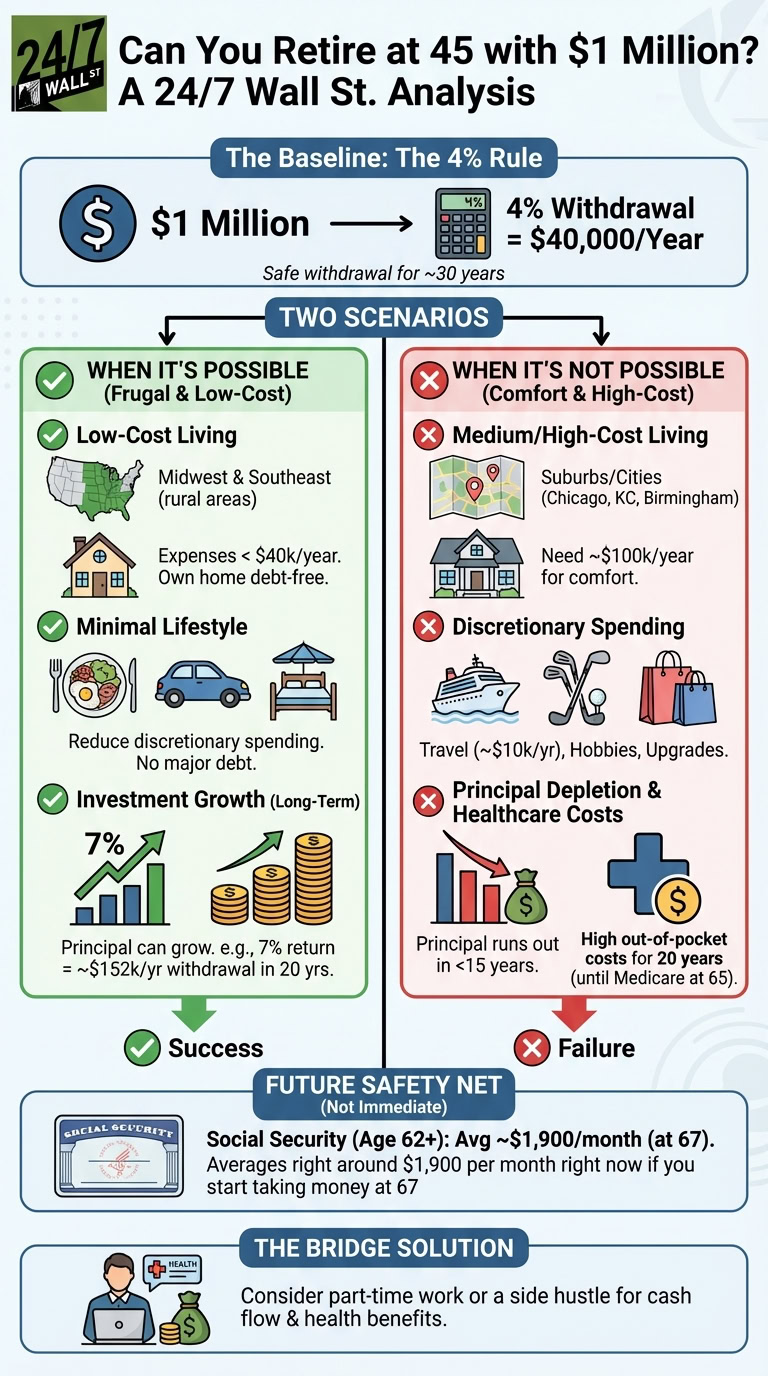
Core Insights - The article discusses the feasibility of retiring early with a savings of $1 million, emphasizing the importance of lifestyle choices and cost of living [1][2] Spending Considerations - The 4% safe withdrawal rule suggests that withdrawing 4% annually from a $1 million nest egg allows for approximately $40,000 per year for about 30 years [3] - Social Security benefits can supplement this income, averaging around $1,900 per month if claimed at age 67, which may influence retirement planning [4] Retirement Viability - To retire comfortably on $40,000 per year, individuals should consider relocating to low-cost states, particularly in the Midwest and Southeast regions [5][6] - With a 7% return on investments, a $1 million principal could grow to nearly $4 million in 20 years, potentially increasing annual retirement funds to around $152,000 [7] Lifestyle Adjustments - Retirees may need to minimize discretionary spending, forgoing regular dining out, vacations, and new cars, while ideally being debt-free and owning a home by age 45 [8] Challenges in Retirement - Living in higher-cost areas may require annual withdrawals closer to $100,000, which could deplete the $1 million principal in about 15 years [9][10] - Rising healthcare costs before qualifying for Medicare can lead to significant out-of-pocket expenses, potentially amounting to hundreds of thousands over 20 years [11] Additional Financial Considerations - For those who enjoy travel or hobbies, additional costs can significantly impact the budget, with annual travel expenses potentially consuming 25% of the safe withdrawal rate [12] - Part-time work or side hustles may be necessary to supplement income and provide health benefits during retirement [12]
How Retirees Are Using Dividend ETFs to Replace Paychecks
Yahoo Finance· 2025-11-23 14:13
Core Insights - Dividend ETFs are becoming increasingly popular among retirees as a means to generate steady income during retirement, providing a sense of stability and predictability in cash flow [1][4][12] Group 1: Benefits of Dividend ETFs - Investing in dividend ETFs allows retirees to have a diversified portfolio, which can help maintain income even if individual companies reduce their payouts [2][3] - These ETFs can serve as a paycheck replacement, converting savings into predictable monthly or quarterly income, which is crucial for retirees transitioning from regular paychecks [5][11] - A blended approach of monthly and quarterly dividend ETFs can optimize cash flow, ensuring consistent income while also allowing for larger payments at intervals [8][9] Group 2: Popular ETF Choices - High-yield dividend ETFs focus on sectors like utilities, telecom, real estate, and energy, providing larger payouts for immediate income needs [9] - Dividend growth ETFs are favored for their potential to increase payouts over time, which helps offset inflation concerns for retirees [9] - Broad-market ETFs offer exposure to large-cap companies while providing modest yields, balancing passive income with long-term growth [9] Group 3: Market Trends and Considerations - The shift towards dividend ETFs is influenced by a decade of rising interest rates, which made cash investments attractive, but expected rate cuts are prompting retirees to seek long-term income solutions [11] - The psychological aspect of receiving income rather than depleting savings is significant for retirees, as it aligns with their lifetime of earning paychecks [12][13]
Why These 2 ETFs Could Redefine Retirement Income in 2026
Yahoo Finance· 2025-11-22 16:57
Core Insights - Retirement planning is rapidly evolving due to concerns over Social Security shortfalls and rising healthcare costs, necessitating immediate attention to income potential for those nearing retirement [2] - Traditional retirement strategies focusing on bonds, stocks, drawdowns, and cash reserves are becoming outdated, as cash loses purchasing power and bonds offer lower yields [4][5] Investment Strategies - The new approach to retirement income blends income generation with long-term market participation, utilizing ETFs that provide structured monthly payments while allowing for portfolio growth [6] - The JPMorgan Equity Premium Income ETF (JEPI) is highlighted for its reliability, focusing on high-quality US stocks and enhancing monthly income through options, yielding 8.38% with a year-to-date return of 5.83% in 2025 [7][8] - The Vanguard Total Stock Market ETF (VTI) offers a lower yield of 1.16% but has delivered a total return of 15.26% in 2025, indicating a potential for growth despite lower immediate income [8]