通用型CAR-T

Search documents
科济药业-B:纳入港股通名单,深化通用型和体内CAR-T布局-20260312
Southwest Securities· 2026-03-12 05:45
Investment Rating - The report assigns a "Buy" rating for the company, indicating an expected relative price increase of over 20% in the next six months [15]. Core Insights - The company is enhancing its universal CAR-T product portfolio, with the in vivo CAR-T expected to initiate clinical trials in 2026. The proprietary platforms, THANK-uCAR® and THANK-u Plus®TM, are being utilized to develop differentiated universal CAR-T cell products [2][3]. - The company reported a revenue of 1.3 billion yuan in 2025, with a net loss of 1 billion yuan, a significant reduction from the previous year's loss of 8 billion yuan. As of December 31, 2025, cash and cash equivalents stood at 1.12 billion yuan [8]. - The company has received 218 orders for its product, Sikeizai®, from East China Pharmaceutical in 2025 and has been included in the "Commercial Health Insurance Innovative Drug Directory" [8]. Financial Projections - Revenue projections for the company are as follows: 2.6 billion yuan in 2026, 4.9 billion yuan in 2027, and 8 billion yuan in 2028, driven by the commercialization of CT053 and CT041 [10][11]. - The company anticipates a significant increase in net profit, projecting a profit of 63.26 million yuan in 2027 and 249.58 million yuan in 2028, following a net loss of 97.86 million yuan in 2025 [3][11]. - Earnings per share (EPS) are expected to improve from -0.17 yuan in 2025 to 0.43 yuan in 2028, reflecting the anticipated growth in profitability [3][11]. Product Development - The company is advancing multiple universal CAR-T products targeting various antigens, including CT0596 (BCMA) and CT1190B (CD19/CD20), with initial data expected to be presented at the ASH conference in December 2025 [2]. - The in vivo CAR-T candidate, KJ-C2529, targeting CD19/CD20 for B-cell lymphoma, is set to begin clinical trials in 2026 [2].
科济药业提速
Xin Lang Cai Jing· 2025-12-29 13:44
Core Insights - Kogei Pharmaceuticals has submitted two new drug clinical trial applications for its universal BCMA CAR-T product CT0596 to the National Medical Products Administration, targeting relapsed/refractory multiple myeloma and primary plasma cell leukemia [1][17][22] - The development of universal CAR-T therapies is seen as a significant advancement in the treatment of multiple myeloma, which remains incurable despite recent therapeutic advancements [2][19] - CT0596 is developed on the THANK-u Plus platform, which enhances the product's durability and safety by gene editing to reduce the risk of graft-versus-host disease and immune rejection [4][21] Group 1: Clinical Development - CT0596 has shown promising preliminary efficacy and safety in early human studies, with 6 out of 8 patients achieving partial response or better, and no severe adverse events reported [4][21] - The submission of clinical trial applications marks the entry of CT0596 into the registration clinical development phase, potentially providing new treatment options for patients with R/R MM and pPCL [5][22] - Kogei plans to explore CT0596's application in other plasma cell tumors and plasma cell-driven autoimmune diseases [5][22] Group 2: Technological Advancements - The THANK-u Plus platform allows for immediate use and mass production of CAR-T cells, significantly reducing treatment costs compared to autologous CAR-T therapies [3][20] - Kogei has developed a robust pipeline of universal CAR-T products targeting various malignancies, including blood cancers and solid tumors, leveraging the advantages of the THANK-u Plus platform [6][23] Group 3: Market Position and Future Directions - Kogei's self-developed CAR-T product, Sazekai (Zewokaiolun), has been approved for use in relapsed or refractory multiple myeloma, with significant market penetration across over 20 provinces in China [29] - The company is actively pursuing partnerships to enhance the development and commercialization of its universal CAR-T products in mainland China [28][29] - The competitive landscape for CAR-T therapies is intensifying, with multiple companies exploring dual-target strategies and innovative delivery methods to improve patient outcomes [14][30]


科济药业:全力推进通用型CAR-T产品开发 降低患者诊疗成本
Zhong Guo Jin Rong Xin Xi Wang· 2025-11-20 13:04
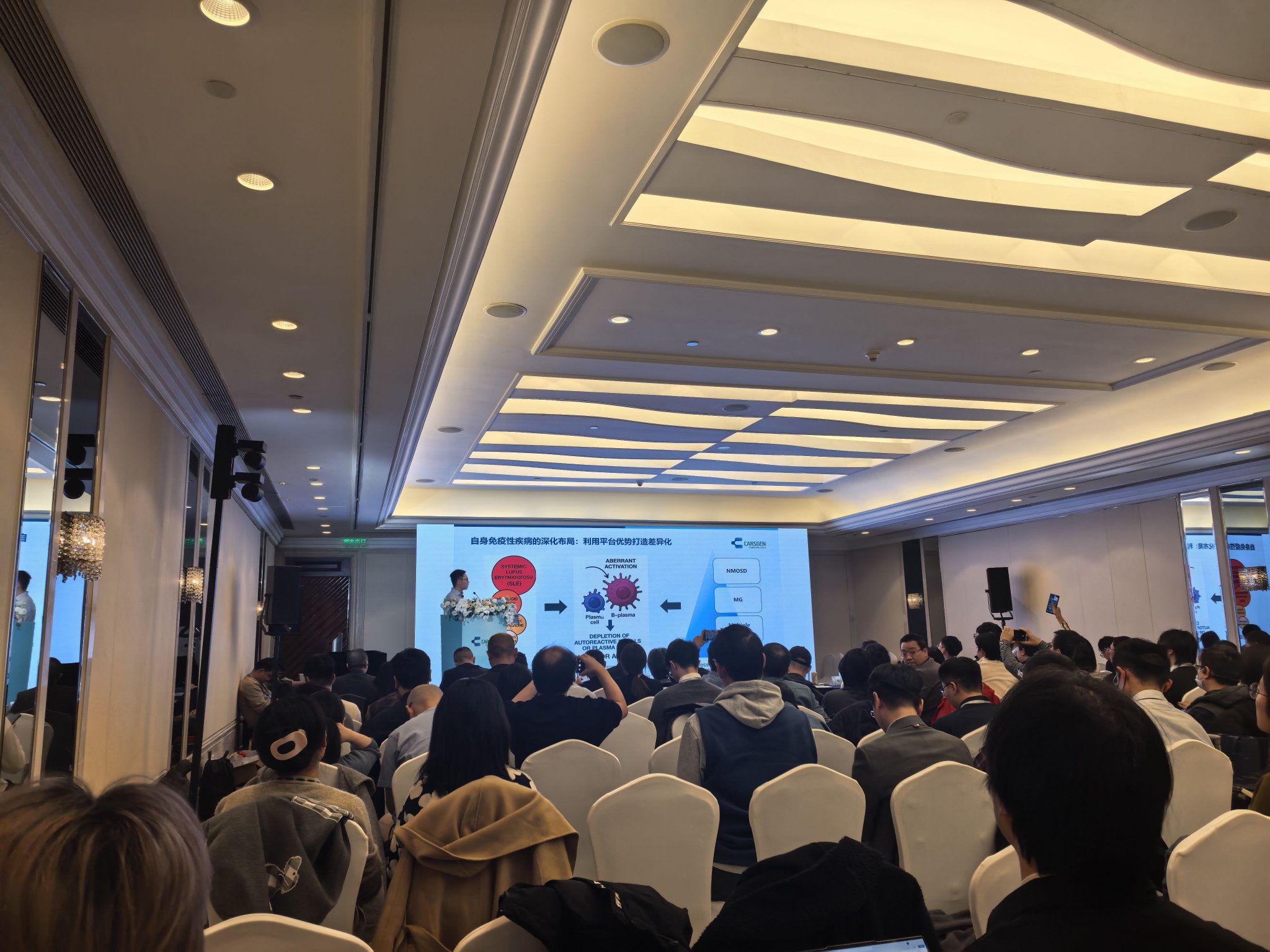
Core Viewpoint - The event hosted by Kexi Pharmaceutical highlighted the company's advancements in CAR-T cell therapy, its core industry layout, and future development plans, showcasing its competitive strengths and industry prospects [1]. Group 1: CAR-T Technology Development - Kexi Pharmaceutical focuses on addressing key challenges in CAR-T therapy, including immune rejection, low patient accessibility, and balancing efficacy with safety [4]. - The company aims to prioritize clinical needs by targeting difficult-to-treat cancers such as pancreatic cancer and leukemia, while also optimizing technology to reduce treatment costs and improve patient access [4]. - Kexi is developing multi-target universal CAR-T candidates that cover solid tumors, hematological cancers, and autoimmune diseases, involving multiple key targets [4]. Group 2: Production and Operational Strategy - The company plans to establish an integrated intelligent cell manufacturing center capable of producing both autologous and allogeneic CAR-T cells, with an expected annual capacity to serve tens of thousands of patients [4]. - Kexi aims to focus on process automation, management information systems, and supply chain collaboration to continuously lower production costs and enhance product quality [5]. Group 3: Business Development and Strategic Partnerships - Kexi Pharmaceutical has seen a surge in business development (BD) transactions, which have become a significant revenue source for biopharmaceutical companies [5]. - The company emphasizes that the success of BD partnerships relies on product competitiveness and corporate strength rather than external factors, maintaining strong relationships with multinational companies [5]. - Kexi has strategically invested in Ukaize Biomedical (Shanghai) Co., Ltd., enhancing its ecosystem in cell therapy and laying a solid foundation for future technological collaboration and industry expansion [5].