
通胀抬头

Search documents
深夜,全线暴跌!道指狂泻超1000点,中概股跳水
证券时报· 2026-03-03 23:13
Market Overview - On March 3, U.S. stock indices opened significantly lower, with all three major indices experiencing declines of over 2%. The Dow Jones Industrial Average fell by over 1100 points, a decrease of 2.39%, while the Nasdaq and S&P 500 dropped by 2.3% and 2.21%, respectively [1][2]. - European stocks also fell across the board, with the UK FTSE 100 and France's CAC40 indices dropping over 3%, and Germany's DAX and Italy's FTSE MIB indices declining over 4% [3]. - In the Asia-Pacific region, major indices such as Japan's Nikkei 225 and South Korea's Composite Index saw declines of over 3% and 7%, respectively. Chinese A-shares and Hong Kong stocks also fell, with the Shanghai Composite Index down 1.43% and the Hang Seng Index down over 1% [3]. Energy Prices and Inflation Concerns - Energy prices surged, with Brent crude oil exceeding $85 per barrel, rising over 7%, and West Texas Intermediate crude oil increasing by over 8%. Both types of oil saw cumulative increases of around 15% over the past two days [5]. - European natural gas prices experienced dramatic increases, with a rise of over 40% on March 2 and further gains of around 30% on March 3. Analysts noted that rising energy prices are putting upward pressure on global borrowing costs [5]. Technology Sector Performance - The technology sector faced widespread declines, with major tech stocks such as Tesla, Google, and Amazon all reporting losses. Tesla fell by over 3%, while other tech giants like NVIDIA and Microsoft also saw declines of around 2% [6][7]. - The Philadelphia Semiconductor Index dropped by over 4.5%, with individual semiconductor stocks like CREDO Technology and Micron Technology experiencing significant losses [7]. Geopolitical Tensions - The ongoing conflict in the Middle East has escalated, with Israel conducting airstrikes against Iranian targets, and Iran's Islamic Revolutionary Guard Corps claiming to have attacked U.S. military bases in the region [8]. This geopolitical tension is contributing to market volatility and investor uncertainty [3].


【笔记20260303— 抹茶汤圆】
债券笔记· 2026-03-03 10:51
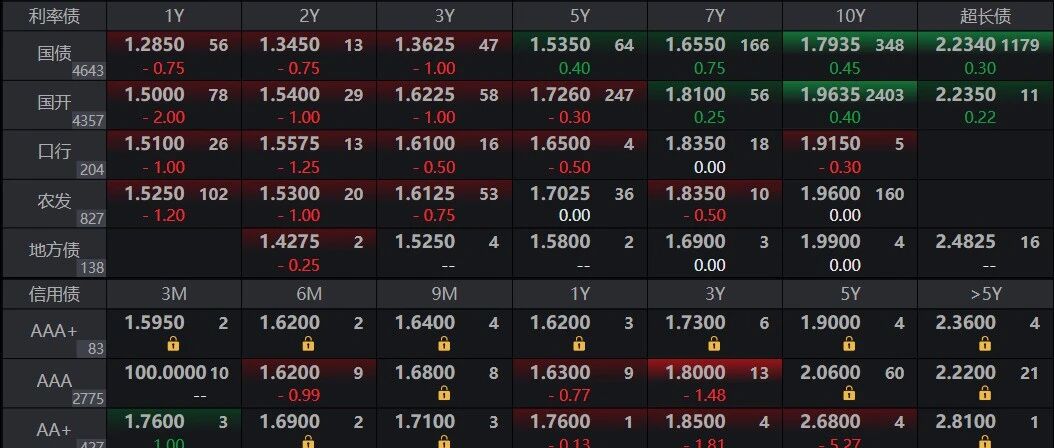
Group 1 - The article emphasizes the importance of adapting to market trends and natural cycles in investment, likening it to agricultural practices where one must not rush the growth process [1] - The current financial environment shows a balanced and slightly loose liquidity, with the central bank conducting a 343 billion yuan reverse repurchase operation while 5,260 billion yuan of reverse repos are maturing, resulting in a net withdrawal of 4,917 billion yuan [3] - The interbank funding rates are trending downwards, with DR001 around 1.27% and DR007 at approximately 1.45% [4] Group 2 - Geopolitical risks are causing significant declines in the stock market, while short-term bonds remain strong due to supportive liquidity, and long-term rates are slightly rising [6] - The stock market's decline is attributed to ongoing conflicts, a strong dollar, rising oil prices, and speculation about the Federal Reserve's actions, with specific declines noted in various international markets [7] - The 10-year government bond yield is fluctuating around 1.79%, indicating a stable sentiment in the bond market despite external pressures [6][9]
有色:短暂休息,把握回调机会
2025-10-19 15:58
Summary of Conference Call on Non-Ferrous Metals Industry Industry Overview - The non-ferrous metals industry is currently experiencing a high-level fluctuation, awaiting demand recovery and liquidity easing to trigger a main upward trend in prices [1][3][13] - The expectation of a soft landing for the US economy, along with the first interest rate cut, has stabilized overseas demand, but the main upward wave in non-ferrous metal prices has not yet started [1][3] Key Points and Arguments Market Outlook - The performance expectations for various non-ferrous sub-sectors in 2026 are generally optimistic, with an expected increase of approximately 20% or more [1][4] - The anticipated main upward wave is expected around the end of Q1 2026, driven by interest rate cuts, the end of the US balance sheet reduction, and overseas reconstruction demand [1][5] Supply and Demand Dynamics - The ongoing US-China geopolitical tensions have normalized, reducing their impact on market sentiment, but the supply-side constraints are stronger than demand influences [1][6] - It is expected that most metals will remain in a supply-demand imbalance in 2026, with supply constraints being more definitive [1][6] Specific Metal Insights - **Gold**: Short-term trading is overheated, with valuations stretched. A potential adjustment is expected after geopolitical events cool down, but long-term prospects remain positive due to economic recovery and inflation [1][7] - **Copper**: Short-term demand is suppressed by high prices, but mining and smelting companies may reduce production, leading to a supply-demand imbalance from Q4 2025 through 2026 [1][8][9] - **Aluminum**: The electrolytic aluminum sector is recommended as a top investment choice due to its strong dividend attributes and resilience in profits, with a significant upside potential if prices rise [1][10][11] Small Metals Perspective - **Cobalt**: Inventory is decreasing, indicating potential for price increases [2][12] - **Lithium**: Currently under pressure but nearing a bottom in supply-demand dynamics, strategic positioning is advised [2][12] - **Tungsten**: Long-term outlook is positive due to supply shortages and geopolitical factors [2][12] Additional Important Insights - The overall sentiment for the non-ferrous metals industry remains optimistic, with recommendations to actively monitor and allocate resources to various metal sectors to capitalize on future growth opportunities [1][14] - The copper market is expected to see a price increase and earnings per share (EPS) growth, with mainstream companies' valuations returning to reasonable levels [1][9][14]
美国6月就业稳健 对通胀抬头和经济可能下滑的担忧缓和
news flash· 2025-07-03 13:07
Core Insights - The U.S. job market showed resilience in June, with an unexpected increase of 147,000 jobs added, and the unemployment rate fell to 4.1%, nearing historical lows [1] - Economic indicators have demonstrated strength, alleviating concerns over rising inflation and potential economic downturns [1] - Federal government employment decreased by 7,000 in June, totaling a reduction of 69,000 since January when the efficiency department was established [1] - Manufacturing employment remained largely unchanged, despite efforts by the Trump administration to boost the sector through tariffs on foreign goods [1]