
流动性宽松

Search documents
中信证券:历次中东冲突后的金价和黄金板块复盘
Sou Hu Cai Jing· 2026-03-19 05:35
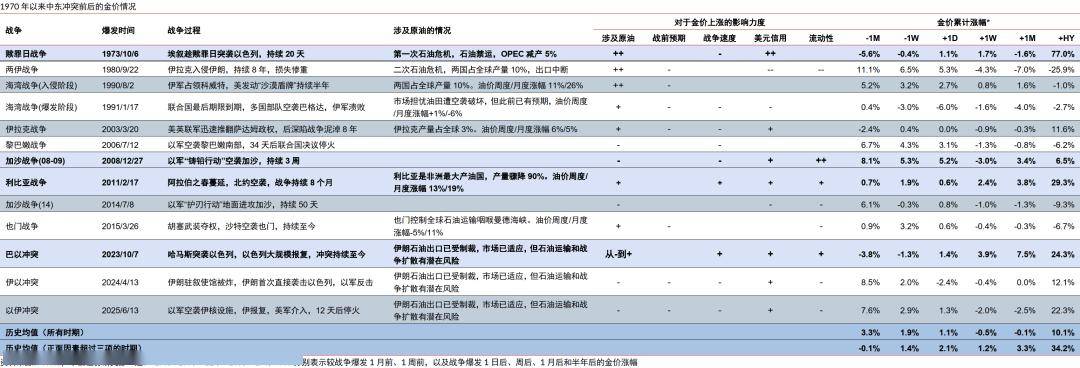
Core Viewpoint - The mid-term trend of gold prices after conflicts in the Middle East is influenced by the factors of US dollar credit and liquidity, with expectations of continued liquidity easing and weakening dollar credit driving gold prices higher [1][4]. Group 1: Historical Performance of Gold Prices - Historically, the average increase in gold prices six months after major Middle Eastern conflicts is 10%, with a significant average increase of 34% when at least three of the five influencing factors are positive [2][4]. - The average half-year increase in gold prices during periods of favorable conditions has reached 26%, with excess returns of 16 percentage points [4][19]. Group 2: Current Market Conditions - The current trend of liquidity easing and weakening dollar credit is expected to continue, which will support gold prices [4][15]. - The US economy is facing "stagflation" risks, which historically correlate with higher probabilities and greater increases in gold prices [8][15]. Group 3: Valuation and Investment Opportunities - The valuation of leading gold companies has dropped to historical lows of 15-20 times PE, indicating a strong margin of safety for investments in the gold sector [28]. - The synchronization of stock prices with gold price peaks has been validated multiple times since 2020, suggesting that new highs in gold prices will likely lead to new highs in the stock prices of gold companies [28].


中信证券:预计流动性宽松及美元信用弱化将继续推升金价
Zhi Tong Cai Jing· 2026-03-19 00:55
Core Viewpoint - The mid-term trend of gold prices is influenced by the credit and liquidity factors of the US dollar, with expectations of continued liquidity easing and weakening dollar credit driving gold prices higher [1][7]. Group 1: Historical Context and Price Trends - Historically, the average increase in gold prices six months after Middle Eastern conflicts is 10% [2]. - An analysis of 12 major conflicts since 1970 shows that while short-term price increases are limited, the mid-term average increase reaches 34% when at least three of five influencing factors are positive [2]. - Previous conflicts have shown that gold prices tend to rise significantly in periods of favorable dollar credit and liquidity conditions, with an average six-month increase of 26% [3]. Group 2: Current Economic Indicators - The current economic environment suggests that liquidity easing and weakening dollar credit will continue to support gold prices, with potential catalysts from "stagflation" concerns [3]. - The expectation of 1-2 rate cuts by the Federal Reserve in 2024, alongside declining real interest rates, is anticipated to benefit gold prices [3]. - The trend of "de-dollarization" has led to increased gold purchases by central banks, with net purchases expected to exceed 1,000 tons annually from 2022 to 2024 [4]. Group 3: Valuation and Investment Outlook - The gold sector is expected to see new highs, with the current price-to-earnings (PE) ratio of leading companies dropping to historical lows of 15-20x, providing a significant margin of safety [5][7]. - Historical data indicates that the gold index has shown substantial gains post-conflict, with average half-year increases of 35% during favorable conditions [5]. - The potential for gold prices to reach $6,000 per ounce is supported by the combination of weakening dollar credit, liquidity easing, and heightened risk aversion [4].
长债短债分化的逻辑与前景
GOLDEN SUN SECURITIES· 2026-03-15 13:40
1. Report Industry Investment Rating - Not provided in the given content 2. Core View of the Report - This week, the bond market showed a differentiated pattern with short - term interest rates declining and long - term interest rates rising. The short - and long - term interest rate differentiation is the result of different institutional behaviors, and they will converge in the medium term. The key to the convergence lies in the monetary policy's reaction to current price increases. It is believed that the current price increase will not lead to a tightening of monetary policy, and the long - term adjustment may not be sustainable. After the end of the quarter, the market is expected to recover [1][8][20] 3. Summary by Relevant Catalogs 3.1 Bond Market Differentiation - This week, the bond market's differentiation intensified. The 1 - year Treasury bond yield dropped 0.9 bps to 1.28%, and the 1 - year certificate of deposit (CD) rate fell 1.8 bps to 1.53%. The 10 - year Treasury bond yield rose 3.3 bps to 1.81%, and the 30 - year Treasury bond yield soared 8.5 bps to 2.37%. The 5 - year AAA - second - tier perpetual bond also rose 4.7 bps in total, and the yield curve steepened significantly [1][8] 3.2 Reasons for Short - term Interest Rate Decline - Banks lack assets, leading to a continuous increase in the deposit - loan gap. From January to February, deposits increased by 520 billion yuan year - on - year, while loans decreased by 530 billion yuan year - on - year, and the loan growth rate slowed from 6.4% in December last year to 6.0% in February. Banks increase inter - bank lending, resulting in loose liquidity [2][11] - The central bank basically approves of the current loose liquidity. This week, the central bank's open - market operations had a net withdrawal of 10.11 billion yuan, and the 600 - billion - yuan repurchase was renewed with a reduced amount of 100 billion yuan. This is due to insufficient overall capital demand. After the end of the quarter, credit demand will further decline in April, maintaining loose liquidity [2][12] - The strengthening of the inter - bank deposit self - regulatory mechanism may further push down short - term interest rates. After the implementation of the mechanism in December 2024, wealth management products and money market funds increased their bond allocations. If the inter - bank deposit rate drops by 10 bps, the 1 - year joint - stock bank CD rate is expected to fall below 1.5%, and the 1 - year AAA medium - term note rate is expected to drop to around 1.55% [3][15] 3.3 Reasons for Long - term Interest Rate Increase - The intensifying conflict between the US and Iran has driven up oil prices. If the oil price remains at the current level, the PPI year - on - year may turn positive in March and rise rapidly to a high level around mid - year. The impact of price increases on long - term bonds is magnified by institutional behavior. At the end of the quarter, banks' long - term bond allocation demand slows down, and securities firms' large - scale selling drives up long - term bond interest rates [4][16] 3.4 Convergence of Short - and Long - term Interest Rates - The key to the convergence of short - and long - term interest rates lies in the monetary policy. If the price increase leads to a tightening of monetary policy, short - term interest rates will rise to converge with long - term rates. However, it is believed that the current price increase is mainly input - driven, concentrated in industries such as non - ferrous metals and energy, and will not lead to an improvement in corporate profits or an increase in financing demand. The central bank's tightening of money has little impact on globally - priced oil and precious metals, so the monetary policy is likely to remain loose [4][19] 3.5 Market Outlook and Investment Suggestions - The weak sentiment of long - term bonds is expected to ease in the medium term. After the end of the quarter, as banks' allocation power recovers and trading institutions close their short positions, the market is expected to gradually recover. In the short term, it is recommended to increase leverage, choose appropriate riding positions, and wait for the post - quarter recovery market. At that time, consider increasing the duration [5][20]
永安期货有色早报-20260312
Yong An Qi Huo· 2026-03-12 02:05
Group 1: Report Industry Investment Rating - No relevant content provided Group 2: Core Viewpoints of the Report - The report maintains a bullish view on copper in the medium term, believing it has incremental demand and limited supply, and can be bought and held [1] - In the short term, aluminum prices are likely to rise due to production disruptions in the Middle East, and there is still a driving force for long positions in the domestic and foreign markets [1] - Zinc prices are expected to be supported in the short term due to limited long - term capital investment and supply disruptions from Iran [2] - Nickel prices are expected to fluctuate within a range under the influence of bearish fundamentals and bullish supply - side policy interventions [4][5] - Stainless steel prices are expected to follow nickel prices and fluctuate within a range [8] - Lead prices are expected to maintain a weak and volatile trend under the influence of overseas inventory drag and recycled lead profit support [10][11] - Tin prices are greatly affected by global macro - liquidity. If liquidity is loose, tin has strong upward elasticity; if liquidity tightens, tin prices may be suppressed [14] - Industrial silicon prices are expected to fluctuate with costs in the short term and bottom - oscillate cyclically in the long term [17] - Lithium carbonate is in a tight - balance state in March, with a risk of inventory accumulation in May and June. The upward space needs futures - spot resonance or unexpected supply disturbances, and the downward breakthrough requires demand collapse or unexpected resumption of production by CATL [19] Group 3: Summary by Metal Copper - This week, copper prices fluctuated and declined. Downstream demand recovered after the Spring Festival, but LME inventory pressure and potential geopolitical conflicts led to the decline. The supply of scrap copper was tight, and the substitution demand for electrolytic copper increased, which may promote the further reduction of refined copper inventory [1] Aluminum - Aluminum production in the Middle East was affected, with a 600,000 - ton aluminum plant in Qatar reducing production and the shipping of a Bahrain aluminum plant being blocked. Short - term aluminum prices are likely to rise, and there is a driving force for long positions in the domestic and foreign markets [1] Zinc - The supply of zinc ore is expected to be tight in the medium term, and the import window has not opened. The downstream demand has recovered after the Lantern Festival, but the orders are weak, and the inventory has accumulated. Long - term capital investment is limited, and supply disruptions from Iran support short - term zinc prices [2] Nickel - The supply of pure nickel decreased in February. The demand is mainly for rigid needs, and the inventory has increased. The short - term fundamentals are weak. With policy intervention on the supply side, nickel prices are expected to fluctuate within a range [4][5] Stainless Steel - The steel mill's production decreased slightly. The downstream demand is recovering. The cost of nickel iron increased slightly, and the chromium iron price remained stable. The inventory increased seasonally. It is expected to follow nickel prices and fluctuate within a range [8] Lead - The primary lead production is resuming, and the recycled lead is expected to resume production in mid - March. The terminal demand is weak, and the inventory has accumulated. Lead prices are expected to maintain a weak and volatile trend [10][11] Tin - Tin prices dropped significantly this week. The supply is expected to recover, but there are supply - side risks. The demand for restocking is strong after the price decline. Tin prices are greatly affected by macro - liquidity [14] Industrial Silicon - Some factories have resumed production. The supply and demand are close to balance, and prices are expected to fluctuate with costs. In the long term, prices are expected to bottom - oscillate cyclically [17] Lithium Carbonate - In March, the supply and demand are both strong, maintaining a tight - balance state. There is a risk of inventory accumulation in May and June. The upward and downward breakthroughs require specific conditions [19]
春节后资金回流分化
Di Yi Cai Jing Zi Xun· 2026-02-25 12:51
Group 1 - A-shares have seen a significant capital inflow after the Spring Festival, with margin financing returning 346 billion yuan on the first trading day after the holiday, indicating a shift in market sentiment [2][3] - The preference for leveraged funds has changed dramatically, with sectors that were previously sold off seeing substantial buying, particularly in technology-related stocks [4][5] - Despite the inflow of margin funds, main capital has continued to flow out, indicating a shift from high valuation sectors to cyclical and undervalued sectors [7][8] Group 2 - On February 24, 26 sectors received capital replenishment from leveraged funds, with significant inflows into electronics, computers, and defense industries, while sectors like utilities and oil & gas saw reductions [5][6] - The overall market sentiment has improved, with major indices showing gains, yet main capital has been net outflowing, particularly from high valuation sectors like media and computing [7][8] - Analysts suggest that the liquidity environment may remain loose post-holiday, with multiple factors such as household savings moving into the market and increased foreign investment potentially benefiting A-shares [9]
流动性宽松持续 同业存单利率或仍有下行空间
Di Yi Cai Jing· 2026-02-25 12:47
Core Viewpoint - The central theme of the articles revolves around the liquidity management by the central bank and its impact on the interbank certificate of deposit (CD) rates, indicating a potential downward trend in rates due to increased liquidity measures and easing of funding pressures in the banking sector. Group 1: Central Bank Actions - The central bank has conducted a net injection of 300 billion yuan in medium-term liquidity through MLF operations, indicating a continued effort to maintain ample liquidity in the banking system [1][2] - The central bank's recent actions include a fixed quantity and multi-price bidding for 600 billion yuan in MLF, reflecting a commitment to long-term liquidity support [2] - Analysts suggest that the central bank's liquidity measures may lead to a decrease in interbank CD rates, with expectations that the rates for state-owned banks could fall below 1.55% [3][4] Group 2: Interbank CD Market Dynamics - The usage rate of interbank CDs has significantly declined, with state-owned banks experiencing a notable easing of "liability shortage" pressures compared to previous years [5][6] - As of January, the balance of interbank CDs was reported at 19.03 trillion yuan, a decrease of 2.77 trillion yuan since May 2025, indicating a contraction in the issuance of these instruments [7] - The interbank CD issuance has not seen a significant increase despite the traditional "opening red" period for banks, with net financing volumes remaining negative for several months [9] Group 3: Market Reactions and Trends - The rates for AAA-rated interbank CDs have fallen below 1.6%, influenced by the central bank's liquidity tools and a reduced willingness among banks to issue CDs due to shrinking funding gaps [4][6] - The overall structure of bank deposits is changing, with a noted increase in asset management products, which are shifting towards interbank deposits and CDs, thereby altering the funding landscape for banks [6] - The interbank CD usage rates among major banks have decreased, with the Agricultural Bank of China leading at 84.79%, but still lower than previous years [8]
流动性宽松持续,同业存单利率或仍有下行空间
Di Yi Cai Jing· 2026-02-25 12:37
Core Viewpoint - The banking sector is experiencing a significant easing of "liability shortage" pressures, with a notable decline in interbank certificate of deposit (CD) rates and a shift in deposit structures due to changes in market conditions and central bank policies [1][6][7]. Group 1: Central Bank Actions - The central bank has conducted a net injection of 300 billion yuan through medium-term lending facility (MLF) operations, indicating a continued effort to maintain liquidity in the banking system [2][3]. - The central bank's actions have led to a downward trend in interbank CD rates, with expectations that the one-year rate for state-owned banks may fall below 1.55% [1][3]. - The central bank's liquidity measures, including MLF and reverse repos, are aimed at ensuring sufficient long-term liquidity, especially following the seasonal tightening of short-term liquidity post-Spring Festival [2][3]. Group 2: Interbank Certificate of Deposit Market - The usage rate of interbank CDs has significantly declined, with state-owned banks showing lower issuance rates compared to previous years [5][8]. - As of January, the balance of interbank CDs was reported at 19.03 trillion yuan, a decrease of 2.77 trillion yuan since May 2025, reflecting a broader trend of reduced reliance on this funding source [7][9]. - The interbank CD rates for AAA-rated products have fallen below 1.6%, influenced by the central bank's liquidity tools and a decrease in banks' willingness to issue CDs due to shrinking funding gaps [4][6]. Group 3: Deposit Trends and Bank Strategies - The pressure on banks regarding liabilities has eased, with a potential return of deposits to state-owned banks as smaller banks lower their deposit rates [6][7]. - The growth of asset management products has contributed to changes in deposit structures, with a notable increase in non-bank deposits impacting the funding strategies of commercial banks [6][7]. - The interbank CD issuance has not seen a significant increase despite the traditional "opening red" period for banks, indicating a cautious approach to funding in the current market environment [9].
暴跌是对杠杆的清洗,而非牛市的终结
对冲研投· 2026-02-13 03:36
Core Viewpoint - Precious metals are currently the focus of market trading, but increased volatility has made trading more challenging. The article aims to analyze the significant fluctuations in precious metals and the potential logical developments that may follow [3]. Group 1: Market Dynamics - The surge in prices began in early December, driven by factors such as the physical currency logic, the continuous weakening of the US dollar index, and heightened market expectations leading to a "short squeeze" logic [4]. - The decline in prices started on January 29, primarily triggered by the "Walsh trade," with the equity market's downturn exacerbating liquidity feedback, leading to a chain reaction of sell-offs across various asset classes [4][21]. - The current precious metals market is in a period of adjustment following significant volatility, with January's surge reflecting a prelude to the collapse of the US dollar's credit, while February's drop serves as a stress test for tightening liquidity expectations [5][43]. Group 2: Key Drivers of Price Movements - The price surge from December to January was fundamentally linked to the deterioration of US dollar credit, physical currency dynamics, and expectations of liquidity easing. The US dollar index fell from 100 to a low of 95.6 during this period [6]. - The logic of physical currency was driven by the decline in sovereign credit, with rising global bond yields due to inflation and default risks prompting a shift of funds into physical precious metals [7]. - The US federal government debt exceeded $38 trillion by the end of 2025, with a fiscal deficit rate expanding to 5.85%, indicating significant risks in the fiscal situation and leading to a depreciation of dollar credit [10]. Group 3: Market Sentiment and Positioning - Following the volatility in early February, the precious metals market has shifted from speculative frenzy to a more rational state, with implied volatility significantly decreasing from historical highs [28]. - Non-commercial long positions have been significantly reduced, indicating a cleansing of speculative leverage that had accumulated above $100, leading to a healthier market structure [29]. - Silver prices found strong support at the 60-day moving average, indicating robust buying interest from industrial capital, while the US dollar index faced resistance at the 98 level, confirming its role as a mid-term top [32]. Group 4: Future Core Drivers - The future direction of the precious metals market will depend on whether the core logic of physical currency and dollar credit remains unchanged, with three main drivers to watch: the interplay between physical currency and dollar credit, liquidity logic and policy support, and the potential for a silver squeeze [33]. - Observing the 10-year US Treasury yield against the dollar index will be crucial, as a divergence could signal a re-evaluation of dollar credit risk [34]. - The liquidity logic is critical, with the reserve ratio of the Federal Reserve falling to around 11%, indicating potential liquidity risks that could prompt a shift in policy from tightening to easing [39].

央行10000亿买断式逆回购来了 延续流动性宽松
2 1 Shi Ji Jing Ji Bao Dao· 2026-02-12 23:50
Core Viewpoint - The People's Bank of China (PBOC) announced a 10 trillion yuan reverse repurchase operation to maintain liquidity in the banking system, indicating a continued supportive monetary policy stance [1][4]. Group 1: Reverse Repo Operations - On February 13, the PBOC will conduct a 10 trillion yuan buyout reverse repo operation with a term of 6 months, marking the sixth consecutive month of increased operations [2][5]. - The operation will utilize a fixed quantity, interest rate bidding, and multiple price levels, with eligible collateral including government bonds, local government bonds, financial bonds, and corporate credit bonds [1][4]. - In February, there will be a 5 trillion yuan 6-month reverse repo maturing, resulting in a net liquidity injection of 5 trillion yuan [5][6]. Group 2: Market Liquidity and Economic Support - Analysts suggest that the PBOC's actions are aimed at ensuring funding for key projects and supporting economic recovery, especially with the early issuance of local government debt limits for 2026 [2][6]. - The combined net injection from the 6-month and 3-month reverse repos in January was 6 trillion yuan, a 3 trillion yuan increase from the previous month, reflecting a sustained effort to inject medium-term liquidity into the market [6][7]. - The PBOC's approach indicates a commitment to maintaining a stable and ample liquidity environment ahead of the Spring Festival, which is crucial for government bond issuance and financial institution credit support [3][7]. Group 3: Future Expectations - Looking ahead, the PBOC is expected to continue using reverse repos and Medium-term Lending Facility (MLF) tools to inject liquidity, with a potential 3 trillion yuan MLF maturing in February [7]. - The increase in net reverse repo injections suggests a reduced likelihood of interest rate cuts in the near term, as the monetary policy remains in an observation phase following a structural policy package introduced on January 15 [7].
央行10000亿买断式逆回购来了,延续流动性宽松
2 1 Shi Ji Jing Ji Bao Dao· 2026-02-12 14:17
Core Viewpoint - The People's Bank of China (PBOC) is implementing a 10 trillion yuan buyout reverse repurchase operation to maintain ample liquidity in the banking system, with a six-month term starting February 13, 2024 [1][2]. Group 1: Reverse Repo Operations - The PBOC will conduct a buyout reverse repo operation of 10 trillion yuan, marking the sixth consecutive month of increased six-month buyout reverse repos, with an additional 500 billion yuan this month, which is 200 billion yuan more than the previous month [2]. - In January, the PBOC had already conducted an 800 billion yuan three-month buyout reverse repo, resulting in a total net injection of 600 billion yuan for that month, which was 300 billion yuan more than the previous month [2]. Group 2: Economic Support and Policy Stance - The primary reason for these operations is to ensure funding for major projects in key sectors and to support the ongoing economic recovery, with new local government debt limits for 2026 already issued [2][3]. - The PBOC's actions are aimed at stabilizing the liquidity environment ahead of the Spring Festival, facilitating government bond issuance, and supporting financial institutions' credit provision, reflecting a continued supportive monetary policy stance [3]. Group 3: Future Expectations - Looking ahead, the expectation is for further liquidity support through MLF and government bond trading tools in February, with 300 billion yuan of MLF maturing, which may also see equal or slightly increased renewals [3]. - The increased net injection from the buyout reverse repo in February suggests a reduced likelihood of a reserve requirement ratio (RRR) cut in the near term, as the monetary policy is currently in an observation phase following a structural policy package introduced on January 15 [3].