量产交付

Search documents
魔法原子上春晚,一个镜头引发的产业思考
机器人大讲堂· 2026-02-19 13:26
Core Viewpoint - The article emphasizes that the 2026 Spring Festival Gala marked a significant turning point for robotics in China, showcasing robots that can perform real-world tasks rather than just demonstrating technical capabilities [10][24]. Group 1: Performance and Capabilities - Magic Atom's robots demonstrated their ability to perform complex tasks such as noodle lifting, water control, and serving drinks, marking the first time humanoid robots executed real-world service tasks on a major stage [4][9]. - The performance included a combination of main stage displays, coordinated group control, and real-world service demonstrations, highlighting the versatility and practical application of robotics [12][24]. - The robots' actions, such as the Z1's 360° rotation and side flips, showcased advanced dynamic control and hardware optimization achieved through months of iterative development [14][19]. Group 2: Technological Innovation - Magic Atom's solution involves modeling human operation data to achieve precise control and stability in real-world environments, demonstrating a robust understanding of both cognitive and control layers in robotics [6][8]. - The robots' ability to adapt to real-world scenarios, such as navigating crowded environments and understanding social cues, reflects a significant advancement in human-robot interaction [8][22]. - The integration of a complete technology stack, from hardware design to algorithm development, allows for rapid problem identification and optimization during performances, enhancing commercial viability [21][22]. Group 3: Market and Policy Implications - The selection of Magic Atom for the Spring Festival Gala indicates a shift in industry expectations from mere performance to practical utility, aligning with national strategies that prioritize productive technology [10][12]. - The article suggests that the era of showcasing robots merely for their ability to perform tricks is over, as the focus now shifts to robots that can solve real problems and create value [24]. - Magic Atom's approach of full-stack self-research and global market expansion positions it favorably in a competitive landscape that increasingly values practical applications over theoretical capabilities [24].


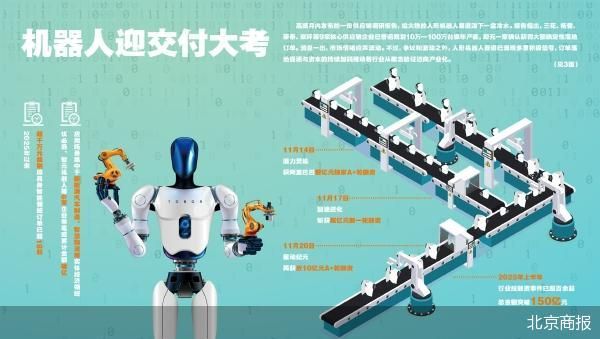
机器人爆单之后
Bei Jing Shang Bao· 2025-11-24 15:52
Core Insights - Goldman Sachs' supply chain report highlights a significant gap between optimistic production capacity plans and actual confirmed orders in the humanoid robot industry, indicating a typical characteristic of the current market [1] - The report suggests that while companies have planned annual production capacities ranging from 100,000 to 1,000,000 units, none have secured large, definitive orders [1] - The industry is facing scrutiny regarding the authenticity of product deliveries, as evidenced by public disputes among leading companies [3] Industry Developments - UBTECH, a leading humanoid robot company, has faced criticism regarding the authenticity of its delivery video, which was challenged by competitors citing visual discrepancies [3] - In response to the criticism, UBTECH released unedited footage to validate its claims, while also emphasizing its partnerships with major companies like BYD and Foxconn to drive commercialization [5][3] - The humanoid robot sector has seen over 18 significant orders exceeding 10 million yuan since 2025, with companies like UBTECH and ZhiYuan Robotics securing contracts in automotive manufacturing and smart logistics [5] Investment Trends - The investment landscape for humanoid robots has been robust, with over 100 financing events in the first half of 2025, totaling over 15 billion yuan [6] - Major investments have been made by top firms, indicating a shift in focus from speculative investments to evaluating actual delivery capabilities [6] - Despite the influx of capital and reported orders, there remains a gap in actual delivery volume, suggesting that the industry is still in the early stages of scaling up [6][7] Company Strategies - UBTECH aims for a production capacity of 5,000 units by 2026 and 10,000 units by 2027, with a target of delivering 500 humanoid robots in 2025 [8] - Accelerated Evolution, another key player, adopts a "small steps" approach, focusing on single-unit deliveries initially to refine production and service capabilities [8] - Both companies are navigating the competitive landscape by emphasizing delivery as the core logic for competition by 2025, transitioning from technology validation to large-scale commercial implementation [9][10]