量化对冲策略

Search documents
2025年私募证券投资机构推荐
头豹· 2025-09-16 12:55
Report Industry Investment Rating - Not provided in the content Core Viewpoints of the Report - In 2025, quantitative strategies are recommended over subjective ones in private securities investment institutions [1] - The private securities investment fund industry in China is characterized by increasing industry concentration with significant advantages for leading institutions, and an enhanced trend of diversified and international investment strategies [23][24] Summary by Relevant Catalogs Market Background - Affected by geopolitical conflicts and US tariff policies, the global stock market rose in the first half of 2025. A-shares showed an "N-shaped" trend, Hong Kong stocks performed better, and US stocks achieved a "V-shaped reversal". By the end of June 2025, the number of A-share listed companies reached 5,420, an increase of 37 from the end of 2024, and the total market value exceeded 100.02 trillion yuan, hitting a record high. The Beizheng 50 Index soared 39.45% in the first half of the year, leading the world in terms of gains. Industries such as non-ferrous metals (17.93%) and enterprise services (16.85%) led the rise, while industries such as coal (-10.02%) and real estate (-6.52%) faced pressure [4] - Chinese private securities investment funds are privately raised from qualified investors and mainly invest in publicly traded financial assets. They have more flexible investment strategies compared to public funds, lower liquidity, and can achieve differentiated returns through personalized strategies. Their operation must meet strict standards for qualified investors and emphasize the principle of self-risk assumption [5] - The development of Chinese private securities investment funds has evolved from disorderly exploration to standardization and specialization. Since 2025, driven by structural opportunities in the A-share market and excess returns from quantitative strategies, the issuance of private securities funds has recovered. In the first half of the year, over 5,400 new products were filed, with the filing scale increasing by 75% year-on-year [6] Market Status - As of the end of August 2025, the outstanding scale of Chinese private securities investment funds reached 5.56 trillion yuan, accounting for 27.4% of the total scale of private funds, a 6.5% increase from 5.24 trillion yuan at the beginning of 2025. Stock strategies dominate, and diversified strategies such as quantitative hedging and macro strategies are also developing rapidly. In July 2025, 1,313 new private securities funds were filed, with a scale of 79.281 billion yuan, a record high for the year. In the first half of the year, a total of 5,461 new filings were made, a 53.6% increase year-on-year, reflecting a significant trend of funds "entering the market through funds" [7][8] - As of the end of August 2025, there were 7,722 private securities fund managers, 385 fewer than at the end of 2024, mainly due to regulatory cleanup of "fake private funds". Geographically, Shanghai, Beijing, and Shenzhen account for over 50% of the total number of managers, and their management scales account for 25.2%, 23.2%, and 9.7% respectively [9] - The market demand for private securities funds shows a trend of diversification and stratification. The number of qualified investors has continued to expand, covering high-net-worth individuals, insurance funds, pensions, and foreign institutions. Insurance funds are accelerating the allocation of equity assets through pilot programs, and foreign institutions are also increasing their layout in the A-share market. Investor demand is significantly differentiated, with conservative funds preferring low-volatility products such as quantitative hedging and macro strategies, and aggressive funds focusing on stock long strategies. Market structural opportunities and policy guidance also affect the flow of funds and drive the continuous iteration of private securities fund strategies [10] Market Competition - The selection of the top ten private securities investment institutions follows a multi-dimensional quantitative evaluation model, with core indicators including management scale and stability, historical performance, and excess return ability [11] - The current industry competition shows a pattern of "siphoning by leading players" and "strategy differentiation". Leading quantitative private funds dominate with technical barriers and excess return ability. In 2025, the number of 10-billion-yuan quantitative private funds reached 41, exceeding that of 10-billion-yuan subjective private funds (40) for the first time. In the first half of the year, the average yield of quantitative private funds was 13.54%, significantly higher than that of subjective private funds (5.51%). Quantitative strategies perform well in volatile markets, while subjective strategies face challenges [12] - Ten institutions, including Gao Yi Asset, Orient Harbor, and Ningbo Magic Square Quantitative, are introduced, each with its own characteristics in terms of management scale, investment strategy, and core team [13][14][15] Development Trends - The Chinese private securities investment fund industry shows a significant "Matthew effect", with leading institutions having significant advantages in terms of funds, talent, technology, data, and trading systems. The number of 10-billion-yuan private fund managers has exceeded 100, and their share of the total industry management scale continues to rise. Small and medium-sized private funds face survival pressure, and foreign private funds are accelerating their localization layout, intensifying industry competition and promoting the concentration of resources to leading institutions [23] - With the deepening of China's capital market reform and the enrichment of financial derivative tools, private securities investment strategies are developing in a diversified direction from traditional stock long to quantitative hedging, macro strategies, event-driven, and cross-border investment. Regulatory authorities encourage private funds to serve the real economy and introduce long-term funds, and the cooperation between private funds and financial institutions such as securities firms and banks is deepening. In the future, strategy innovation and international layout will become core competitiveness [24]
近七成告负 量化对冲策略何以失效?
Zhong Guo Ji Jin Bao· 2025-08-24 04:38
Core Insights - In the past year, nearly 70% of quantitative hedge fund strategies reported negative net asset value growth despite a bullish market, indicating a significant underperformance compared to the overall market [1][2][6] - The average return of 23 quant hedge funds was -1.04%, with 16 funds showing negative returns [2][3] - Factors contributing to this underperformance include rising hedging costs, insufficient style adaptability, liquidity pressures, and strategy homogeneity [6][8][9] Performance Overview - The Shanghai Composite Index, Shenzhen Component Index, and ChiNext Index saw cumulative gains of approximately 34%, 49%, and 73% respectively over the past year [2] - Among the better-performing funds, Zhongyou Absolute Return Strategy achieved the highest net asset value growth of 5.56%, while other notable funds included Shenwan Lingshin Quantitative Hedge Strategy A and Guangda Sunshine Hedge Strategy [2][5] - Conversely, nine funds experienced net asset value declines exceeding 2%, with four funds dropping over 4%, and the maximum decline approaching 7% [3][5] Year-to-Date Performance - Year-to-date, quantitative hedge funds have shown improvement, with an average return of 0.96% as of August 22, 2023, and 15 funds reporting positive growth [3][5] - The highest year-to-date net asset value growth reached 10.79% for Zhongyou Absolute Return Strategy [5] Contributing Factors to Underperformance - Rising hedging costs have been a significant issue, with the cost of short positions increasing due to reduced or reversed futures discounts, impacting overall fund returns [6][7][9] - The market's structural divergence has made it challenging for strategies reliant on a single style to adapt to rapidly changing market conditions [8][9] - Liquidity pressures in a bullish market have complicated the rebalancing of portfolios, affecting the execution efficiency of strategies [8][9] - The accumulation of similar strategies among mainstream quant funds has led to increased competition and reduced opportunities for excess returns [8][9] Strategic Adjustments - To enhance returns, many hedge funds are adjusting their hedging ratios based on changes in futures basis and diversifying their portfolios by including interest rate bonds, convertible bonds, and increasing long equity positions [9][10] - Some funds have utilized the low correlation between quantitative hedge strategies and convertible bond strategies to spread risk [10]

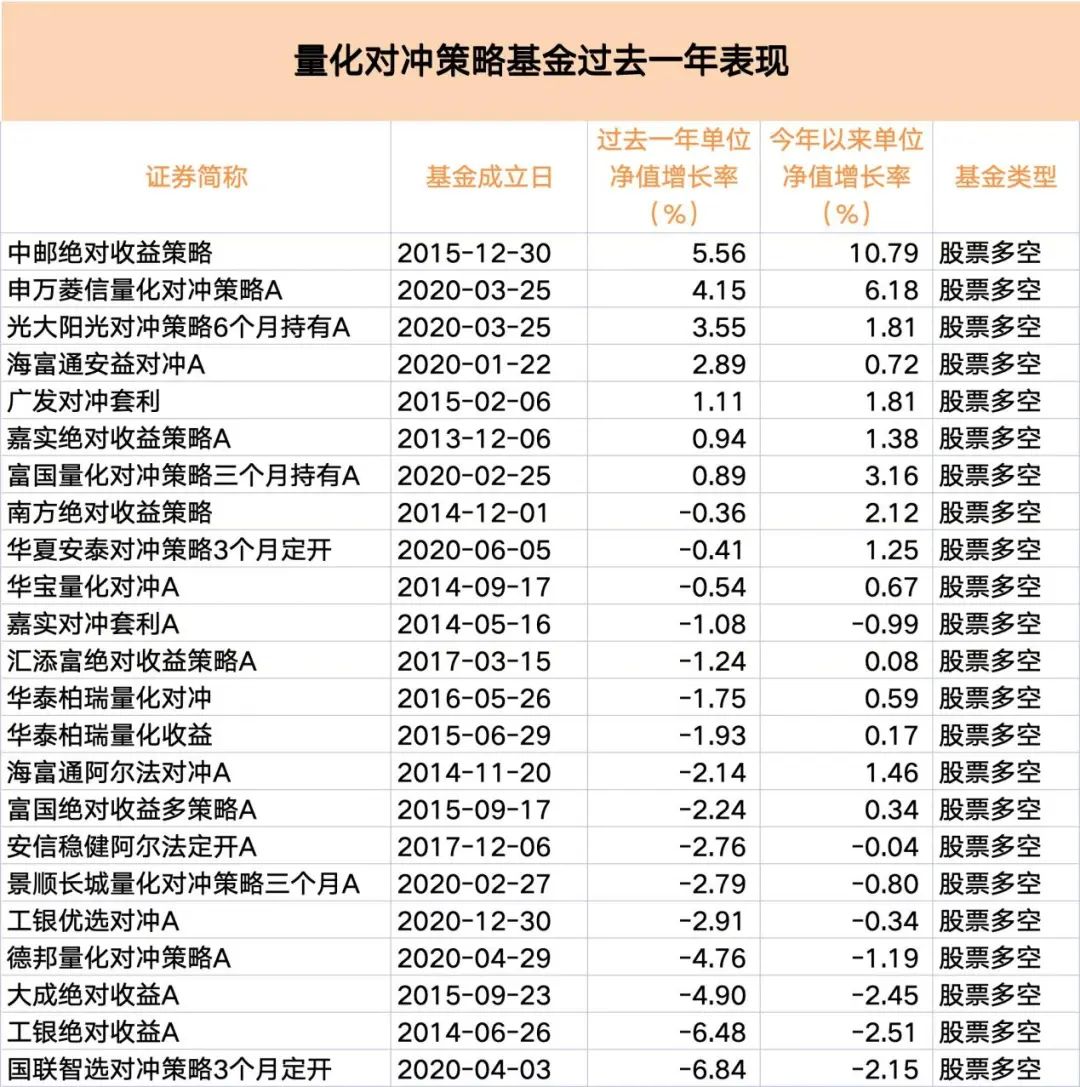
近七成告负,量化对冲策略何以失效?
Sou Hu Cai Jing· 2025-08-24 04:34
Core Insights - In the past year, nearly 70% of quantitative hedge strategy theme funds reported negative net asset value growth despite a bullish market, indicating a significant underperformance compared to the overall market [1][2][4]. Performance Overview - As of August 22, the Shanghai Composite Index, Shenzhen Component Index, and ChiNext Index saw cumulative gains of approximately 34%, 49%, and 73% respectively over the past year [4]. - Among 23 quant hedge strategy theme funds, the average return was -1.04%, with 16 funds showing negative returns, accounting for nearly 70% of the total [4][5]. - The best-performing fund, Zhongyou Absolute Return Strategy, achieved a net asset value increase of 5.56%, while several others also reported positive growth [4][5][7]. Factors Contributing to Underperformance - The underperformance of quantitative hedge funds in a bull market is attributed to several key factors: 1. Rising hedging costs due to reduced or reversed futures discounts, which have significantly impacted fund returns [8][9]. 2. Insufficient adaptability to market style changes, leading to challenges in keeping pace with rapidly shifting market trends [9][10]. 3. Liquidity pressures in a bullish market, making it difficult for funds to adjust their portfolios effectively [10]. 4. Strategy homogeneity, resulting in increased competition and reduced opportunities for excess returns [10]. Strategic Adjustments - To enhance returns, many hedge funds are adjusting their hedging ratios based on cost changes and diversifying their portfolios by including interest rate bonds, convertible bonds, and long equity strategies [11][12]. - Some funds have successfully integrated convertible bond strategies to mitigate risks and improve return potential [12].
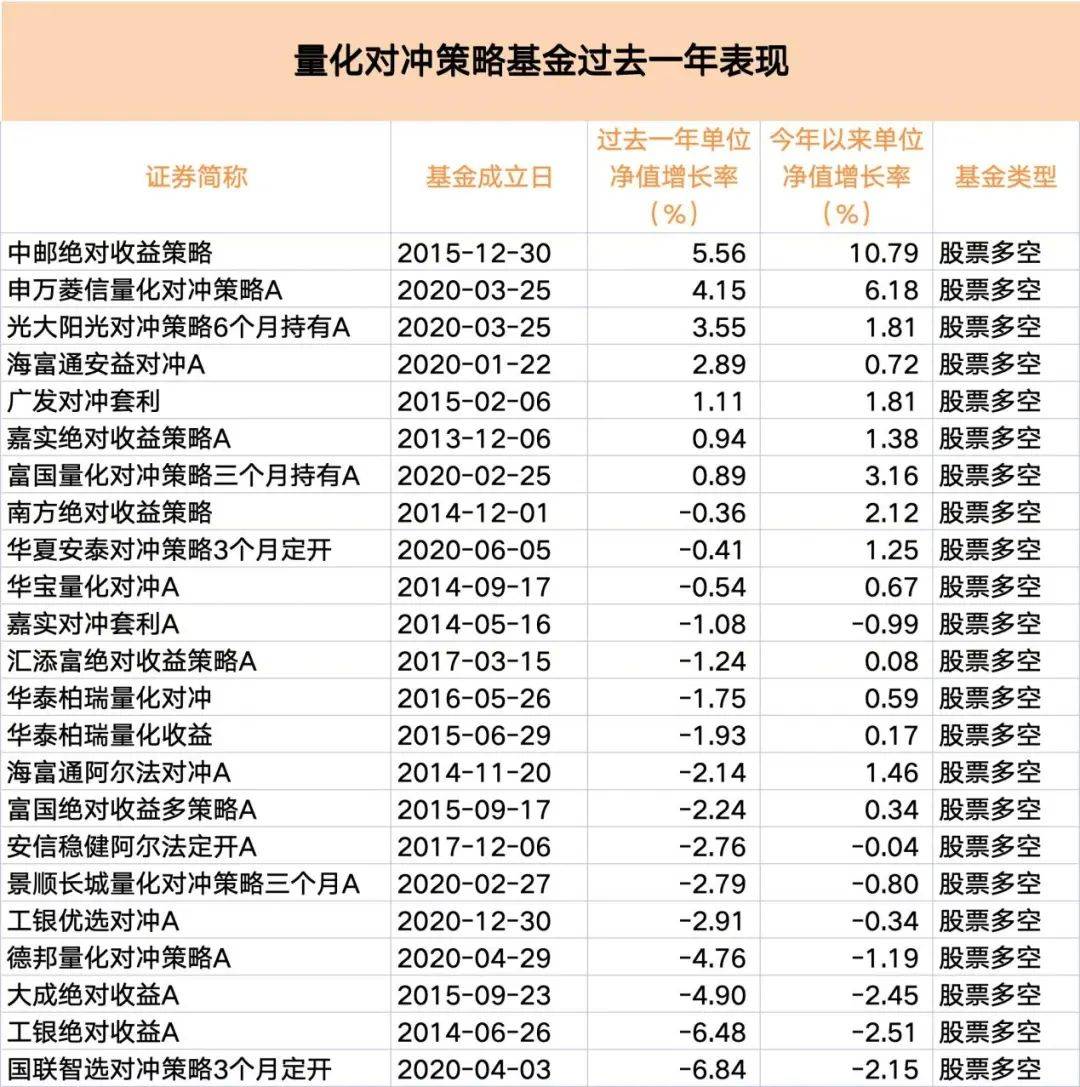
近七成告负,量化对冲策略何以失效?
中国基金报· 2025-08-24 04:13
Core Viewpoint - In the past year, nearly 70% of quantitative hedge fund strategies have reported negative unit net value growth despite a bullish market, primarily due to rising hedging costs, insufficient style adaptability, liquidity pressures, and strategy homogeneity [2][4][9]. Performance Overview - As of August 22, the Shanghai Composite Index, Shenzhen Component Index, and ChiNext Index have seen cumulative increases of approximately 34%, 49%, and 73% respectively over the past year [6]. - Among 23 quant hedge funds, the average return was -1.04%, with 16 funds showing negative growth, accounting for nearly 70% [6][8]. - The best-performing fund, Zhongyou Absolute Return Strategy, achieved a unit net value increase of 5.56% over the past year [8]. Factors Contributing to Poor Performance - **Rising Hedging Costs**: Increased costs due to reduced or reversed futures discounts have significantly impacted fund returns, with the recent futures discount rates for the CSI 500 and CSI 1000 reaching 3.2% and 4.5% respectively [10][11]. - **Insufficient Style Adaptability**: The current market structure's increasing divergence poses challenges for strategies reliant on a single style, making it difficult to keep pace with rapidly changing market trends [10]. - **Liquidity Pressures**: Increased trading activity in a bullish market has led to greater liquidity fluctuations in small-cap stocks, complicating the rebalancing efforts of quant hedge funds [11]. - **Strategy Homogeneity**: The rising concentration of mainstream quant strategies has led to accumulated risks, making it challenging for some funds to achieve excess returns through differentiated strategies [12]. Strategies to Enhance Returns - Quant hedge funds are adopting neutral investment strategies, utilizing index futures for complete hedging of long stock portfolios while employing quantitative multi-factor stock selection models [13][14]. - Funds are dynamically adjusting hedging ratios based on basis level changes in index futures to optimize costs and are diversifying their sources of returns by incorporating interest rate bonds, convertible bonds, and increasing long stock strategies [15]. - For instance, some funds have reduced their hedging ratios in response to significant negative basis levels in the CSI 1000 index, while others have included convertible bonds in their portfolios to enhance return elasticity [15].