金发姑娘式美国宏观经济环境

Search documents
“金发姑娘”叙事将重新主导市场? NRF预测创纪录消费大军涌向感恩节购物周
Zhi Tong Cai Jing· 2025-11-21 03:56
Core Insights - The upcoming Thanksgiving weekend in the U.S. is expected to see a record number of shoppers, contradicting pessimistic views from some Wall Street analysts regarding consumer spending and economic outlook [1] - The NRF's forecast indicates a strong holiday shopping season, which could significantly boost the U.S. economy in Q4 and 2026, as consumer spending accounts for 60%-70% of GDP [1] - The "Goldilocks" economic scenario suggests moderate growth and stable inflation, with expectations of a downward trajectory for interest rates [2] Retail Performance - Walmart reported a Q3 revenue increase of 5.8% to $179.496 billion, exceeding market expectations, and has raised its full-year guidance for 2026 [2] - The company anticipates a net sales growth of 4.8%-5.1% for the fiscal year 2026, up from a previous estimate of 3.75%-4.75% [2] Shopping Trends - A record 186.9 million people are expected to shop from Thanksgiving to Cyber Monday, an increase of 3 million from last year [3] - Black Friday remains the most popular shopping day, with 70% of surveyed consumers planning to shop on that day [3] Consumer Spending - NRF predicts that U.S. consumers will spend over $1 trillion during the Thanksgiving holiday shopping season, with an average budget of $890 per person [4] - Digital payment methods are increasingly popular, with 59% of shoppers expected to use digital wallets and apps [4] Gift Preferences - Families with children are expected to increase their gift budgets by approximately $33, with popular gifts including Legos, Barbie dolls, and Hot Wheels [5] - Gift cards and toys remain popular, with consumers projected to spend about $29.1 billion on gift cards, reflecting a 1.7% increase from last year [5] - There is a growing trend towards purchasing second-hand gifts, with over half of respondents considering this option to manage holiday budgets [5]

大而美”东风起+AI投资独舞:大摩解码2026年美国经济“金发姑娘式软着陆
Zhi Tong Cai Jing· 2025-11-18 06:48
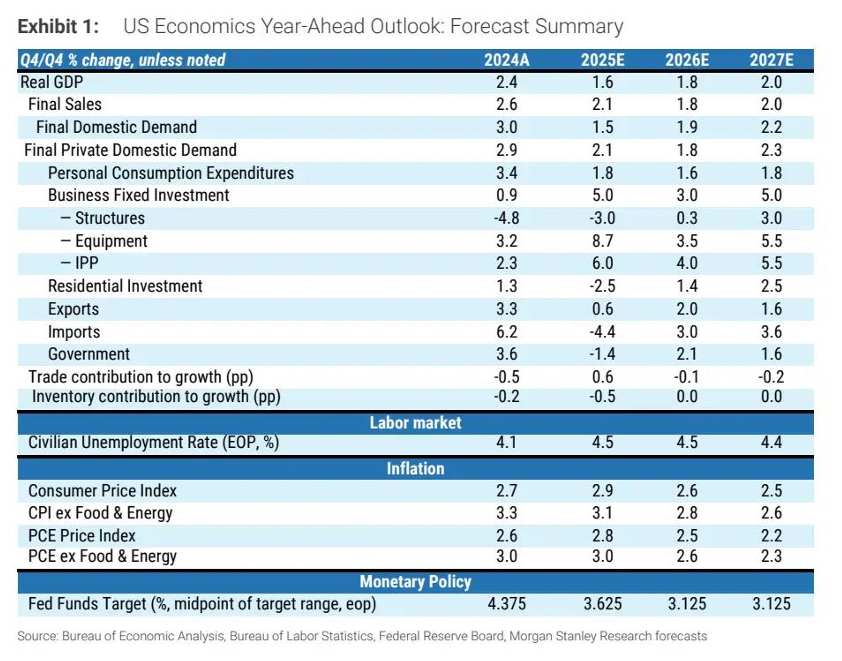
Core Viewpoint - Morgan Stanley's latest report indicates that the OBBBA tax reform, effective from 2026, will significantly boost economic growth, alongside the temporary inflation effects from Trump's tariffs dissipating, leading to a "Goldilocks" economic environment in the U.S. by 2026 [1][3] Economic Growth Projections - The macro analysis team at Morgan Stanley forecasts U.S. real GDP growth of 1.6% in 2025, 1.8% in 2026, and 2.0% in 2027, suggesting a gradual return to a "Goldilocks" scenario where growth is moderate and inflation is stable [1][2][3] Consumer Spending and Inflation - Consumer spending is expected to slow down in 2026 but not collapse, with inflation gradually receding and interest rates declining, which will support spending among lower-income groups [5][8] - The anticipated inflation effects from tariffs are expected to fade in the second half of 2026, allowing for increased consumer spending as the Federal Reserve implements preventive rate cuts [8][11] Investment Trends - AI-related investments are projected to contribute positively to GDP growth, while non-AI investments are expected to recover slowly from a previous drag on growth [11][12] - Significant AI investments by major tech companies like Microsoft and Google are expected to contribute approximately 0.4 percentage points to U.S. GDP growth annually from 2026 to 2027 [11][12] Stock Market Outlook - Morgan Stanley defines 2026 as the "Year of Risk Reboot," with a focus on strong corporate earnings driven by fiscal and monetary stimulus, projecting the S&P 500 index to rise to 7800 points [4] Trade and Net Exports - The role of net exports in GDP growth is expected to be minimal, with a slight increase in export growth projected at around 2% in 2026, influenced by ongoing trade uncertainties and the gradual fading of tariff impacts [17]