
金融去监管化

Search documents
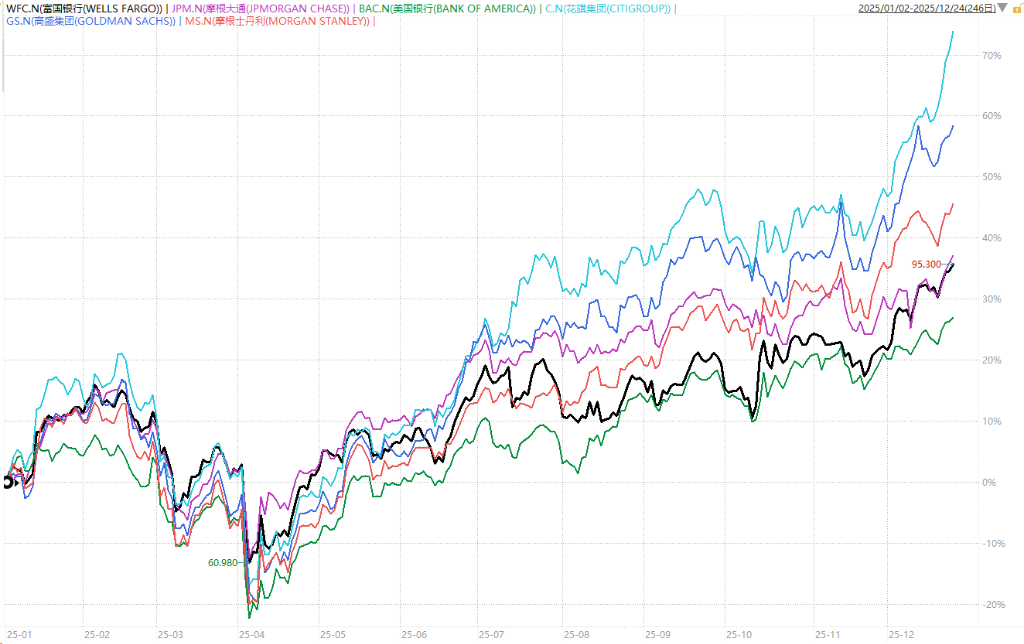
特朗普“去监管”推动,美国银行股市值今年涨了6000亿美元
Hua Er Jie Jian Wen· 2025-12-25 03:51
Group 1 - The financial deregulation pushed by the Trump administration has led to a recovery in investment banking and an increase of $600 billion in market value for the six largest U.S. banks this year [1] - As of Wednesday's close, the total market capitalization of JPMorgan Chase, Bank of America, Citigroup, Wells Fargo, Goldman Sachs, and Morgan Stanley exceeded $2.38 trillion, a significant rise from $1.77 trillion at the end of last year, and they are expected to outperform the S&P 500 for the second consecutive year [1][2] - In contrast, the total market capitalization of the six largest European banks is only $1 trillion, highlighting the growing divergence between U.S. and European banking sectors since the 2008 financial crisis [2] Group 2 - Regulatory policy shifts have been a key factor driving stock price increases, with U.S. regulators proposing to allow the largest banks to increase leverage and reforming capital requirements [2][4] - Strong recovery in investment banking has further boosted market confidence, with Citigroup's stock rising over 70% this year, leading the six major banks, and Goldman Sachs' stock climbing nearly 60% to reach an all-time high [2][7] - Analysts predict that bank stock and fixed income trading revenues will exceed historical peaks this year, with projected trading revenues of $92 billion for equities and $163 billion for fixed income [8] Group 3 - The deregulation measures introduced by the Trump administration have directly enhanced bank stock performance, with analysts emphasizing the importance of regulatory changes on stock prices [4] - Banks are expected to have excess capital available for business expansion, stock buybacks, and dividends, as they have been holding more capital than necessary under previous proposals [5] - Despite concerns from some lawmakers regarding the risks of deregulation, investors have shown minimal apprehension towards the increased risk-taking by banks [6]


关税靴子正式落地之后
CMS· 2025-04-10 05:01
Group 1: Tariff Policy Insights - Trump announced a 90-day suspension of reciprocal tariff policies, implementing a 10% baseline tariff instead[1] - The suspension indicates a need for more negotiation time, as no agreements were reached with other economies during the one-week window[2] - The focus of Trump's administration is shifting from tariffs to tax reform and deregulation as the 100-day agenda approaches its end[2] Group 2: Economic Impact Analysis - The U.S. GDP is projected to decline by 5.97% over 3-5 years due to high tariffs, with China, the EU, Canada, and Mexico seeing declines of 2.86%, 1.86%, 0.46%, and 0.21% respectively[6] - U.S. CPI is expected to rise by 3.57% over the same period, while China's CPI may change by 0.38%[12] - U.S. exports are forecasted to drop by 17.40%, with China's exports declining by 12.54% over 3-5 years[16] - U.S. imports are anticipated to decrease by 19.52%, with China's imports down by 8.77%[18] Group 3: Market Reactions and Future Outlook - The S&P 500 index typically adjusts by around 20% during economic slowdowns, with potential government interventions to mitigate risks[3] - If no additional tariffs are imposed, the likelihood of a recovery in U.S. stock markets in Q2 is high, contingent on the performance of major indices[3] - The impact of tariffs on trade, output, and inflation is expected to fluctuate in the short term but will stabilize in the long term[4]