钦三角

Search documents
一条134公里的人工运河,将改变广西经济地理格局
21世纪经济报道· 2026-01-31 03:56
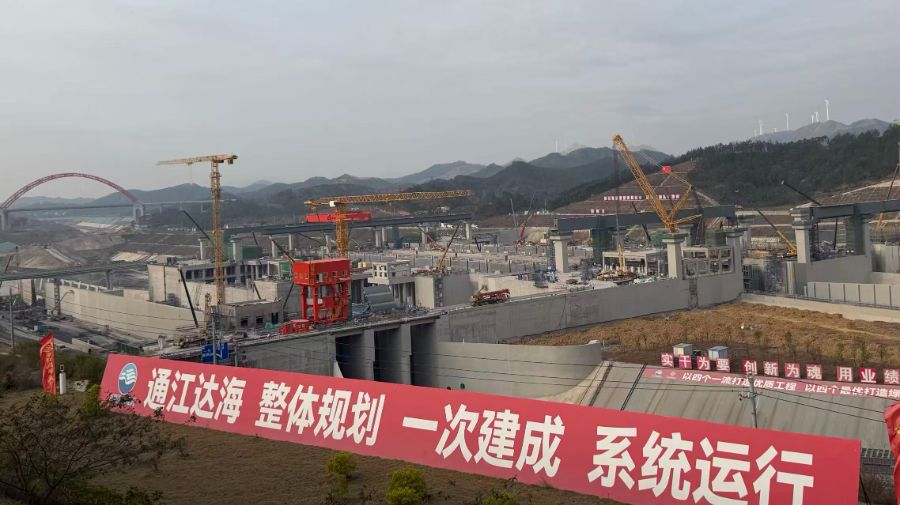
Core Viewpoint - The construction of the Pinglu Canal, a new waterway connecting Nanning to the Beibu Gulf, is expected to significantly enhance logistics efficiency and economic development in Guangxi, addressing long-standing transportation challenges and facilitating direct maritime access for goods [1][10][11]. Group 1: Project Overview - The Pinglu Canal, spanning 134.2 kilometers, is set to open by the end of 2026, allowing 5,000-ton vessels to navigate directly from Nanning to the sea via Qinzhou [1][3]. - The canal construction involves 52 months of work, including the excavation of 339 million cubic meters of earth and the pouring of 12.9 million cubic meters of concrete, equivalent to a highway stretching over 1,650 kilometers [6][10]. - The project has been a long-term goal for Guangxi, gaining momentum after being included in national strategic plans in 2019 and 2021 [10][11]. Group 2: Economic Impact - The Pinglu Canal is projected to reduce shipping distances significantly, with transport costs decreasing by 58.19 yuan/ton for Nanning and up to 80.11 yuan/ton for other cities like Chongzuo [11][12]. - The canal will facilitate faster shipping routes to Southeast Asia, with transport times to ports in Thailand and Vietnam reduced by up to 86% and 83%, respectively [11][12]. - The canal is expected to transform Guangxi's economic landscape, shifting from a "channel economy" to an "industrial economy" by attracting industries to the region [12][13]. Group 3: Strategic Development - The development of the Pinglu Canal is seen as a catalyst for regional economic integration, with the potential to create a "Qin Triangle" similar to the Yangtze and Pearl River Deltas, enhancing competitiveness through urban collaboration [17][18]. - Local governments are actively promoting the canal in their investment strategies, with companies like BYD establishing operations near the canal to leverage reduced logistics costs [15][16]. - The success of the canal will depend on effective industrial planning, policy innovation, and the integration of urban development along the waterway [13][18].

一条134公里的人工运河,将改变广西经济地理格局
2 1 Shi Ji Jing Ji Bao Dao· 2026-01-30 13:33
Core Viewpoint - The construction of the Pinglu Canal, a 134.2-kilometer waterway connecting Nanning to the Beibu Gulf, is set to significantly enhance logistics and economic development in Guangxi, addressing long-standing transportation challenges and facilitating direct maritime access for the region's goods [1][7][8]. Infrastructure Development - The Pinglu Canal is expected to be completed by the end of 2026, with over 20,000 workers and 5,000 machines involved in its construction over four years [1][2]. - The canal will allow 5,000-ton vessels to navigate, reducing the shipping distance to the sea by 560 kilometers [1][4]. - The project includes the construction of three double-line ship locks and 27 bridges, requiring the excavation of 339 million cubic meters of earth and the pouring of 12.9 million cubic meters of concrete [4][5]. Economic Impact - The canal is projected to lower transportation costs significantly for various cities in Guangxi, with reductions of up to 80.11 yuan per ton for certain areas [8][9]. - The new waterway will facilitate faster shipping times to Southeast Asia, with transport distances to ports in Thailand and Vietnam reduced by up to 86% and 83%, respectively [9][10]. - The canal is anticipated to transform Guangxi's economic landscape, shifting from a "channel economy" to an "industrial economy" by attracting industries to the region [11][12]. Strategic Importance - The Pinglu Canal is part of China's broader strategy to enhance the Western Land-Sea New Corridor, which aims to improve connectivity and trade routes between western China and Southeast Asia [7][8]. - The canal's construction has been recognized as a national strategic initiative, with its planning included in key national development documents since 2019 [7][8]. - The project is expected to create a new economic zone, referred to as the "Qin Triangle," which will enhance regional economic competitiveness through integrated development [15][16]. Future Prospects - Local governments are actively promoting the canal as a key element in attracting investment and developing new industries, with initiatives already underway in cities like Nanning and Qinzhou [13][14]. - The successful implementation of the canal is seen as crucial for Guangxi to capitalize on its geographical advantages and improve its logistics capabilities, potentially leading to a significant economic transformation [10][11].