铁可塑性

Search documents
“孤独伤脑”谜题破解
Huan Qiu Wang Zi Xun· 2026-02-09 02:34
Core Findings - The research team from South China University of Technology, in collaboration with Zhejiang University and Southern Medical University, has discovered that social isolation triggers iron accumulation in specific brain regions, activating a new neural plasticity pathway termed "iron plasticity" [1] - This finding addresses the long-standing question of how loneliness affects the brain and opens a non-invasive, reversible intervention pathway that does not rely on traditional anti-anxiety medications [1] Research Insights - The study utilized a mouse model simulating long-term solitary living, revealing that the iron content in the "ventral hippocampus," a region more involved in emotional regulation, was abnormally elevated in isolated mice [1] - Excessive iron acts as a "false signal," activating a molecule called α-synuclein, which leads to excessive neuronal firing, causing the body to continuously receive anxiety alerts such as "danger" and "escape" [1] - This change specifically targets the emotional center of the brain, resulting in a heightened stress response to "social deprivation" [1] Implications for Mental Health - Traditionally, iron was viewed merely as a nutritional element essential for maintaining neural health; however, this research indicates that under psychological stress, iron can become a "double-edged sword," directly driving the structural and functional remodeling of neural synapses [1] - The concept of "iron plasticity" provides a new perspective on the metabolic origins of mental disorders, potentially leading to innovative treatment approaches [1]
社交隔离为何让人焦虑?华工团队解开“孤独伤脑”的长久谜题
Nan Fang Du Shi Bao· 2026-01-30 08:24
Core Findings - The research conducted by a team led by Associate Professor Wang Zhuo from South China University of Technology, in collaboration with Zhejiang University and Southern Medical University, reveals that social isolation triggers iron accumulation in a specific brain region, leading to the activation of a new neural plasticity pathway termed "ferroplasticity" [2][3] - This discovery addresses the long-standing question of how loneliness affects the brain and opens a new non-invasive intervention pathway that does not rely on traditional anti-anxiety medications [2] Group 1 - The study utilized a mouse model simulating long-term human isolation, finding that isolated mice exhibited abnormal iron levels in the "ventral hippocampus," a brain area associated with emotional regulation [2] - Excessive iron activates a molecule called α-synuclein, causing neurons to overfire and send anxiety signals to the body, indicating a specific stress response to social deprivation [2][3] Group 2 - The research team identified a novel mechanism termed "ferroplasticity," linking disrupted iron metabolism in the brain to emotional disorders, thus providing insights into the metabolic roots of mental illnesses [3] - They explored a non-invasive nasal delivery method targeting key molecules like iron or α-synuclein, showing significant therapeutic effects, which could lead to the development of non-invasive, targeted anti-anxiety therapies [3] Group 3 - Future steps include advancing the safety and dosage optimization of nasal spray formulations for human use and developing non-invasive imaging techniques to detect iron accumulation in the ventral hippocampus [3] - The team aims to explore the role of this mechanism in other neuropsychiatric disorders and plans to initiate clinical trials to bring their research findings to the public [3]


孤独焦虑损伤大脑!华南理工大学团队解开长久谜题
2 1 Shi Ji Jing Ji Bao Dao· 2026-01-30 02:42
Core Insights - The World Health Organization has identified "social isolation" as a significant global health threat, with research revealing that social isolation can lead to anxiety and changes in brain function [5][6]. Group 1: Research Findings - A research team from South China University of Technology has discovered that social isolation triggers iron accumulation in a specific brain region, leading to a new pathway of neural plasticity termed "ferroplasticity" [5][7]. - The study indicates that iron, previously considered a nutrient for neural health, can become a "double-edged sword" under psychological stress, driving structural and functional changes in neural synapses [5][6]. Group 2: Implications for Treatment - The research suggests a novel non-invasive intervention method through nasal delivery targeting key molecules like iron or α-synuclein, which showed significant reduction in anxiety behaviors in mice within two weeks [8][9]. - This approach could potentially benefit over 1 billion people globally suffering from social isolation-related psychological issues, paving the way for new non-invasive anxiety therapies [8][9]. Group 3: Future Directions - The research integrates neuroscience, metal biology, and translational medicine, marking a significant achievement in brain science and mental health [9]. - Future steps include advancing the safety and dosage optimization of nasal spray formulations and exploring imaging techniques for iron accumulation in the brain, with plans to initiate clinical trials [9].

我国科学家解开“孤独伤脑”的长久谜题
Huan Qiu Wang Zi Xun· 2026-01-30 01:45
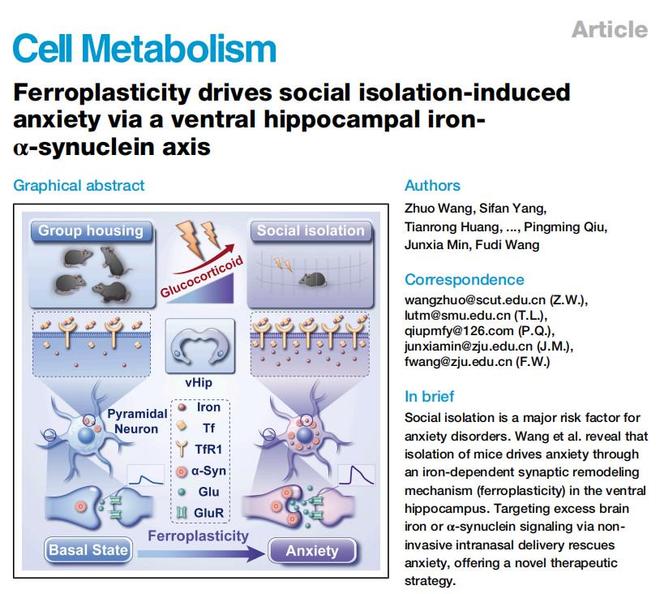
Core Insights - The research reveals that social isolation triggers iron accumulation in specific brain regions, activating a new neural plasticity pathway termed "iron plasticity" [1][5][6] - This discovery provides a novel, non-invasive intervention approach for anxiety without traditional medications, addressing the long-standing issue of "loneliness harming the brain" [1][5] Group 1: Research Findings - The study utilized a mouse model simulating long-term human isolation, finding increased iron levels in the "ventral hippocampus," a region associated with emotional regulation [5] - Excess iron activates a molecule called α-synuclein, leading to excessive neuronal firing and heightened anxiety signals, indicating a specific stress response to social deprivation [5][6] - The research establishes a link between disrupted iron metabolism and emotional disorders, suggesting a metabolic basis for understanding mental illnesses [6] Group 2: Intervention and Implications - The team tested a non-invasive nasal delivery method targeting key molecules related to iron plasticity, resulting in significant anxiety reduction in mice within two weeks, faster than traditional social reintegration [8] - This approach could potentially benefit over 1 billion people globally suffering from anxiety related to social isolation, offering a new direction for non-invasive, targeted anxiety therapies [8] - Future plans include advancing the safety and dosage optimization of the nasal spray for human trials, as well as exploring the role of iron accumulation in other neuropsychiatric disorders [8]
华南理工大学医学院团队解开“孤独伤脑”谜题
Zhong Guo Xin Wen Wang· 2026-01-29 03:38
Core Insights - The research reveals that "social isolation" triggers iron accumulation in specific brain regions, leading to a new neural plasticity pathway termed "Ferroplasticity" [1][2] - This discovery provides a novel intervention approach that does not rely on traditional anxiolytic medications, potentially offering a non-invasive and reversible solution to anxiety related to social isolation [1][2] Group 1: Research Findings - The study, conducted by a team from South China University of Technology and other institutions, published in the journal Cell Metabolism, demonstrates that isolated mice exhibit increased iron levels in the ventral hippocampus, a region associated with emotional regulation [1] - Excessive iron acts as a "false signal," activating α-synuclein molecules, which leads to excessive neuronal firing and anxiety responses, particularly affecting the emotional center of the brain [2] - The newly identified mechanism, "Ferroplasticity," links iron metabolism dysregulation to emotional disorders, providing insights into the metabolic roots of mental illnesses [2] Group 2: Potential Applications - The research indicates that targeting key molecules involved in "Ferroplasticity" through nasal administration can significantly reduce anxiety behaviors in mice within two weeks, faster than traditional social reintegration methods [2] - This suggests the potential for a nasal spray treatment to safely and conveniently prevent or alleviate anxiety in high-risk populations, such as isolated elderly individuals, workers in closed environments, post-operative patients, and socially avoidant adolescents [2] - The team plans to advance the development of nasal spray formulations for human safety and dosage optimization, as well as imaging techniques to detect iron accumulation in the ventral hippocampus [3]
孤独让大脑“生锈”!王福俤团队等Cell子刊:揭开社交隔离引发焦虑的新机制
生物世界· 2026-01-28 04:21
Core Insights - The article discusses a study revealing the neurobiological basis of anxiety disorders caused by social isolation, highlighting the role of "ferroplasticity" in this process [3][7][15]. Group 1: Biological Basis of Loneliness - Social isolation is recognized as a significant environmental factor leading to anxiety disorders, with the World Health Organization classifying it as a global public health emergency [7]. - The study identifies iron's dual role in the brain, being essential for neuronal function but also neurotoxic when homeostasis is disrupted [7][8]. Group 2: Discovery of Ferroplasticity Mechanism - The research team conducted experiments on male mice subjected to social isolation for four weeks, which resulted in increased anxiety-like behaviors and elevated cortisol levels [9][10]. - Activation of glucocorticoid receptors (GR) in the ventral hippocampus was found to increase the expression of transferrin receptor-1 (TfR1), leading to iron accumulation and elevated levels of alpha-synuclein (α-Syn) [9][14]. Group 3: Molecular Pathway of Anxiety - The study outlines a specific molecular pathway linking social isolation to anxiety behaviors: social isolation → GR receptor activation → TfR1 upregulation → iron accumulation → α-Syn increase → synaptic function alteration → hyperactivity in the ventral hippocampus → anxiety behaviors [12][14]. Group 4: Translational Strategies - The research team developed non-invasive treatment strategies using nasal sprays of iron chelator deferoxamine (DFO) and antisense oligonucleotides targeting α-Syn, which effectively alleviated anxiety-like behaviors [16][17]. - The study suggests that social support can reverse the effects of social isolation on iron levels and α-Syn expression, indicating its therapeutic potential [16][17].