
银发族市场

Search documents
投资印度版携程9年,携程套现170亿元
2 1 Shi Ji Jing Ji Bao Dao· 2025-11-21 03:16
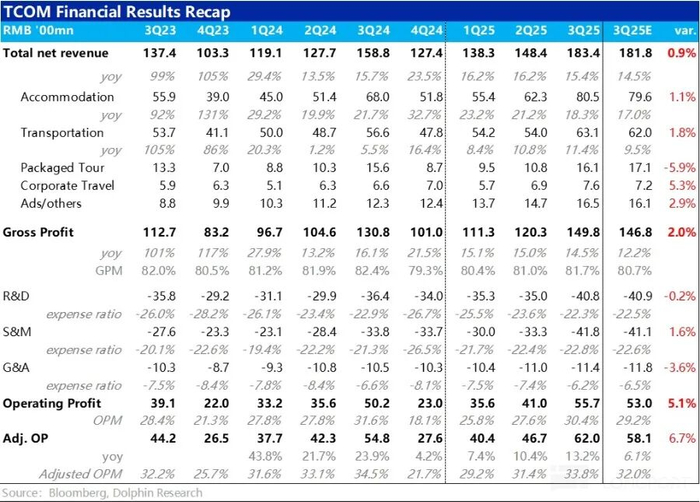
Core Insights - Ctrip Group reported a significant increase in net profit for Q3 2025, reaching RMB 19.9 billion, a year-on-year growth of 194%, marking a rare instance where net profit exceeded revenue [1] - The profit surge was primarily driven by a strategic exit from a cross-border investment, specifically the sale of part of its stake in Indian online travel giant MakeMyTrip, yielding approximately RMB 17 billion [1][4] - Excluding this investment gain, Ctrip's net profit for Q3 was substantially lower than the previous year's RMB 6.8 billion [1] Financial Performance - Total net revenue for Q3 2023 was RMB 13.74 billion, reflecting a year-on-year increase of 99% [2] - Accommodation revenue reached RMB 5.59 billion, up 92% year-on-year, while transportation revenue surged by 705% to RMB 5.37 billion [2] - Operating profit stood at RMB 3.91 billion, with an operating profit margin of 28.4% [2] Investment Strategy - Ctrip's investment in MakeMyTrip began in January 2016 with an investment of USD 180 million in convertible bonds, marking a strategic move into the Indian market [4] - The investment was based on the potential of the Indian market, which was projected to grow significantly, supported by a rising middle class [4] - Ctrip's stake in MakeMyTrip increased over the years, culminating in a sale of shares in June 2025, reducing its voting rights from 45.3% to 16.9% [5][6] Growth Engines - Ctrip identified three main growth engines: AI technology, inbound tourism, and targeted market segmentation [8][9] - The company is leveraging AI to enhance customer service and operational efficiency, with its AI travel assistant TripGenie seeing a user growth of over 200% [8] - Inbound tourism is highlighted as a rapidly growing segment, with significant potential for growth compared to developed countries [9] Market Challenges - Despite strong Q3 performance, the online travel industry faces renewed price competition, particularly with competitors like JD and Douyin entering the market [12] - Ctrip's management emphasized the importance of quality service over price competition, although market trends may challenge this approach [12] - The recovery of international travel remains slow, with global airline capacity only at 88% of pre-pandemic levels, impacting Ctrip's international growth [12] Marketing and Shareholder Returns - Ctrip is adopting a more refined marketing strategy, adjusting spending based on market maturity and channel characteristics [13] - The company announced a new USD 5 billion stock buyback plan, indicating a commitment to shareholder returns amidst market recovery and competition [13]


投资印度版携程9年,携程套现170亿元
21世纪经济报道· 2025-11-21 02:36
Core Viewpoint - Ctrip Group reported a significant increase in net profit for Q3 2025, reaching 19.9 billion RMB, a year-on-year growth of 194%, primarily driven by a strategic exit from its investment in MakeMyTrip, which generated approximately 17 billion RMB in revenue from the sale of shares [1][4]. Investment in MakeMyTrip - Ctrip's investment in MakeMyTrip began in January 2016 with a convertible bond of 180 million USD, marking its entry into the Indian market, which was seen as having high growth potential due to a rapidly rising middle class [4][5]. - The investment was strategically timed, as the IMF projected India's economic growth at 7.5% in 2016, with a significant increase in the middle-class population, providing a strong foundation for tourism consumption [4]. - Over nine years, Ctrip's stake in MakeMyTrip grew, with the book value of the investment reaching 6.2 billion RMB by the end of 2023 and 7.1 billion RMB by the end of 2024, indicating a stable appreciation [5][6]. - In June 2025, Ctrip sold part of its shares in MakeMyTrip for 2.5 to 3 billion USD, reducing its voting rights from 45.3% to 16.9%, transitioning from a strategic to a financial investor [5][6]. Growth Engines - Ctrip's management highlighted three main growth engines: AI technology, inbound tourism, and targeted market segmentation [8][9]. - AI is positioned as a core strategic pillar, with Ctrip's AI travel assistant, TripGenie, expanding its user base significantly, indicating a strong focus on enhancing customer experience through technology [8]. - The inbound tourism sector is identified as a rapidly growing area, with Ctrip noting that China's inbound tourism revenue as a percentage of GDP is significantly lower than that of developed countries, suggesting substantial growth potential [9]. - Ctrip is also focusing on the silver economy, targeting older consumers who have three times the spending power of younger demographics, and has seen significant growth in its "Old Friends Club" membership and transaction volume [9][10]. Market Challenges - Despite strong Q3 performance, the online travel industry faces renewed price competition, with major players like JD and Douyin entering the market [13]. - Ctrip's management emphasized the importance of quality service over price competition, as the market trends indicate a persistent decline in hotel and flight prices [13][14]. - The recovery of international business remains slow, with global airline capacity only at 88% of pre-pandemic levels, which could hinder faster growth for Ctrip's international operations [14]. - Ctrip is adopting a differentiated competitive strategy, including a global SOS service network for customer support and a refined marketing approach based on market maturity [14].
投资“印度版携程”套现170亿元 携程Q3净利暴增194%
2 1 Shi Ji Jing Ji Bao Dao· 2025-11-20 10:58
Core Insights - Ctrip Group reported a significant increase in net profit for Q3 2025, reaching 19.9 billion RMB, a year-on-year growth of 194%, marking a rare instance where net profit exceeded revenue [1] - The profit surge was primarily driven by a strategic exit from a cross-border investment, specifically the sale of part of its stake in Indian online travel giant MakeMyTrip, yielding approximately 17 billion RMB [1][5] - Excluding this investment gain, Ctrip's Q3 net profit was substantially lower than the previous year's 6.8 billion RMB [1] Investment in MakeMyTrip - Ctrip's investment in MakeMyTrip began in January 2016, with an initial investment of 180 million USD in convertible bonds, positioning Ctrip as a significant player in the Indian market [1][2] - The investment was based on the strong growth potential of the Indian economy and the rapid rise of its middle class, which was estimated to have reached 140 million people [2] - MakeMyTrip was already the largest OTA in India at the time of investment, holding a 15% market share in domestic flights and experiencing a 50% growth in hotel revenue [2] Strategic Developments - Ctrip's stake in MakeMyTrip was further solidified through a series of strategic equity operations, culminating in Ctrip holding approximately 49% of the voting rights by the end of 2024 [3] - The investment's value increased over the nine years, with Ctrip reporting a book value of 6.2 billion RMB and 7.1 billion RMB for its stake in MakeMyTrip by the end of 2023 and 2024, respectively [3] - In June 2025, Ctrip sold part of its Class B shares in MakeMyTrip for 2.5 to 3 billion USD, reducing its voting rights from 45.3% to 16.9%, transitioning from a strategic to a financial investor [3][4] Market Position and Future Growth - Despite relinquishing control over MakeMyTrip, Ctrip remains the largest minority shareholder, allowing it to benefit from the growth of the Indian online travel market, which has seen MakeMyTrip achieve over 50% market share in the OTA sector [4] - MakeMyTrip's total gross booking value (GBV) for FY2025 is projected to reach 9.8 billion USD, reflecting a year-on-year growth of 23.1% [4] Ctrip's Growth Engines - Ctrip's management highlighted three key growth engines: AI technology, inbound tourism, and targeted market segmentation [6][7] - The company is leveraging AI to enhance customer service and operational efficiency, with its AI travel assistant, TripGenie, experiencing over 200% user growth in the first half of 2025 [6] - Inbound tourism is identified as a rapidly growing segment, with significant potential for growth compared to developed countries, where inbound tourism revenue constitutes 1% to 5% of GDP [7] Market Challenges - Ctrip faces challenges from intensified price competition in the online travel industry, exacerbated by competitors like JD.com and Douyin [10] - Despite a strong Q3 performance, the overall market conditions remain challenging, with domestic hotel and flight prices showing only slight declines [10] - The recovery of international business is also constrained, with global airline capacity only reaching 88% of pre-pandemic levels, impacting Ctrip's growth potential [10] Competitive Strategy - In response to market challenges, Ctrip is adopting a differentiated competitive strategy, emphasizing high-quality service over price competition [11] - The company has announced a new 5 billion USD stock buyback plan, indicating a commitment to shareholder returns [11] - Ctrip's ongoing investment in technology and customer support services is crucial for maintaining its competitive edge in the evolving travel market [11]