
TripGenie

Search documents
泛亚互联网 2026 展望 -AI 应用加速对变现与利润率的影响-Pan-Asia Internet 2026 Outlook Accelerating AI Adoptions Impact on Monetization Margins
2026-01-06 02:23
Summary of Pan-Asia Internet Research Conference Call Industry Overview - **Pan-Asia Internet Sector**: The conference call focused on the outlook for the Pan-Asia internet sector, highlighting the impact of AI adoption on monetization and margins for 2026 [1][4]. Key Insights by Region China Internet - **Performance**: China's internet sector led in 2025 with a +31% return, outperforming the US (+20%), Korea (+14%), SEA (+11%), Japan (+10%), and India (+9%) [5]. - **AI Focus**: Key themes for 2026 include: - Growth in recurring revenues from cloud infrastructure and AI model usage. - Competition among AI chatbots for user traffic. - Companies deploying proprietary AI agents for user engagement and monetization [8]. - **Top Picks**: Tencent and Alibaba as core AI plays, along with Trip.com and NetEase for stable earnings growth [8]. India Internet - **Operating Margins**: Expected improvement in operating margins driven by operating leverage and better unit economics, particularly for companies like Swiggy and Paytm [7]. - **Key Themes**: - Intense competition in quick commerce. - Regulatory easing for fintech, particularly for Paytm. - Rebound in online travel agencies (OTAs) due to sustained demand [7]. - **Top Picks**: Eternal and MakeMyTrip [7]. Korea Internet - **Market Dynamics**: - Coupang expected to gain market share in e-commerce and food delivery. - Integration of AI in KakaoTalk to enhance search capabilities [9]. - Selective approach to gaming due to competition and delays in major game releases [9]. - **Top Picks**: Coupang for e-commerce, Krafton for gaming, and HYBE for K-pop entertainment [9]. Japan Internet - **Growth Drivers**: - Solid online ads market driven by video and staffing ads, while search ads stagnate. - Mid-single-digit growth expected in e-commerce, supported by AI recommendations [10]. - **Top Picks**: Recruit and Nintendo [10]. ASEAN Internet - **Growth Potential**: - SEA positioned as an AI data center hub, supporting digital economy growth. - Intensifying competition between Shopee and TikTok in e-commerce [11]. - **Top Picks**: Grab and GoTo for operational efficiencies and potential synergies from consolidation [11]. Financial Metrics and Valuations - **China Internet Valuations**: - Alibaba Group: Target price of $225, representing a 54.9% upside [13]. - JD.com: Target price of $44, with a 57.8% upside [13]. - **Korea Internet Valuations**: - Coupang: Target price of $28, with an 18.7% upside [12]. - Krafton: Target price of $440, with a 78.9% upside [12]. - **India Internet Valuations**: - Eternal: Target price of $440, with a 58.3% upside [12]. Additional Insights - **Regulatory Developments**: Anticipated changes in India's laws regarding multi-brand retail FDI and fintech regulations [7]. - **Consumer Behavior**: Increased productivity from AI tools may lead to more leisure time, benefiting sectors like travel and online gaming [8]. This summary encapsulates the key points discussed during the conference call, providing insights into the performance and outlook of the Pan-Asia internet sector across various regions.



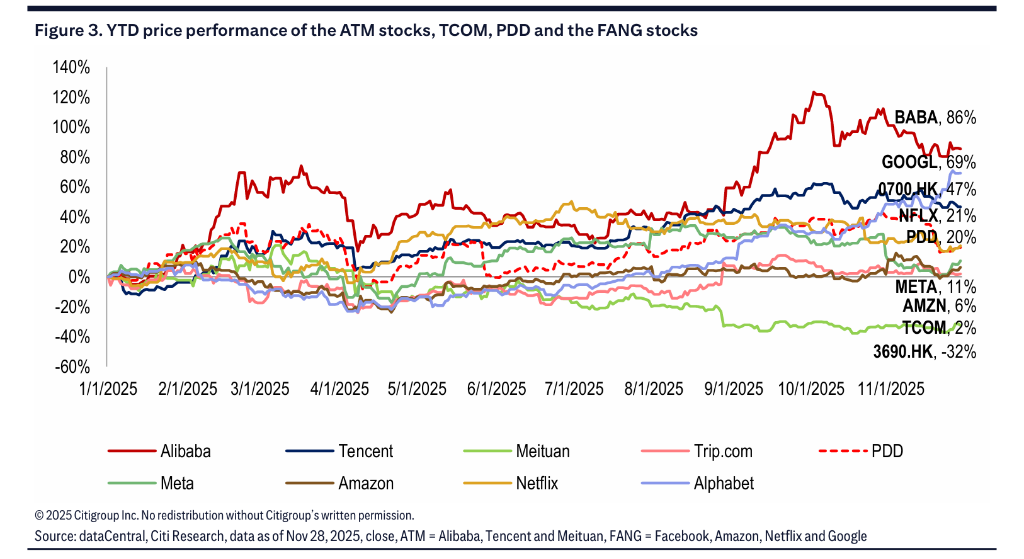
我们对中国 AI 近期核心争议的看法-China AI Intelligence_ What is ahead_ Our take on the recent key debates in China AI
2025-12-08 15:36
Summary of Key Points from the Conference Call on China AI Development Industry Overview - The focus is on the **China AI industry**, particularly developments in **Large Language Models (LLMs)**, computing infrastructure, and enterprise/consumer adoption of AI technologies [1][2][3]. Core Insights 1. **Investment Trends**: There is increasing investor interest in China's AI development, with discussions centered around AI investment, application, and domestic substitution, particularly in chips [1]. 2. **LLM Capability**: By 2026, it is expected that China's domestic LLM capabilities will rapidly iterate and catch up with US counterparts [1]. 3. **Monetization Paths**: China and the US are following similar monetization paths for AI, with cloud services and advertising being the most visible areas for growth [1]. 4. **Infrastructure Development**: Continued localization of computing power is anticipated, with improvements in chip performance and supernodes taking on more inference and training workloads [1][2]. Financial Metrics - **CAPEX Comparison**: In Q325, major Chinese cloud providers' CAPEX was 10% of their revenue and 50% of their operating cash flow, compared to 27% and 71% for US hyperscalers. The estimated combined CAPEX of China's internet leaders is around **Rmb400 billion** in 2025, about one-tenth of US peers, while achieving comparable LLM performance [2][24]. AI Disruption Risk 1. **Gradual Disruption**: The pace of AI disruption in China is expected to be gradual due to a fragmented chatbot landscape and high entry barriers in vertical industries [3][27]. 2. **Chatbot Landscape**: Unlike the US, where ChatGPT has a dominant position, China's chatbot apps like Doubao and DeepSeek have not yet consolidated, leading to a more balanced bargaining power between AI apps and vertical platforms [27]. Preferred Stocks - **Investment Recommendations**: The report highlights **Tencent** and **Alibaba** as comprehensive AI leaders, with **Baidu** showing potential upside. Other recommended stocks include **GDS/VNET** in the IDC space and **Meitu/Kuaishou** for AI applications [4]. Strategic Updates from Key Players 1. **Alibaba**: Increasing focus on consumer-facing AI products, with the Qwen app expected to leverage advanced AI models and integrate deeper within Alibaba's ecosystem [12][13]. 2. **ByteDance**: Doubao is expected to broaden its use cases and integrate with broader ecosystems, enhancing its capabilities as a system-level AI assistant [14][15]. Future Catalysts - Anticipated catalysts for the AI sector include continued model iteration, strategic updates from key companies, and capital market updates from domestic chip companies and AI labs [10][11]. Conclusion - The outlook for China's AI industry remains positive, with expectations for accelerated adoption and monetization by 2026. The focus on prudent CAPEX, stable IDC utilization, and gradual disruption risk suggests a robust environment for investment opportunities in the sector [2][3][4].
中国AI大战将在2026年“全面加剧”:“流量入口”成大厂“必争之地”,AI出海也将加速
硬AI· 2025-12-02 09:07
Core Viewpoint - The Chinese internet sector is expected to see a remarkable growth of 36.5% in 2025, but the real competition will unfold in 2026 around artificial intelligence (AI) [2][3] Group 1: 2026 AI Competition - The competition in the AI sector will focus on three main themes: AI cloud infrastructure, AI chatbots, and AI applications [6][7] - Major players like Alibaba, ByteDance, and Tencent are competing to capture user traffic through their AI chatbots, aiming to secure key monetization avenues in the AI era [3][7] Group 2: AI Cloud Infrastructure - Alibaba and Baidu are leading a capital race in AI cloud infrastructure, with Alibaba's capital expenditure reaching approximately 120 billion RMB over the past four quarters and planning to invest 380 billion RMB in the next three years [8] - Alibaba's cloud business revenue grew by 34% year-on-year in Q3 2025, while Baidu's AI cloud revenue also saw a 21% year-on-year increase, reaching 6.2 billion RMB [8] Group 3: AI Chatbot Competition - AI chatbots are defined as the "traffic entry point" in the AI era, with Alibaba, ByteDance, and Tencent heavily investing in this user acquisition battle [11] - ByteDance's chatbot "Doubao" leads the Chinese market with 197 million monthly active users (MAU) as of October 2025 [11] Group 4: Vertical AI Applications - Companies in vertical sectors like Meituan, Ctrip, and Didi are training their proprietary AI agents using exclusive data to enhance user engagement and explore new monetization opportunities [16] - Ctrip's AI travel assistant "TripGenie" saw its user base grow by over 200% year-on-year in the first half of 2025 [16] Group 5: Global Expansion of AI - Chinese AI applications are accelerating their global expansion, with ByteDance's products ranking among the top in global MAU [20] - As of November 2025, ByteDance's "Dola" and another Chinese product "DeepSeek" ranked fourth and fifth globally, with 47 million and 39 million MAU respectively [20] Group 6: Performance Review and Outlook - In Q3 2025, 27 out of 44 internet companies exceeded profit expectations, attributed to cost optimization and productivity gains from AI [26] - The gaming industry is expected to benefit from AI-driven efficiency improvements, with the average revenue per user (ARPU) rebounding to 41 RMB, a 13.3% year-on-year increase [27] - The tourism sector shows resilience, with tourism expenditure as a percentage of GDP at 4.3% in 2024, indicating growth potential [28]


花旗:中国AI大战将在2026年“全面加剧”,“流量入口”成大厂“必争之地”,AI出海也将加速
美股IPO· 2025-12-02 08:02
Core Viewpoint - The Chinese internet sector is expected to lead global returns with a remarkable 36.5% growth in 2025, but the real competition will unfold in 2026 around artificial intelligence (AI) [1][3] Group 1: AI Competition Themes - The competition in China's AI sector in 2026 will focus on three main themes: AI cloud infrastructure, AI chatbots, and AI applications [5] - Major players like Alibaba, ByteDance, and Tencent are vying for user traffic through their AI chatbots, aiming to secure key entry points for future ecosystem commercialization [3][5] Group 2: AI Cloud Infrastructure Investment - Alibaba and Baidu are leading a capital race in AI cloud infrastructure, with Alibaba's capital expenditure reaching approximately 120 billion RMB over the past four quarters and plans to invest 380 billion RMB over the next three years [6] - Alibaba's cloud business revenue grew by 34% year-on-year in Q3 2025, while Baidu's AI cloud revenue also saw a 21% year-on-year increase, reaching 6.2 billion RMB [6] Group 3: AI Chatbot User Acquisition - AI chatbots are defined as the "traffic entry point" of the AI era, with Alibaba, ByteDance, and Tencent heavily investing in user acquisition [9] - ByteDance's chatbot "Doubao" leads the Chinese market with 197 million monthly active users (MAU) as of October 2025 [9] Group 4: Vertical AI Applications - Companies in vertical sectors like Meituan, Ctrip, and Didi are training proprietary AI agents using their exclusive data to enhance user engagement and explore new monetization opportunities [13] - Ctrip's AI travel assistant "TripGenie" saw its user base grow by over 200% year-on-year in the first half of 2025 [13] Group 5: Global Expansion of AI Applications - Chinese AI applications are accelerating their global expansion, with ByteDance's products ranking fourth and fifth globally in MAU [15] - Combining Doubao's 197 million MAU in China with Dola's 47 million overseas users results in a total of approximately 250 million MAU, placing ByteDance's AI chat products third globally [15] Group 6: Performance Review and Future Outlook - In Q3 2025, 27 out of 44 internet companies exceeded profit expectations, attributed to cost optimization and productivity gains from AI [18] - The gaming industry is expected to benefit from AI-driven efficiency improvements, with the average revenue per user (ARPU) rebounding to 41 RMB, a 13.3% year-on-year increase [18] - The tourism sector shows resilience, with tourism spending as a percentage of GDP at 4.3% in 2024, indicating further growth potential [19]

中国AI大战将在2026年“全面加剧”:“流量入口”成大厂“必争之地”,AI出海也将加速
Hua Er Jie Jian Wen· 2025-12-02 06:42
Core Insights - In 2025, China's internet sector is expected to lead globally with a remarkable return rate of 36.5%, but the real story will unfold in 2026 around artificial intelligence (AI) [1] - The competition in China's AI sector will focus on three main themes: AI cloud infrastructure, AI chatbots, and AI applications [3] Group 1: AI Cloud Infrastructure - Major players like Alibaba and Baidu are heavily investing in AI cloud infrastructure, with Alibaba's capital expenditure reaching approximately 120 billion RMB in the past four quarters and plans to invest 380 billion RMB over the next three years [3] - Alibaba's cloud business revenue grew by 34% year-on-year in Q3 2025, while Baidu's AI cloud revenue also saw a 21% year-on-year increase, reaching 6.2 billion RMB [3] Group 2: AI Chatbot Competition - AI chatbots are identified as the "traffic entry point" for the AI era, with Alibaba, ByteDance, and Tencent competing fiercely for user engagement [7] - ByteDance's chatbot "Doubao" leads the Chinese market with 197 million monthly active users (MAU) as of October 2025 [7] Group 3: Vertical AI Applications - Companies in vertical sectors like Meituan, Ctrip, and Didi are developing proprietary AI agents using their unique data to enhance user engagement and explore new monetization opportunities [11] - Ctrip's AI travel assistant "TripGenie" saw its user base grow by over 200% year-on-year in the first half of 2025 [11] Group 4: Global Expansion of AI Applications - Chinese AI applications are accelerating their global reach, with ByteDance's products ranking among the top in the world; "Dola" and another Chinese product "DeepSeek" have 47 million and 39 million MAU, respectively [14] - Combining the overseas users of Dola with Doubao's domestic users, ByteDance's AI chat products could reach approximately 250 million MAU, placing them third globally [14] Group 5: Performance Review and Future Outlook - In Q3 2025, 27 out of 44 internet companies reported better-than-expected profits, attributed to ongoing cost optimization and productivity gains from AI [18] - The report anticipates that the proliferation of AI tools will enhance consumer efficiency, leading to increased leisure and entertainment spending, particularly benefiting the gaming and tourism sectors [18] - The gaming industry is expected to thrive due to improved development efficiency, with the average revenue per user (ARPU) rebounding to 41 RMB, a 13.3% year-on-year increase [18] - The tourism sector shows resilience, with tourism expenditure as a percentage of GDP at 4.3% in 2024, indicating growth potential as international flight passenger volumes return to pre-pandemic levels [18]
国证国际:维持携程集团-S(09961)“买入”评级 业绩向上前景稳健
智通财经网· 2025-11-21 07:16
Core Viewpoint - Ctrip Group-S (09961) maintains a "Buy" rating with Q3 2025 performance slightly exceeding expectations, net revenue increased by 16% year-on-year to 18.4 billion RMB, and operating profit margin stable at 30% [1] Financial Performance - Q3 performance slightly exceeded expectations with net revenue of 18.4 billion RMB, a year-on-year increase of 16%, surpassing the bank/market expectations by 2%/1% [1] - Accommodation bookings increased by 14% year-on-year, while transportation ticketing revenue rose by 9%, accounting for 44% and 34% of total revenue respectively, contributing 51% and 27% to revenue growth [1] - Gross profit increased by 15% year-on-year with a gross margin of 82%, remaining stable both year-on-year and quarter-on-quarter [1] - Operating profit reached 5.6 billion RMB, an 11% year-on-year increase, exceeding bank/market expectations by 4%/5%, with an operating profit margin rising to 30% [1] - Adjusted net profit attributable to shareholders was 19.2 billion RMB, significantly above market expectations of 5.6 billion RMB, primarily reflecting gains from the disposal of overseas investment in MakeMyTrip [1] Operational Data - Domestic hotel ADR and ticket prices saw a slight decline in Q3, with domestic tourism revenue per capita increasing by 5% and total visits up by 13% year-on-year [2] - Outbound hotel and ticket bookings increased by 20% year-on-year, and 40% compared to Q3 2019, indicating a recovery faster than the industry average [2] - International OTA hotel and ticket bookings maintained over 60% year-on-year growth, with the Asia-Pacific market being the largest [2] - Inbound tourism bookings more than doubled year-on-year [2] - TripGenie has expanded to over 200 countries, with user growth exceeding 200% year-on-year [2] Financial Forecast and Valuation - During the National Day holiday, outbound hotel and ticket bookings increased by 30%, with strong growth in Europe and stable hotel ADR [3] - Q4 total revenue is expected to grow by 16% year-on-year, with accommodation and transportation bookings projected to increase by 15% and 12% respectively [3] - For 2026, total revenue is forecasted to grow by 14%, with adjusted net profit expected to reach 20.8 billion RMB and a profit margin of 29.6% [3] - The bank is optimistic about the company's long-term profit margin exceeding 30%, driven by supply advantages and improved profitability in overseas operations [3] - The valuation benchmark has been adjusted to 2026, with a target price raised to 693 HKD (9961.HK) / 89 USD (TCOM.US) based on a 20x 2026 P/E ratio [3] - The company continues to invest in AI and overseas markets while maintaining good ROI and financial discipline [3]
国证国际:维持携程集团-S“买入”评级 业绩向上前景稳健
Zhi Tong Cai Jing· 2025-11-21 07:14
Core Viewpoint - Ctrip Group-S (09961) maintains a "Buy" rating with Q3 2025 performance slightly exceeding expectations, net revenue increased by 16% year-on-year to 18.4 billion RMB, and operating profit margin stable at 30% [1] Financial Performance - Q3 revenue reached 18.4 billion RMB, a 16% year-on-year increase, slightly above the firm's and market expectations by 2% and 1% respectively [2] - Accommodation bookings grew by 14% year-on-year, while transportation ticketing revenue increased by 9%, accounting for 44% and 34% of total revenue, contributing 51% and 27% to revenue growth [2] - Gross profit rose by 15% year-on-year with a gross margin of 82%, remaining stable both year-on-year and quarter-on-quarter [2] - Operating profit was 5.6 billion RMB, an 11% year-on-year increase, exceeding the firm's and market expectations by 4% and 5% respectively, with an operating profit margin of 30% [2] - Adjusted net profit attributable to shareholders was 19.2 billion RMB, significantly above market expectations of 5.6 billion RMB, mainly reflecting gains from the disposal of overseas investment in MakeMyTrip [2] Operational Data - Domestic hotel ADR and ticket prices saw a slight decline in Q3, with domestic tourism revenue per capita increasing by 5% and total visits up by 13% year-on-year [3] - Outbound hotel and flight bookings increased by 20% year-on-year, and 40% compared to Q3 2019, indicating a faster recovery than the industry average [3] - International OTA hotel and flight bookings maintained over 60% year-on-year growth, with the Asia-Pacific market being the largest [3] - Inbound travel bookings more than doubled year-on-year [3] - TripGenie has expanded to over 200 countries, with user growth exceeding 200% year-on-year [3] Financial Forecast and Valuation - During the National Day holiday, outbound travel hotel and flight bookings increased by 30%, with notable growth in Europe and stable hotel ADR [4] - Q4 total revenue is expected to grow by 16% year-on-year, with accommodation and transportation bookings projected to increase by 15% and 12% respectively [4] - For 2026, total revenue is forecasted to grow by 14%, with adjusted net profit expected to reach 20.8 billion RMB and a profit margin of 29.6% [4] - The firm is optimistic about the company's long-term profit margin exceeding 30%, driven by supply advantages and improved profitability in overseas operations [4] - The valuation benchmark has been adjusted to 2026, with a target price raised to 693 HKD (9961.HK) / 89 USD (TCOM.US) based on a 20x 2026 P/E ratio [4] - The company continues to invest in AI and overseas markets while maintaining good ROI and financial discipline [4]
投资印度版携程9年,携程套现170亿元
2 1 Shi Ji Jing Ji Bao Dao· 2025-11-21 03:16
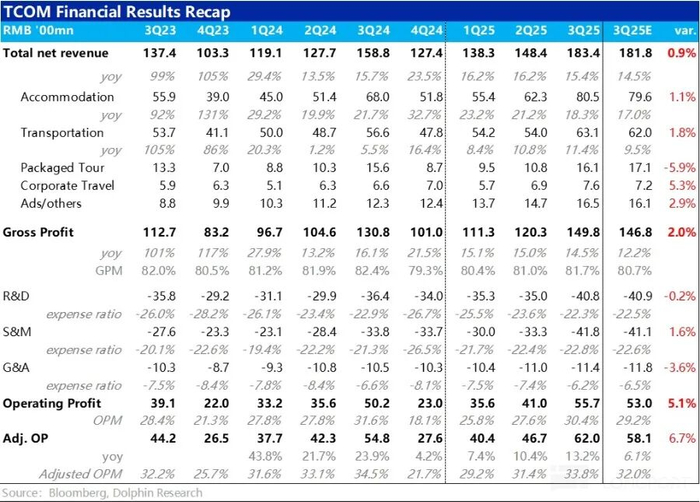
Core Insights - Ctrip Group reported a significant increase in net profit for Q3 2025, reaching RMB 19.9 billion, a year-on-year growth of 194%, marking a rare instance where net profit exceeded revenue [1] - The profit surge was primarily driven by a strategic exit from a cross-border investment, specifically the sale of part of its stake in Indian online travel giant MakeMyTrip, yielding approximately RMB 17 billion [1][4] - Excluding this investment gain, Ctrip's net profit for Q3 was substantially lower than the previous year's RMB 6.8 billion [1] Financial Performance - Total net revenue for Q3 2023 was RMB 13.74 billion, reflecting a year-on-year increase of 99% [2] - Accommodation revenue reached RMB 5.59 billion, up 92% year-on-year, while transportation revenue surged by 705% to RMB 5.37 billion [2] - Operating profit stood at RMB 3.91 billion, with an operating profit margin of 28.4% [2] Investment Strategy - Ctrip's investment in MakeMyTrip began in January 2016 with an investment of USD 180 million in convertible bonds, marking a strategic move into the Indian market [4] - The investment was based on the potential of the Indian market, which was projected to grow significantly, supported by a rising middle class [4] - Ctrip's stake in MakeMyTrip increased over the years, culminating in a sale of shares in June 2025, reducing its voting rights from 45.3% to 16.9% [5][6] Growth Engines - Ctrip identified three main growth engines: AI technology, inbound tourism, and targeted market segmentation [8][9] - The company is leveraging AI to enhance customer service and operational efficiency, with its AI travel assistant TripGenie seeing a user growth of over 200% [8] - Inbound tourism is highlighted as a rapidly growing segment, with significant potential for growth compared to developed countries [9] Market Challenges - Despite strong Q3 performance, the online travel industry faces renewed price competition, particularly with competitors like JD and Douyin entering the market [12] - Ctrip's management emphasized the importance of quality service over price competition, although market trends may challenge this approach [12] - The recovery of international travel remains slow, with global airline capacity only at 88% of pre-pandemic levels, impacting Ctrip's international growth [12] Marketing and Shareholder Returns - Ctrip is adopting a more refined marketing strategy, adjusting spending based on market maturity and channel characteristics [13] - The company announced a new USD 5 billion stock buyback plan, indicating a commitment to shareholder returns amidst market recovery and competition [13]
投资印度版携程9年,携程套现170亿元
21世纪经济报道· 2025-11-21 02:36
Core Viewpoint - Ctrip Group reported a significant increase in net profit for Q3 2025, reaching 19.9 billion RMB, a year-on-year growth of 194%, primarily driven by a strategic exit from its investment in MakeMyTrip, which generated approximately 17 billion RMB in revenue from the sale of shares [1][4]. Investment in MakeMyTrip - Ctrip's investment in MakeMyTrip began in January 2016 with a convertible bond of 180 million USD, marking its entry into the Indian market, which was seen as having high growth potential due to a rapidly rising middle class [4][5]. - The investment was strategically timed, as the IMF projected India's economic growth at 7.5% in 2016, with a significant increase in the middle-class population, providing a strong foundation for tourism consumption [4]. - Over nine years, Ctrip's stake in MakeMyTrip grew, with the book value of the investment reaching 6.2 billion RMB by the end of 2023 and 7.1 billion RMB by the end of 2024, indicating a stable appreciation [5][6]. - In June 2025, Ctrip sold part of its shares in MakeMyTrip for 2.5 to 3 billion USD, reducing its voting rights from 45.3% to 16.9%, transitioning from a strategic to a financial investor [5][6]. Growth Engines - Ctrip's management highlighted three main growth engines: AI technology, inbound tourism, and targeted market segmentation [8][9]. - AI is positioned as a core strategic pillar, with Ctrip's AI travel assistant, TripGenie, expanding its user base significantly, indicating a strong focus on enhancing customer experience through technology [8]. - The inbound tourism sector is identified as a rapidly growing area, with Ctrip noting that China's inbound tourism revenue as a percentage of GDP is significantly lower than that of developed countries, suggesting substantial growth potential [9]. - Ctrip is also focusing on the silver economy, targeting older consumers who have three times the spending power of younger demographics, and has seen significant growth in its "Old Friends Club" membership and transaction volume [9][10]. Market Challenges - Despite strong Q3 performance, the online travel industry faces renewed price competition, with major players like JD and Douyin entering the market [13]. - Ctrip's management emphasized the importance of quality service over price competition, as the market trends indicate a persistent decline in hotel and flight prices [13][14]. - The recovery of international business remains slow, with global airline capacity only at 88% of pre-pandemic levels, which could hinder faster growth for Ctrip's international operations [14]. - Ctrip is adopting a differentiated competitive strategy, including a global SOS service network for customer support and a refined marketing approach based on market maturity [14].

投资“印度版携程”套现170亿元 携程Q3净利暴增194%
2 1 Shi Ji Jing Ji Bao Dao· 2025-11-20 10:58
Core Insights - Ctrip Group reported a significant increase in net profit for Q3 2025, reaching 19.9 billion RMB, a year-on-year growth of 194%, marking a rare instance where net profit exceeded revenue [1] - The profit surge was primarily driven by a strategic exit from a cross-border investment, specifically the sale of part of its stake in Indian online travel giant MakeMyTrip, yielding approximately 17 billion RMB [1][5] - Excluding this investment gain, Ctrip's Q3 net profit was substantially lower than the previous year's 6.8 billion RMB [1] Investment in MakeMyTrip - Ctrip's investment in MakeMyTrip began in January 2016, with an initial investment of 180 million USD in convertible bonds, positioning Ctrip as a significant player in the Indian market [1][2] - The investment was based on the strong growth potential of the Indian economy and the rapid rise of its middle class, which was estimated to have reached 140 million people [2] - MakeMyTrip was already the largest OTA in India at the time of investment, holding a 15% market share in domestic flights and experiencing a 50% growth in hotel revenue [2] Strategic Developments - Ctrip's stake in MakeMyTrip was further solidified through a series of strategic equity operations, culminating in Ctrip holding approximately 49% of the voting rights by the end of 2024 [3] - The investment's value increased over the nine years, with Ctrip reporting a book value of 6.2 billion RMB and 7.1 billion RMB for its stake in MakeMyTrip by the end of 2023 and 2024, respectively [3] - In June 2025, Ctrip sold part of its Class B shares in MakeMyTrip for 2.5 to 3 billion USD, reducing its voting rights from 45.3% to 16.9%, transitioning from a strategic to a financial investor [3][4] Market Position and Future Growth - Despite relinquishing control over MakeMyTrip, Ctrip remains the largest minority shareholder, allowing it to benefit from the growth of the Indian online travel market, which has seen MakeMyTrip achieve over 50% market share in the OTA sector [4] - MakeMyTrip's total gross booking value (GBV) for FY2025 is projected to reach 9.8 billion USD, reflecting a year-on-year growth of 23.1% [4] Ctrip's Growth Engines - Ctrip's management highlighted three key growth engines: AI technology, inbound tourism, and targeted market segmentation [6][7] - The company is leveraging AI to enhance customer service and operational efficiency, with its AI travel assistant, TripGenie, experiencing over 200% user growth in the first half of 2025 [6] - Inbound tourism is identified as a rapidly growing segment, with significant potential for growth compared to developed countries, where inbound tourism revenue constitutes 1% to 5% of GDP [7] Market Challenges - Ctrip faces challenges from intensified price competition in the online travel industry, exacerbated by competitors like JD.com and Douyin [10] - Despite a strong Q3 performance, the overall market conditions remain challenging, with domestic hotel and flight prices showing only slight declines [10] - The recovery of international business is also constrained, with global airline capacity only reaching 88% of pre-pandemic levels, impacting Ctrip's growth potential [10] Competitive Strategy - In response to market challenges, Ctrip is adopting a differentiated competitive strategy, emphasizing high-quality service over price competition [11] - The company has announced a new 5 billion USD stock buyback plan, indicating a commitment to shareholder returns [11] - Ctrip's ongoing investment in technology and customer support services is crucial for maintaining its competitive edge in the evolving travel market [11]