银行改革重组

Search documents
银行直售房,没那么吓人
Ge Long Hui· 2025-11-12 10:55
Core Insights - The recent surge in banks selling properties has raised concerns about the accumulation of non-performing assets within the banking sector [1][2][4] - Data indicates that the number of properties listed for sale by various rural credit systems is substantial, with Guangdong, Sichuan, and other provinces showing significant figures [1][2][6] - Despite the high number of properties being sold, they represent a small fraction of the overall housing inventory in major cities like Guangzhou, Shenzhen, and Chengdu [6][11][9] Summary by Sections Property Sales Data - Since August 2024, the Guangdong rural credit system has listed 12,386 properties for sale, while the Sichuan rural credit system has listed 24,821 properties since November 2024 [1] - Other provinces such as Liaoning, Guizhou, Jilin, and Fujian have also contributed to the total number of properties being sold [1] Market Reaction - The market has reacted with surprise, speculating that banks may be facing a significant amount of non-performing assets [2][4] - The perception is that the properties being sold are just the tip of the iceberg, indicating a larger issue with banks needing to liquidate assets [2] Non-Performing Loans and Asset Management - The sale of properties is often linked to borrowers' inability to repay loans, leading banks to reclaim and sell these assets [3] - The current data suggests that the number of properties being sold is relatively small compared to the total inventory of second-hand homes available in the market [6][11] Trends in Non-Performing Loan Rates - The overall non-performing loan rates for listed banks have been declining since 2020, indicating that banks have been effectively managing and disposing of non-performing assets [12][13] - As of November 2025, the non-performing loan rates for various banks show a downward trend compared to previous years, with many banks reporting lower rates than in 2020 [12][13] Industry Restructuring - The banking sector has undergone significant reforms and consolidations, with over 300 rural banks being merged or restructured in 2025 alone [15] - Major banks have also participated in these consolidations, indicating a strategic move to strengthen their positions and manage non-performing assets more effectively [15] Asset Disposal Efforts - Banks have been actively disposing of non-performing assets, with significant amounts being processed each year [18][20] - In 2025, banks disposed of 1.5 trillion yuan in non-performing assets, reflecting a proactive approach to managing risk [20] - The rural commercial banks have seen the highest non-performing loan rates but have also experienced the most significant reductions in these rates over the years [21][22]


年内首家!这家银行评级被三连降
券商中国· 2025-05-20 11:16
Core Viewpoint - The credit rating of Shanxi Yuci Rural Commercial Bank has been downgraded by China Chengxin International from BB to BB-, marking the first downgrade of a commercial bank's credit rating this year [1][2]. Group 1: Reasons for Downgrade - The bank's non-performing loans have increased rapidly, with a non-performing loan ratio reaching 34.43% and a significant shortfall in loan loss provisions, with a coverage ratio of only 0.38% [2][3]. - Loan growth has been weak, leading to a negative net interest margin of -0.53% and a net loss of 206 million yuan for the year, which is an increase of nearly 110 million yuan year-on-year [2][3]. - The bank is facing severe capital shortages, with core Tier 1 capital adequacy ratio and total capital adequacy ratio at -23.87% and -21.26%, respectively, and many shareholders listed as dishonest [2][3]. Group 2: Historical Context - The bank has experienced three consecutive downgrades since 2021, with its credit rating falling from A+ to BB- over this period [1][4][6]. - The bank's financial reports from 2021 to 2024 have consistently received qualified audit opinions, indicating ongoing financial distress [7]. Group 3: Industry Trends - The trend of downgrading ratings for small and medium-sized banks has been prevalent, with over 10 banks experiencing downgrades annually from 2018 to 2021 [8]. - Recent reforms and mergers in the banking sector aim to mitigate risks and strengthen operational foundations, with local government capital injections becoming more common [8][9]. - The support from local governments is seen as a significant positive factor for banks, potentially leading to improved capital adequacy and credit ratings [9].

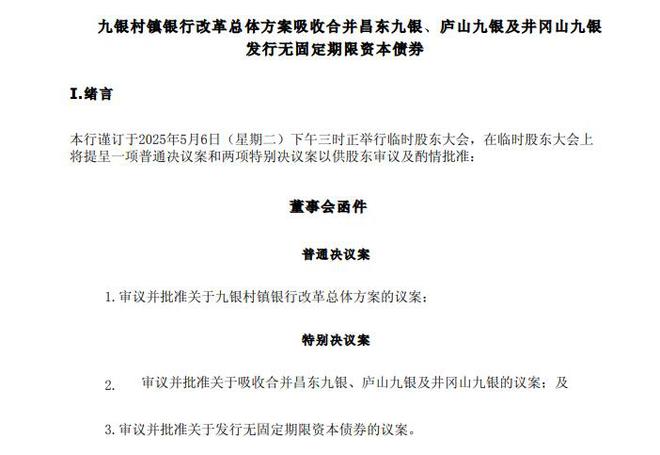
九江银行拟对旗下20家村镇银行开展改革重组,曾因管理不到位致使母行收罚单
Jin Rong Jie· 2025-04-17 09:40
Core Viewpoint - Jiujiang Bank plans to reform and restructure its 20 rural banks under the Jiu Yin brand, aiming to gradually acquire full ownership and convert them into branches of Jiujiang Bank [1][3]. Group 1: Restructuring Plans - The restructuring will involve acquiring shares from other stakeholders in the Jiu Yin rural banks located in Jiangxi province, with the goal of achieving 100% ownership before merging them into branches [3]. - For rural banks outside Jiangxi, Jiujiang Bank will decide on their future based on regulatory requirements, which may include maintaining their current status, acquiring them, or an orderly exit [3]. Group 2: Financial Performance - As of the end of 2024, Jiujiang Bank reported total assets of 516.46 billion yuan, reflecting a 2.50% year-on-year growth, but faced significant pressure on asset quality with non-performing loans (NPLs) rising to 7.01 billion yuan and an NPL ratio of 2.19%, above the industry average [6]. - The bank's net interest income reached 9.171 billion yuan in 2024, an increase of 10.6% year-on-year, driven by reduced interest expenses on liabilities [7]. - However, non-interest income faced challenges, with net commission income declining by 12.9% to 847 million yuan, primarily due to a decrease in wealth management fees [7].