银行核心一级资本补充

Search documents
时隔近5个月威海银行H股定增对象终敲定 核心一级资本充足率连降接近监管红线
Xin Lang Cai Jing· 2025-12-23 01:56
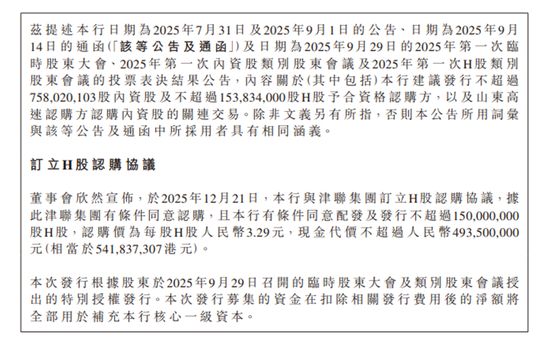
Core Viewpoint - Weihai Bank has announced a subscription agreement with Tianjin Lian Group to issue up to 150 million H-shares, with the net proceeds aimed at supplementing the bank's core Tier 1 capital [1] Group 1: Share Issuance Details - The subscription price for the H-shares is set at RMB 3.29 per share, representing a premium of approximately 17.97% over the closing price of HKD 3.06 on the Hong Kong Stock Exchange on the announcement date [2] - The total cash consideration for the H-shares is expected to be no more than RMB 493.5 million [2] - The proposed issuance of H-shares accounts for about 15.3% of the total H-shares outstanding prior to the issuance [3] Group 2: Capital Adequacy Concerns - As of the end of Q3 this year, Weihai Bank's core Tier 1 capital adequacy ratio stood at 8.02%, which is close to the regulatory minimum requirement of 7.5% as per the "Commercial Bank Capital Management Measures" [2] - The bank's core Tier 1 capital adequacy ratio was reported at 9.31% at the end of last year, indicating a significant decline and an urgent need for capital replenishment [2] Group 3: Previous Issuance Plans - Earlier in July, the bank's board approved a plan to issue up to 760 million domestic shares and up to 150 million H-shares, with the domestic shares expected to raise no more than RMB 2.49 billion [2] - The domestic shares issuance is aimed at existing domestic state-owned shareholders, including Shandong High-speed Group, which plans to participate in the subscription according to its current shareholding ratio [2] Group 4: Investor Background - Tianjin Lian Group, which is under the Tianjin State-owned Assets Supervision and Administration Commission, has been involved in cross-border capital operations and resource integration, and became one of the top ten shareholders of Weihai Bank last year [4]

10月28日起摘牌,“浦发转债”转股比例超99%
Hua Xia Shi Bao· 2025-10-27 11:18
Core Viewpoint - The Shanghai Pudong Development Bank's convertible bond (浦发转债) will be delisted on October 28, marking the end of its conversion period, with a conversion rate reaching 99.67%, significantly higher than market expectations [2][5]. Group 1: Convertible Bond Details - The浦发转债 was issued in November 2019 with a total scale of 50 billion yuan, making it the largest convertible bond issuance at that time [2]. - As of October 27, the未转股 (unconverted) proportion was only 0.33%, indicating a successful conversion process [5]. - The bond faced challenges earlier in the year, with a未转股 proportion of 99.9971% as of March 31, and 49.14% as of September 30 [3]. Group 2: Capital Support and Conversion - Major investors, including China Mobile and China Orient Asset Management, have actively participated in the conversion process, providing capital support to浦发银行 [4][5]. - China Mobile increased its stake in浦发银行 from 17% to 18.18% after converting 56.31 million convertible bonds into 450 million shares [4][5]. - The conversion of浦发转债 is expected to enhance浦发银行's core Tier 1 capital adequacy ratio, which stood at 8.91% as of June 30, 2025 [5]. Group 3: Market Impact - Following the delisting of浦发转债, only six bank convertible bonds will remain in the market, with a total market size reduction of over 90 billion yuan since the beginning of the year [6]. - The trend of convertible bonds in the banking sector has seen no new issuances in 2023, with several bonds exiting the market due to strong redemption clauses being triggered [6][7]. - The conversion of convertible bonds is viewed as a strategic move to bolster banks' capital strength and support business expansion [7].


今年首只支持中小银行专项债即将发行 135亿元“补血”辽宁5家城商行
Xin Hua Wang· 2025-08-12 06:28
Core Viewpoint - The issuance of 13.5 billion yuan special bonds to support small and medium-sized banks in Liaoning Province signifies a continued effort to enhance the capital of local banks, reflecting strong market demand for such financial instruments [1][5]. Group 1: Bond Issuance Details - Liaoning Province will issue 13.5 billion yuan in special bonds on April 14, 2022, aimed at supplementing the capital of five local banks [1][2]. - This issuance marks the third round of special bonds for supporting small and medium-sized banks since last year, indicating ongoing progress and effectiveness in previous rounds [1][3]. Group 2: Fund Utilization - The funds raised from the special bonds will be used to directly supplement the core tier one capital of the banks, a significant advantage over other capital-raising tools like perpetual bonds and subordinated debt [2][6]. - The current round of funding will be allocated to five city commercial banks in Liaoning, with specific capital injections of 2 billion yuan, 3 billion yuan, 3 billion yuan, 2.5 billion yuan, and 3 billion yuan respectively [3][4]. Group 3: Historical Context and Impact - Since the first issuance in May 2021, Liaoning Province has successfully raised 10 billion yuan and 9.6 billion yuan in previous rounds, targeting various banking institutions including newly established city commercial banks and rural financial institutions [3][4]. - The special bonds have been instrumental in enhancing the capital base of over 300 small and medium-sized banks across 20 provinces and municipalities in China, significantly aiding their core tier one capital replenishment [5][6].
这只转债最后交易日!不及时操作,或将亏损约19%
Zhong Guo Zheng Quan Bao· 2025-08-07 23:01
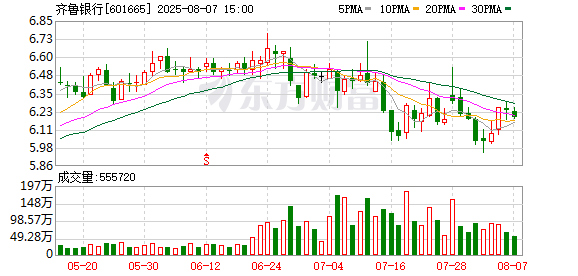
Group 1 - Qilu Bank announced that Qilu Convertible Bonds will be delisted on August 14, following the last trading day on August 8 and the last conversion day on August 13 [1][2] - As of August 7, the market price of Qilu Convertible Bonds was 123.69 CNY per bond, significantly higher than the redemption price of 100.71 CNY per bond, indicating a potential loss of approximately 19% for investors who do not convert or sell in time [1][2] - The early redemption was triggered due to the underlying stock price rising, with Qilu Bank's stock price increasing nearly 16% year-to-date as of August 7 [2][3] Group 2 - This year, five bank convertible bonds have triggered early redemption clauses, with Qilu Convertible Bonds being the latest [3] - The banking sector has shown strong performance, with the Shenwan Primary Bank Index rising over 14% this year, and several banks, including Pudong Development Bank and Agricultural Bank, experiencing significant stock price increases [3] - The issuance of bank convertible bonds is seen as an important tool for capital replenishment, providing advantages such as easier issuance and lower financing costs [3] Group 3 - According to estimates, after the conversion of Qilu Convertible Bonds, Qilu Bank's core Tier 1 capital adequacy ratio is expected to reach 11.62% by 2025, an increase of 0.87 percentage points from 2024 [4]

明天,这只转债最后交易日!不及时操作,或将亏损约19%
Zhong Guo Zheng Quan Bao· 2025-08-07 15:25
Core Points - Qilu Bank's convertible bond (Qilu Convertible Bond) will be redeemed early, with the last trading day on August 8 and delisting on August 14 [1][2] - As of August 7, the market price of Qilu Convertible Bond was 123.69 CNY per share, significantly higher than the redemption price of 100.71 CNY per share, indicating a potential loss of approximately 19% for investors who do not convert or sell in time [1][2] - The bond was originally set to mature in 2028 but triggered the early redemption clause due to the underlying stock price rising above 130% of the conversion price for 15 trading days [2][3] Company Summary - Qilu Bank's stock price has increased nearly 16% year-to-date as of August 7, contributing to the bond's early redemption [2][3] - The unconverted balance of Qilu Convertible Bond is 453 million CNY, with an unconverted ratio of 5.67% [2] - The bank has warned investors about the significant potential losses if they fail to convert or sell their bonds within the specified timeframe [2] Industry Context - This year, five bank convertible bonds have triggered early redemption clauses, indicating a trend in the banking sector [3] - The Shanghai Securities Index for the banking sector has risen over 14% this year, with several banks experiencing substantial stock price increases, such as Pudong Development Bank (40%) and Agricultural Bank (30%) [3] - Convertible bonds are viewed as an important tool for banks to supplement core Tier 1 capital, with advantages including easier issuance and lower financing costs [3][4]
明天 这只转债最后交易日!不及时操作 或将亏损约19%
Zhong Guo Zheng Quan Bao· 2025-08-07 15:24
Core Points - Qilu Bank's convertible bond (Qilu Convertible Bond) will be delisted from the Shanghai Stock Exchange on August 14, following its last trading day on August 8 and last conversion day on August 13 [2][3] - As of August 7, the market price of Qilu Convertible Bond was 123.69 CNY per share, significantly higher than the redemption price of 100.71 CNY per share, indicating a potential loss of approximately 19% for investors who do not convert or sell in time [2][3] - The bond was originally set to mature in 2028 but was triggered for early redemption due to the underlying stock price rising, with the stock closing above 130% of the conversion price for 15 trading days between June 3 and July 4 [3] Market Context - This year, five bank convertible bonds have triggered early redemption clauses, reflecting a broader trend in the banking sector [4] - The Shenwan Primary Bank Index has risen over 14% this year, with several banks, including Pudong Development Bank and Agricultural Bank, seeing significant stock price increases [4] - Two bank convertible bonds are set to mature this year, with the Citic Convertible Bond already delisted in March and the Pudong Convertible Bond expected to be delisted in October [5] Capital Implications - Bank convertible bonds are viewed as an important tool for capital replenishment, offering advantages such as easier issuance and lower financing costs [5] - Following the conversion of Qilu Convertible Bond, it is estimated that Qilu Bank's core Tier 1 capital adequacy ratio will reach 11.62% by 2025, an increase of 0.87 percentage points from 2024 [5]
国有大行定增再迎新进展中国银行、交通银行已完成缴款验资
Zheng Quan Ri Bao· 2025-06-15 15:54
Group 1 - The core viewpoint is that major state-owned banks in China are progressing with capital increases through targeted stock issuances to enhance their core tier one capital, which is crucial for supporting future business development [1][2]. - China Bank has completed a targeted issuance of A-shares, raising a total of 165 billion yuan, fully subscribed by the Ministry of Finance, aimed at increasing its core tier one capital [1]. - The Bank of Communications has also completed a targeted issuance of approximately 14.1 billion A-shares at a price of 8.51 yuan per share, raising a total of 120 billion yuan, which will be used to supplement its core tier one capital [1]. Group 2 - The government has proposed issuing special treasury bonds worth 500 billion yuan to support the capital replenishment of major state-owned commercial banks [1]. - Other banks, such as China Construction Bank and Postal Savings Bank, are also in the process of capital increases, with Construction Bank's application for targeted A-share issuance approved by the Shanghai Stock Exchange [2]. - Analysts believe that capital market replenishment of core tier one capital will help banks meet regulatory requirements, enhance risk resilience, and support sustainable business development [2]. Group 3 - The pricing of the capital increases complies with the regulations set by the China Securities Regulatory Commission, ensuring that the issuance price is not lower than 80% of the average trading price of the stock over the previous 20 trading days, with a premium issuance achieved [3]. - The premium issuance is designed to balance the interests of new and existing shareholders, maximize the benefits for all parties, and positively influence market confidence and bank stock valuations [3].


三大国有行,集体宣布!
券商中国· 2025-05-24 09:50
Core Viewpoint - The article discusses the approval of A-share stock issuance by China Bank, Bank of Communications, and Postal Savings Bank to specific investors, aimed at raising capital to strengthen their core tier one capital [1][2]. Group 1: Stock Issuance Details - On March 30, the three banks announced plans to raise funds through A-share stock issuance, with total fundraising amounts of up to RMB 165 billion for China Bank, RMB 120 billion for Bank of Communications, and RMB 130 billion for Postal Savings Bank [4]. - The specific investors for these issuances include the Ministry of Finance, China Tobacco, and other entities, with subscription amounts detailed for each [4]. Group 2: Ownership Changes - Following the issuance, the Ministry of Finance will hold over 30% of Bank of Communications, making it the controlling shareholder, whereas the bank previously had no controlling shareholder or actual controller [5]. Group 3: Capital Utilization - The funds raised will be used entirely to supplement core tier one capital after deducting related issuance costs [6]. - The government plans to issue special treasury bonds worth RMB 500 billion to support state-owned commercial banks in capital replenishment, as part of a broader policy to enhance their risk resilience and credit capacity [6][8]. Group 4: Impact on Capital Adequacy - As of the end of 2024, the core tier one capital adequacy ratios of the major state-owned banks, except for Bank of Communications, have shown improvements compared to mid-2024 [7]. - Post-capital increase, Bank of Communications and Postal Savings Bank expect their core tier one capital adequacy ratios to rise by 1.28 percentage points and 1.51 percentage points, respectively, reaching 11.52% and 11.07% [7]. Group 5: Economic Support - The article emphasizes that enhancing the core tier one capital of state-owned banks is crucial for their stable operation and ability to support the real economy, thereby boosting market confidence [8]. - Financial authorities assert that the overall health of the six major state-owned banks is stable, with sufficient provisions and key indicators within a "healthy range," which supports the initiative to increase their core tier one capital [8].


证监会批复同意!三大行,集体宣布!
证券时报· 2025-05-24 09:20
Core Viewpoint - The article discusses the approval of A-share stock issuance by major Chinese banks, specifically Bank of China, Bank of Communications, and Postal Savings Bank, to raise capital for enhancing their core tier one capital levels [1][5]. Group 1: Stock Issuance Details - On May 23, the China Securities Regulatory Commission approved the application for A-share stock issuance by Bank of Communications [1][3]. - The total fundraising amounts for the three banks are capped at RMB 165 billion for Bank of China, RMB 120 billion for Bank of Communications, and RMB 130 billion for Postal Savings Bank [5]. - The issuance targets include the Ministry of Finance and other entities, with specific subscription amounts detailed for each bank [5][6]. Group 2: Capital Enhancement Purpose - The funds raised will be used exclusively to supplement core tier one capital after deducting issuance costs [7]. - The government plans to issue special treasury bonds worth RMB 500 billion to support state-owned commercial banks in capital replenishment [7][10]. - The core tier one capital is crucial for banks' operations and risk management, and the government aims to enhance banks' ability to serve the real economy [10][11]. Group 3: Capital Adequacy Ratios - As of the end of 2024, the core tier one capital adequacy ratios for major state-owned banks have improved, with China Construction Bank showing the highest increase of 0.47 percentage points to 14.48% [8][9]. - Post-issuance, the core tier one capital adequacy ratios for Bank of Communications and Postal Savings Bank are projected to rise by 1.28 percentage points and 1.51 percentage points, respectively, reaching 11.52% and 11.07% [9]. Group 4: Market Impact and Future Outlook - The capital injection is expected to enhance the market competitiveness and operational management of the four major state-owned banks, supporting stable growth in their performance [11]. - The state-owned banks are viewed as a stabilizing force in the financial system, and the capital increase will bolster their credit issuance capabilities, thereby reinforcing their role in supporting the real economy [11].