银行网点优化

Search documents
2025年逾1万家银行网点关闭 降本增效同时还需做好服务
Zhong Guo Zheng Quan Bao· 2026-01-12 23:20
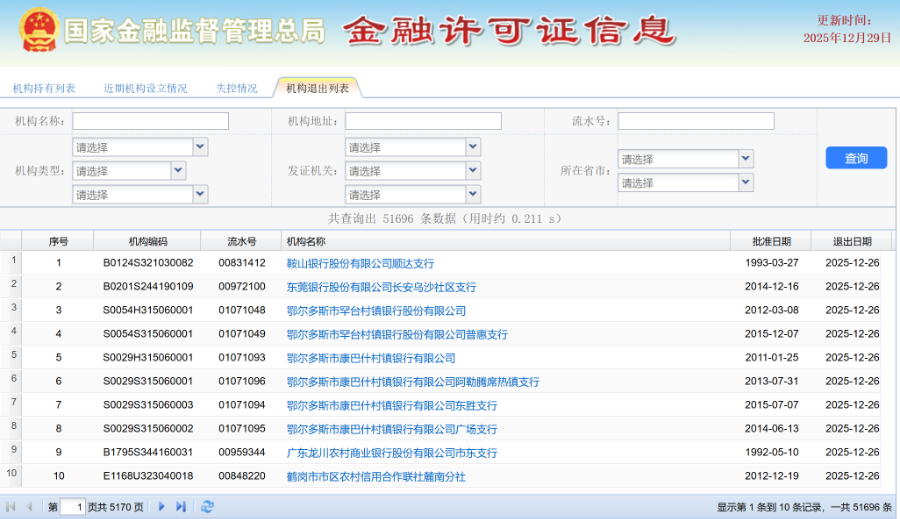
Core Insights - The number of bank branches in China is projected to decrease by over 2,000 in 2025, with more than 11,000 branches approved for closure and over 8,400 new branches approved for establishment [1][2]. Group 1: Bank Branch Reductions - The reduction in bank branches is primarily driven by the reform of small financial institutions and the proactive closure of inefficient branches by banks [1]. - Rural credit cooperatives and village banks are the main contributors to the decline, with approximately 2,200 rural credit cooperative branches and nearly 1,000 village bank branches closing [2]. - The ongoing reform of provincial rural commercial banks and the consolidation of small financial institutions are significant factors in the branch reductions [2]. Group 2: Large Bank Branch Changes - Both state-owned and joint-stock banks have experienced a net decrease in branch numbers, with state-owned banks opening around 300 new branches while closing over 700, and joint-stock banks opening over 200 while closing more than 300 [3]. - The decline in physical branches is attributed to the shift in customer behavior towards digital banking, with over 90% of basic services now conducted online, leading to a significant drop in counter service demand [3]. Group 3: Operational Costs and Efficiency - The operational costs of bank branches are notably high, with annual costs in third-tier cities reaching several million yuan [4]. - Many secondary branches, which primarily handle liabilities and personal business, have limited profitability but still incur average operational costs, often resulting in losses [4]. Group 4: Service Optimization and Social Responsibility - While closing inefficient branches can enhance profitability, banks must also consider the hidden value of branches in brand representation and customer service [5]. - To address the challenges posed by branch closures, banks are encouraged to develop a comprehensive service network that includes online, offline, and mobile services, particularly for elderly and rural customers [5][6]. - Recommendations include creating user-friendly apps for older adults, establishing financial service points in communities, and ensuring that essential services remain accessible to vulnerable groups [5][6].
银行网点“优化”:去年净增623家 近三年首次转正
2 1 Shi Ji Jing Ji Bao Dao· 2026-01-04 08:24
Core Viewpoint - The transformation of the banking industry in 2025 is evolving from superficial adjustments of branches to deeper structural optimization, characterized by a precise "slimming and strengthening" action, which involves shutting down inefficient branches while reconstructing offline value through specialized layouts [1]. Group 1: Branch Closures and Openings - In 2025, a total of 7,871 offline branches of commercial banks were closed, while 8,494 new branches were established, resulting in a net increase of 623 branches, marking the first positive growth in branch numbers in three years [1][5]. - The closure of branches accelerated in 2024, with 2,483 branches shut down compared to 2,649 in 2023, indicating that the total number of closed branches in the past year exceeded the sum of the previous two years [3]. - The highest number of branch closures due to regulatory approvals for mergers or dissolutions occurred in Inner Mongolia, totaling 2,400 branches, primarily due to the large-scale integration of local rural credit systems [3]. Group 2: Impact of Digital Banking - The rise of mobile and online banking has led to a significant decline in business volume at traditional branches, particularly in cash and basic counter services, with some branches experiencing a year-on-year decrease of over 70% in counter business [4]. - The operational cost of a single traditional branch can reach several million yuan annually, while the corresponding business volume has been declining, leading to a serious cost-revenue imbalance [4]. Group 3: Future Branch Strategies - Banks are focusing on transforming their branch networks into comprehensive, ecological, and intelligent service points, with an emphasis on technology and data empowerment to enhance customer service [5]. - The banking sector is shifting from "quantity expansion" to "structural optimization," with a focus on reducing physical branches to control operational costs while investing in intelligent and experiential branches [7]. - Over 90% of branches have implemented smart teller machines, and some have introduced remote video customer service and VR experience areas, indicating a trend towards integrating technology into banking services [7]. Group 4: Regulatory Guidance and Market Trends - The financial regulatory authority has stated that it will guide banks to ensure the supply of physical branches in rural areas while balancing economic and social benefits, avoiding both excessive competition and financial exclusion [8]. - The trend of establishing specialized branches is seen as a way for banks to build their brand and customer loyalty, although challenges such as high costs and variable usage rates exist [8]. - The future of bank branches is envisioned as interactive points for customer engagement and brand representation, rather than mere transaction locations [8][10].