
网点转型

Search documents
银行网点“优化”:去年净增623家 近三年首次转正
2 1 Shi Ji Jing Ji Bao Dao· 2026-01-04 08:24
Core Viewpoint - The transformation of the banking industry in 2025 is evolving from superficial adjustments of branches to deeper structural optimization, characterized by a precise "slimming and strengthening" action, which involves shutting down inefficient branches while reconstructing offline value through specialized layouts [1]. Group 1: Branch Closures and Openings - In 2025, a total of 7,871 offline branches of commercial banks were closed, while 8,494 new branches were established, resulting in a net increase of 623 branches, marking the first positive growth in branch numbers in three years [1][5]. - The closure of branches accelerated in 2024, with 2,483 branches shut down compared to 2,649 in 2023, indicating that the total number of closed branches in the past year exceeded the sum of the previous two years [3]. - The highest number of branch closures due to regulatory approvals for mergers or dissolutions occurred in Inner Mongolia, totaling 2,400 branches, primarily due to the large-scale integration of local rural credit systems [3]. Group 2: Impact of Digital Banking - The rise of mobile and online banking has led to a significant decline in business volume at traditional branches, particularly in cash and basic counter services, with some branches experiencing a year-on-year decrease of over 70% in counter business [4]. - The operational cost of a single traditional branch can reach several million yuan annually, while the corresponding business volume has been declining, leading to a serious cost-revenue imbalance [4]. Group 3: Future Branch Strategies - Banks are focusing on transforming their branch networks into comprehensive, ecological, and intelligent service points, with an emphasis on technology and data empowerment to enhance customer service [5]. - The banking sector is shifting from "quantity expansion" to "structural optimization," with a focus on reducing physical branches to control operational costs while investing in intelligent and experiential branches [7]. - Over 90% of branches have implemented smart teller machines, and some have introduced remote video customer service and VR experience areas, indicating a trend towards integrating technology into banking services [7]. Group 4: Regulatory Guidance and Market Trends - The financial regulatory authority has stated that it will guide banks to ensure the supply of physical branches in rural areas while balancing economic and social benefits, avoiding both excessive competition and financial exclusion [8]. - The trend of establishing specialized branches is seen as a way for banks to build their brand and customer loyalty, although challenges such as high costs and variable usage rates exist [8]. - The future of bank branches is envisioned as interactive points for customer engagement and brand representation, rather than mere transaction locations [8][10].

淮安农商银行召开网点转型工作启动推进会
Jiang Nan Shi Bao· 2025-09-18 08:11
Core Viewpoint - The article discusses the strategic transformation of Huai'an Rural Commercial Bank's branch network to enhance competitiveness and service quality in response to market demands and internal development challenges [1][2]. Group 1: Transformation Objectives - The transformation of the branch network is a practical measure to implement the decisions of the Jiangsu Rural Commercial Bank's leadership, aimed at addressing market competition and customer demand changes [2]. - The goal is to reshape the branch structure to enhance operational capacity and improve financial service quality, thereby solidifying the bank's position as a leading rural financial institution [2]. Group 2: Strategic Focus Areas - The bank aims to create new types of branches that are intelligent, lightweight, sales-oriented, and experience-focused, with a strategic upgrade in functionality, service models, and operational management [2]. - The transformation will involve a shift from transaction processing to service marketing, from decentralized operations to centralized efficiency, and from passive service to proactive engagement over a three-year period [2]. Group 3: Implementation Approach - A comprehensive evaluation of branch effectiveness will be conducted to categorize and assess all branches, creating a roadmap for transformation [2]. - A leadership group will oversee the transformation process, ensuring collaboration across departments, optimizing physical branch layouts, and enhancing online service capabilities [2]. - The bank emphasizes a smooth and orderly transition, adhering to compliance standards and developing replicable transformation models through scientific pilot testing [2].
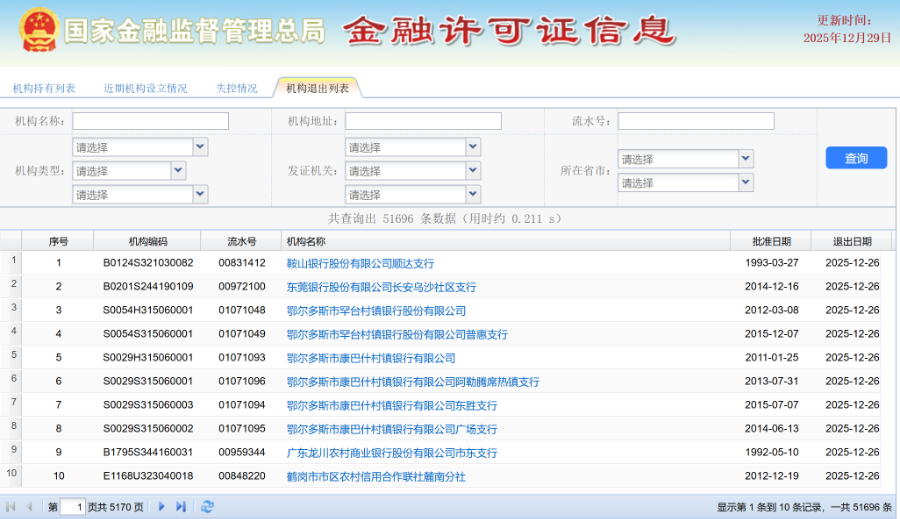
上半年超2600家网点退出
Zhong Guo Jing Ying Bao· 2025-07-10 02:12
Core Viewpoint - The rapid decline of physical bank branches in China is driven by the shift towards online banking, cost-cutting measures, and the integration of financial technology, leading to a significant transformation in the banking sector's operational model [1][2][3]. Group 1: Bank Branch Exit Statistics - As of June 2023, 2,677 bank branches have been approved for closure, surpassing the total number of closures in 2022 (2,483 branches) [1]. - The majority of branch closures are attributed to cost-effectiveness pressures, with individual branch operating costs ranging from 2 million to 5 million yuan, and total costs nearing 10 million yuan when including staffing [2]. Group 2: Customer Behavior and Digital Transformation - Customer behavior is increasingly shifting online, with mobile banking and corporate online banking users reaching 88%, and over 90% of high-frequency transactions being conducted online [2]. - The foot traffic in physical branches has decreased by 60% over the past five years, indicating a significant migration to digital channels [2]. Group 3: Reasons for Branch Closures - The closure of branches is primarily due to insufficient customer traffic and overlapping service areas, with over 60% of closed branches categorized as low-efficiency [2]. - The restructuring and merging of small banks, particularly rural commercial banks, are also contributing factors, with 89 village banks absorbed by their parent institutions in the first half of 2025 [2]. Group 4: Future Development of Bank Branches - Future bank branches are expected to transition from transaction processing to enhancing customer experience, incorporating remote video advisors and smart terminals [4]. - The focus of bank operations will shift towards high-net-worth client wealth management and complex services for small and medium-sized enterprises [4]. - Banks will also explore innovative forms such as metaverse banking and AI customer service, aiming for a seamless integration of online and offline services [4]. Group 5: Importance of Physical Branches - Despite the reduction in physical branches, they remain essential for combining online and offline services, providing community financial services with a human touch [5].