
银行股增持潮

Search documents
南京银行再获股东增持 江苏交控持股拟增至15%以上
Zhong Guo Ji Jin Bao· 2026-02-11 09:36
Group 1 - Nanjing Bank's shareholder Jiangsu Communications Holding Co., Ltd. plans to increase its stake from over 10% to over 15%, pending regulatory approval [2][3] - The board of directors of Nanjing Bank unanimously approved this proposal during a meeting on February 10 [3] - Recently, another shareholder, Zijin Group, also increased its stake in Nanjing Bank, raising its ownership from 13.02% to 14.02% [3] Group 2 - Nanjing Bank reported total assets of 30,224.24 billion yuan, a 16.63% increase from the previous year [5] - The bank's total deposits reached 16,707.89 billion yuan, up 11.67%, and total loans amounted to 14,243.56 billion yuan, increasing by 13.37% [5] - The bank achieved an operating income of 55.54 billion yuan, a year-on-year growth of 10.48%, and a net profit attributable to shareholders of 21.81 billion yuan, up 8.08% [5] Group 3 - Nanjing Bank's non-performing loan ratio stood at 0.83%, with a provision coverage ratio of 313.31% as of the reporting period [6] - The banking sector is experiencing a trend of increased shareholding, with several banks, including Nanjing Bank, announcing buyback plans [6] - Analysts expect the banking sector to continue to see valuation improvements, supported by stable macro-financial conditions and a recovery in income and profitability [6][7]


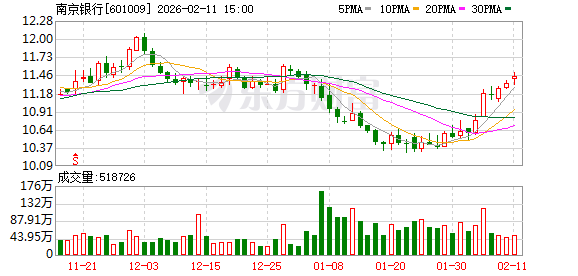
南京银行再获股东增持,江苏交控持股拟增至15%以上
Zhong Guo Ji Jin Bao· 2026-02-11 09:21
Group 1 - Jiangsu Transportation Holding Co., Ltd. plans to increase its stake in Nanjing Bank from over 10% to over 15%, pending regulatory approval [1][2] - The board of directors of Nanjing Bank unanimously approved this proposal during a meeting on February 10 [2] - Recently, Nanjing Bank also received an increase in shareholding from its existing shareholder, Zijin Group, which raised its stake from 13.02% to 14.02% [2] Group 2 - Nanjing Bank reported total assets of 30,224.24 billion yuan, a year-on-year increase of 16.63% [3] - The bank's total deposits reached 16,707.89 billion yuan, growing by 11.67% year-on-year, while total loans increased by 13.37% to 14,243.56 billion yuan [3] - The bank achieved an operating income of 55.54 billion yuan, a year-on-year growth of 10.48%, and a net profit attributable to shareholders of 21.81 billion yuan, up 8.08% [3] Group 3 - Nanjing Bank's non-performing loan ratio stood at 0.83%, with a provision coverage ratio of 313.31% as of the reporting period [4] - The banking sector is experiencing a trend of increased shareholding, with several banks, including Nanjing Bank, announcing buyback plans [4] - Analysts expect the banking sector to see valuation improvements due to stable macro-financial conditions and a reassessment of systemic risks [4]
增持不停歇!银行股成“香饽饽”,大股东、高管“真金白银”组团力挺
Bei Jing Shang Bao· 2025-11-25 13:37
Core Viewpoint - A surge in share buybacks by listed banks in China's A-share market is observed, driven by strong confidence from major shareholders and management teams in the banks' future prospects and the current undervaluation of bank stocks [1][5][6] Group 1: Share Buyback Activities - Numerous listed city commercial banks and rural commercial banks, including Nanjing Bank, Suzhou Rural Commercial Bank, Chengdu Bank, and others, have disclosed their share buyback progress since November [1][3] - Chengdu Bank reported that its major shareholders, Chengdu Industrial Capital Holding Group and Chengdu Xintianyi Investment, have cumulatively increased their holdings by 14.04 million shares, amounting to 253 million yuan [3][4] - Nanjing Bank's major shareholder, BNP Paribas, increased its stake by 128 million shares, raising its total holding from 17.02% to 18.06% [4] Group 2: Financial Performance and Market Sentiment - The banking sector's fundamentals remain robust, with commercial banks achieving a net profit of 1.9 trillion yuan in the first three quarters, and 24 listed banks announcing a total cash dividend of 263.79 billion yuan [5][6] - The stock prices of several banks have reached historical highs, with Agricultural Bank of China seeing a year-to-date increase of nearly 60% [6][7] - Analysts suggest that the current buyback trend reflects internal confidence in the banks' future and signals to the market that their value is underestimated [5][7] Group 3: Future Outlook - The ongoing recovery in the macroeconomic environment is expected to support the banking sector's performance, with analysts highlighting the importance of sustained economic recovery, interest rate changes, and long-term capital inflows for future stock performance [7][8] - Investors are advised to maintain a long-term perspective and focus on banks with strong fundamentals, emphasizing the importance of asset quality, profitability, and dividend policies [7][8]

外资大股东再度增持南京银行,持股比例创历史新高
Sou Hu Cai Jing· 2025-11-24 01:39
Core Viewpoint - International financial capital is showing confidence in China's regional banks, particularly Nanjing Bank, through significant share purchases by major shareholders [5][6][10] Group 1: Shareholder Actions - On November 21, Nanjing Bank announced that its largest shareholder, BNP Paribas, increased its stake by approximately 12.8 million shares, raising its total holding from 17.02% to 18.06%, marking a historical high [5] - BNP Paribas had previously increased its stake in Nanjing Bank from 16.14% to 17.02% between September 22 and 26, 2025 [5] - Other major shareholders, including Zijin Group and Nanjing Gaoke, have also made significant purchases, with Zijin Trust increasing its stake from 12.56% to 13.02% and Nanjing Gaoke investing 1.684 billion yuan to acquire 14.8 million shares, nearing the threshold for a mandatory bid [6][7] Group 2: Market Trends - The trend of increasing stakes in Nanjing Bank is part of a broader movement among listed banks, with several banks like Chengdu Bank and Qingdao Bank also announcing share purchases by their major shareholders [8] - Chengdu Industrial Capital Group increased its stake in Chengdu Bank by 14.04 million shares, investing 253 million yuan, while Qingdao Guoxin Financial Holdings acquired 243 million H-shares of Qingdao Bank for approximately 957 million yuan [8] Group 3: Long-term Value Perspective - The continuous share purchases by major shareholders provide strong support for Nanjing Bank's stock price, which rose by 12.39% from September 22 to November 21, 2025, despite a broader market decline [9] - The current A-share market is shifting from high-growth to low-valuation, high-dividend sectors, with bank stocks being attractive due to their low valuation and high dividend yield, estimated at around 4.3% for mainland bank stocks [9][10] - The wave of share purchases reflects a transformation in the valuation logic of bank stocks, with investors increasingly focusing on structural advantages such as customer base, regional economic resilience, asset quality stability, and effective corporate governance [10]

浦发银行半月获股东三度增持 银行股“资本投票”潮已至?
Jing Ji Guan Cha Wang· 2025-10-26 12:05
Group 1 - China Mobile increased its stake in Shanghai Pudong Development Bank through convertible bonds, raising its ownership from 17.00% to 18.18% between October 10 and October 24, 2025 [1][2] - The stake increase occurred in three separate transactions on October 13, 17, and 24, each crossing the 1% disclosure threshold, reflecting a strategic management of shareholding [1][2] - The transactions involved a total of 450,156,195 shares, 149,805,835 shares, and 118,611,350 shares being converted from convertible bonds [1] Group 2 - Other major shareholders in the banking sector have also been increasing their stakes, indicating a growing confidence in the banking industry [2] - Postal Savings Bank's major shareholder increased its stake by 19.91 million shares, with plans for further increases within the next 12 months [2] - The trend of increasing stakes is not limited to large banks, as regional banks like Qingdao Bank and Suzhou Bank have also seen significant increases from local state-owned enterprises [3][4] Group 3 - The current wave of bank share increases is characterized by diverse stakeholders, including local state-owned platforms, central state-owned enterprises, foreign institutional investors, and industrial capital [5] - The increases are primarily funded by self-owned capital, with a general commitment to long-term holding, particularly in regional banks in economically active areas [5] - This trend reflects a broader restructuring logic within the financial system, as stakeholders publicly endorse the long-term value of banks through their investments [5][6] Group 4 - The recent increase in bank shares indicates a shift in valuation logic, moving from short-term profit fluctuations to a focus on structural advantages such as customer base, regional economic resilience, and asset quality stability [6] - Banks with these characteristics are becoming attractive to long-term investors, serving as a stabilizing force in the financial market [6]
