锂三角

Search documents
碳酸锂行情日报:锂三角旧闻翻炒,锂电池终于涨价
鑫椤锂电· 2026-01-13 08:46
Market Trends - On January 13, the spot settlement price for battery-grade lithium carbonate (99.5%) was 160,500 CNY/ton, an increase of 8,500 CNY from the previous working day, with limited actual transaction volume as downstream procurement remains cautious [1] - The settlement price for battery-grade lithium hydroxide (56.5% coarse particles) was 138,000 CNY/ton, up 8,000 CNY from the previous working day [1] - The futures market saw lithium carbonate futures open higher on January 13, with the main contract closing at 166,980 CNY/ton, an increase of 11,560 CNY from the previous working day, while the position volume decreased [1] Price Changes - The average price level for lithium iron phosphate battery cells indicates that the terminal's tolerance for lithium carbonate prices is around 155,000 CNY [4] - The ICC lithium battery settlement prices for January 12 and 13 show a rise in prices for various lithium products, including lithium carbonate and lithium hydroxide, with specific increases noted [2] Industry Focus - Tianhua New Energy announced plans to complete the construction of the ceramic soil (containing lithium) mine in Jiangxi Jinzifeng - Yifeng County by the first half of 2027, aiming to achieve mining production in the second half of the year [5] Lithium Market Sentiment - Recent rumors about the formation of a "Lithium Triangle" in South America have surfaced, suggesting a shift from market supply-demand pricing to alliance pricing and quota bidding. However, 95% of surveyed companies believe the likelihood of this happening is low [6] Lithium Supply Data - In December 2025, Chile exported 18,341 tons of lithium carbonate, a month-on-month increase of 2.1% but a year-on-year decrease of 8.68%. Exports to China were 11,705 tons, down 20.34% month-on-month and 12.41% year-on-year [7] Market Outlook - The ICC Xinluo Insights suggest that since the fourth quarter of 2025, lithium carbonate prices have doubled, with ongoing price increases leading to heightened market divergence. The global lithium resource situation is expected to remain tight in 2026, with demand elasticity continuing to rise [10]

玻利维亚总统候选人竟嚷嚷:当选后,要搅黄中俄锂矿交易
Guan Cha Zhe Wang· 2025-08-26 09:15
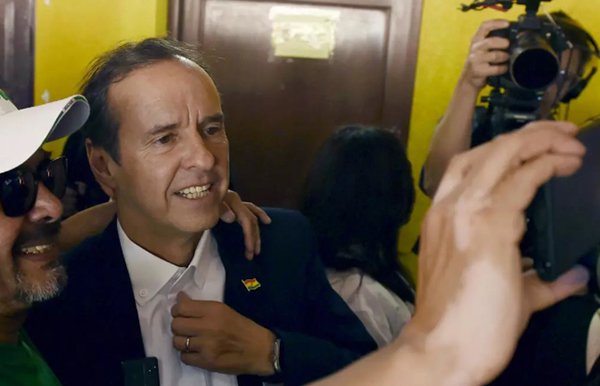
Core Viewpoint - The upcoming Bolivian presidential election is marked by a significant shift in political dynamics, with former president Jorge Quiroga of the "Liberty" alliance campaigning on an anti-China and anti-Russia platform, threatening to annul multi-billion dollar lithium mining agreements if elected [1][3]. Group 1: Election Context - The first round of voting concluded on August 17, with Rodrigo Paz Pereira and Jorge Quiroga leading with approximately 32% and 26.7% of the votes, respectively [1][3]. - According to Bolivian law, candidates must secure over 50% of the votes or at least 40% with a 10-point lead over the second candidate to win, necessitating a second round between Quiroga and Pereira on October 19 [3]. Group 2: Political Landscape - The ruling "Movement for Socialism" party faced a historic collapse, with its candidate Eduardo del Castillo receiving only 3.16% of the votes, resulting in a significant loss of congressional seats [3][4]. - Former president Evo Morales's exclusion from the election due to term limits and his subsequent call for invalid votes contributed to the left's political decline [4][5]. Group 3: Economic Factors - Bolivia's lithium resources, estimated at 23 million tons, are crucial for the country's economic future, especially as the nation faces severe economic challenges, including dwindling dollar reserves and soaring inflation [5][7]. - The current government has signed lithium extraction agreements valued at approximately $2 billion with Russian and Chinese companies, which are now under scrutiny due to political opposition [7][8]. Group 4: Future Challenges - Regardless of the election outcome, the new government will confront significant economic challenges, including a drop in foreign reserves from $15.12 billion in 2014 to $2.807 billion in 2023, and an inflation rate of 24% as of June 2025, the highest in 34 years [8][9]. - The potential for social unrest is high if economic conditions do not improve, as public patience may quickly diminish [9].