长线资金配置

Search documents
不止于年末“日历效应”,红利真正的价值在于长线
Sou Hu Cai Jing· 2025-12-05 02:33
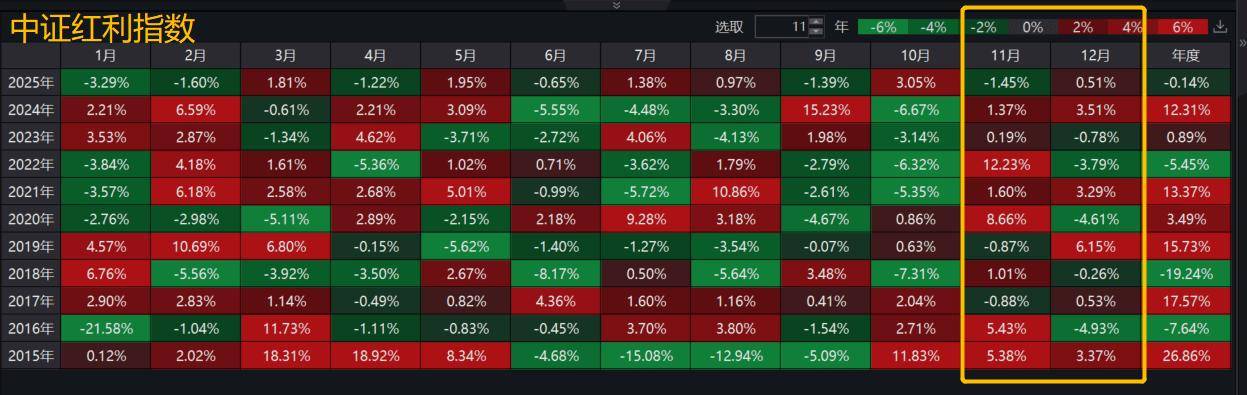
Core Viewpoint - As the year-end approaches, the market is becoming cautious, leading to a resurgence in high-dividend assets, with funds shifting towards these investments [1] Group 1: Market Trends - On December 4, the CSI Dividend ETF (515080) saw a net inflow of 37.94 million yuan, while the Hong Kong Dividend Low Volatility ETF (520550) attracted 30.04 million yuan, marking its 11th consecutive day of inflows, totaling nearly 100 million yuan [1] - Institutional investors are typically shifting towards defensive, stable dividend assets to lock in annual returns, indicating a growing preference for these investments [1] - Historical data shows that the CSI Dividend Total Return Index has an 80% probability of closing positive in November and a 50% probability in December since 2015, demonstrating a seasonal "calendar effect" [1][2] Group 2: Long-term Investment Value - Despite underperforming mainstream indices over the past year, dividend assets have shown strong resilience in the long term, outperforming the 300 and 50 indices over three and ten years [4] - The annualized return of dividend assets over the past five years has been 10%, primarily driven by shareholder returns, with price contributions at only 4% [5] Group 3: Dividend Yield and Economic Environment - The current low interest rate environment in China has led to a decline in long-term rates, with the latest 10-year government bond yield at 1.87%, while the CSI Dividend Index has a yield of 4.87% and the Hong Kong Dividend Low Volatility Index at 6.61% [7][8] - The attractiveness of dividend indices, with yields between 4% and 7%, is heightened by the decreasing risk-free return from government bonds [8] Group 4: Index Adjustments and Composition - Dividend indices typically undergo semi-annual or annual rebalancing to maintain their vitality, with the recent adjustments including the addition of strong sectors like metals and banking while removing weaker sectors like steel and real estate [9][10] - The average dividend yield of newly included stocks is expected to be 4.15%, compared to 3.89% for those being removed, indicating an enhancement in investment value [10] Group 5: Dividend Growth Trends - The trend of regular dividends has become established in A-shares since the implementation of the "New National Nine" policies, with the CSI Dividend Index constituents projected to distribute over 92 billion yuan in dividends in 2024, marking a historical high [12][13] - The Hong Kong Dividend Low Volatility Index has also shown a consistent increase in total dividends, exceeding 100 billion yuan for three consecutive years [14]