长远思维

Search documents
今日视点:“五个必须”定方向 政策协同稳大局
Xin Lang Cai Jing· 2025-12-14 23:05
Core Viewpoint - The Central Economic Work Conference held on December 10-11 in Beijing serves as a critical juncture for China's economic development, providing a roadmap for the 14th Five-Year Plan's conclusion and the 15th Five-Year Plan's initiation, amidst complex external environments and domestic economic transitions [1][6]. Economic Performance - China's economy has shown resilience against external uncertainties and internal transformation pressures, with major development goals expected to be met by the end of 2025. Key indicators include a 7.2% growth in high-tech manufacturing and a 6.7% increase in digital product manufacturing in October [7][8]. - Domestic demand has maintained a high contribution rate to economic growth, and energy consumption per unit of GDP has continued to decline, laying a solid foundation for the upcoming 15th Five-Year Plan [7][8]. Challenges and Opportunities - Despite positive performance, challenges remain, including insufficient global economic growth, frequent geopolitical conflicts, and internal supply-demand imbalances. However, China's large market size, complete industrial system, and rich human resources provide strong support for long-term economic stability [2][8]. Policy Directions - The conference emphasized a macro policy framework focused on "stability while seeking progress and improving quality." Fiscal policy is set to be more proactive, while monetary policy will aim for moderate flexibility and efficiency [4][9]. - Eight key tasks were outlined for the upcoming year, including prioritizing domestic demand, driving innovation, enhancing high-quality development, promoting open cooperation, and ensuring social welfare [4][9]. Capital Market Reforms - The capital market is recognized as a core hub for serving the real economy, with a commitment to deepening comprehensive reforms in investment and financing. This includes the introduction of new measures such as a refinancing framework and further reforms in the ChiNext market [5][10]. Systematic Approach - The conference's directives reflect a systematic and long-term perspective, emphasizing the need for coordinated efforts across various regions and departments to implement policies effectively, thereby fostering economic growth and addressing development challenges [6][11].
“五个必须”定方向 政策协同稳大局
Zheng Quan Ri Bao· 2025-12-14 16:13
Core Viewpoint - The Central Economic Work Conference held on December 10-11 in Beijing aims to set the direction for economic development during the 14th Five-Year Plan's conclusion and the 15th Five-Year Plan's initiation, providing a "construction blueprint" for high-quality development amidst complex external and internal challenges [1][2]. Group 1: Economic Performance and Challenges - China's economy has shown resilience against external uncertainties and internal transformation pressures, with key development goals expected to be met, and significant progress in modern industrial system construction [1]. - In October, the value added of high-tech manufacturing and digital product manufacturing increased by 7.2% and 6.7% respectively, indicating ongoing industrial structure optimization [1]. - Despite these achievements, challenges remain, including insufficient global economic growth, frequent geopolitical conflicts, and internal supply-demand imbalances [2]. Group 2: Policy Directions and Action Plans - The conference emphasized a macro policy framework focused on "seeking progress while maintaining stability" and "improving quality and efficiency," with fiscal policy being "more proactive" and monetary policy aiming for "moderate easing" [4]. - Eight key tasks for economic work in the coming year were outlined, including promoting domestic demand, driving innovation, enhancing high-quality development, and ensuring risk management in key areas [4]. - The "Five Musts" proposed during the conference serve as a guide for future economic actions, emphasizing the need to leverage China's large market and complete industrial system, and to combine investment in physical and human capital [3]. Group 3: Capital Market Reforms - The capital market is recognized as a core hub for serving the real economy, with a focus on "continuously deepening comprehensive reforms in capital market investment and financing" [5]. - Past reforms, such as the "1+6" policy for the Sci-Tech Innovation Board, have laid the groundwork for future initiatives, including the introduction of a refinancing framework and further reforms in the Growth Enterprise Market [5]. - The emphasis on systemic thinking and long-term planning in the conference's directives aims to ensure that various policies work in concert to stimulate economic growth and address development challenges [6].
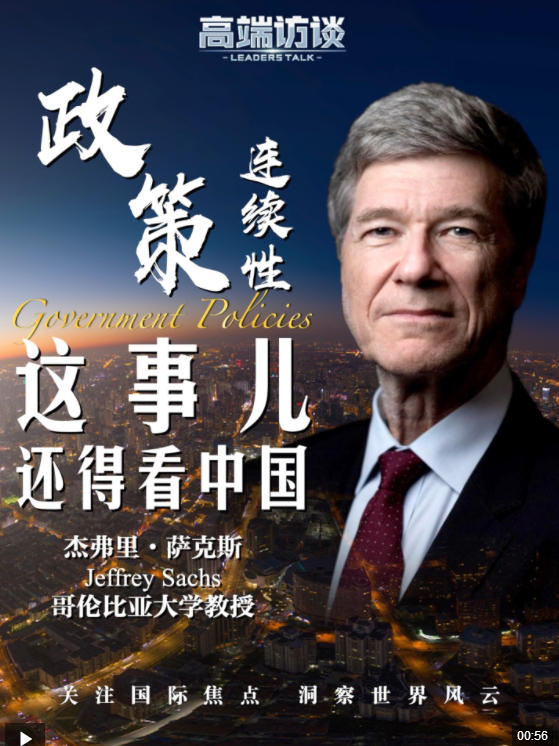
视频丨美教授:“十五五”式长期规划是美国该有的长远思维
Yang Shi Xin Wen Ke Hu Duan· 2025-10-22 03:05
Core Viewpoint - Jeffrey Sachs, a professor at Columbia University, emphasizes the instability of U.S. President Trump's policies compared to China's long-term planning approach, such as the five-year plans [2] Group 1 - Sachs expresses hope that the U.S. will adopt a long-term perspective and engage in diplomatic interactions and negotiations with China [2] - He criticizes the U.S. for its unilateralism and erratic actions, contrasting it with China's consistent policy-making [2]
美教授:“十五五”式长期规划是美国该有的长远思维
Yang Shi Xin Wen Ke Hu Duan· 2025-10-22 02:01
Core Viewpoint - Jeffrey Sachs, a professor at Columbia University, emphasizes the instability of U.S. President Trump's policies compared to China's long-term planning approach, such as its five-year plans [1] Group 1 - Sachs expresses hope that the U.S. will adopt a long-term perspective and engage in diplomatic interactions and negotiations with China [1] - He criticizes the U.S. for its unilateralism and erratic decision-making [1]

这才是未来几年,最有远见的活法
洞见· 2025-07-13 11:00
Core Viewpoint - The article discusses the concept of "middle-aged poverty" and emphasizes the importance of long-term thinking and crisis awareness for individuals, particularly those in middle age, to navigate life's challenges and maintain stability in uncertain times [5][6]. Group 1: Health Management - The article highlights the increasing difficulty of finding good jobs and the pressure to "involution" in the workplace, leading to health deterioration due to overwork [11][12]. - It suggests practical health management strategies, including ensuring adequate sleep, prioritizing work tasks, and maintaining regular health check-ups [13][14][15]. Group 2: Financial Management - The article cites Warren Buffett's philosophy on financial management, emphasizing the importance of saving before spending and avoiding debt to build wealth [18][20]. - It warns against consumer traps and the pressure to spend, especially in uncertain economic conditions, advocating for financial prudence [21][25][27]. Group 3: Emotional and Mental Well-being - The article advises individuals to protect their emotional energy by avoiding negative influences and not engaging with toxic individuals [30][31]. - It stresses the importance of maintaining rational thinking and not being swayed by emotional or misleading information, particularly in the context of investments [39][40]. Group 4: Family Dynamics - The article discusses the detrimental effects of internal family conflicts, or "internal consumption," on overall family well-being and success [47][48]. - It emphasizes the need for good communication, shared responsibilities, and creating a supportive family environment to foster resilience against external challenges [56][60].