稳中求进

Search documents
香飘飘:公司坚持“稳中求进”的经营基调,主动调整产品出货节奏
Zheng Quan Ri Bao Wang· 2026-02-12 12:09
Core Viewpoint - The company, Xiangpiaopiao (603711), is adapting its operational strategy in response to changes in the peak sales window due to the timing of the Spring Festival, while maintaining a focus on stability and progress in its business operations [1] Group 1: Operational Adjustments - The company is proactively adjusting its product shipment rhythm to align with the changing external consumer market environment [1] - Strict control over channel inventory levels is being implemented to ensure product freshness and protect the interests of consumers and distributors [1] Group 2: Financial Performance - In the fourth quarter, the company's revenue decline year-on-year has significantly narrowed compared to the first three quarters [1]

信银理财:以“稳”应“变” 在财富棋局中做客户的长期同行者
Jin Rong Jie Zi Xun· 2026-02-10 04:56
Core Viewpoint - The company emphasizes a brand philosophy of "steady progress and long-term value" through a new promotional video that uses chess culture as a metaphor for wealth management, encouraging a calm and long-term perspective on market fluctuations and wealth accumulation [1][3]. Brand Communication - In a context of information overload and market volatility, the company identifies "stability" as a key communication theme, which signifies a disciplined approach to investment rather than stagnation, rooted in thorough research and stringent risk control [3]. - The video integrates the wisdom of chess into the wealth management context, promoting a mature investment mindset that respects market rules and understands the symbiotic relationship between risk and return [3]. Operational Commitment - To fulfill its commitment to "steady progress," the company focuses on rigorous investment processes and decision-making discipline, establishing a comprehensive research system covering macroeconomic, industry, and individual analyses to support investment decisions [3]. - The company has implemented a multi-layered, full-process risk control mechanism to safeguard client assets, while also providing investment products that align with clients' risk preferences and fostering transparent communication to build trust [3]. Future Development - Looking ahead, the company aims to enhance its core capabilities, improving the professionalism and precision of asset allocation, while maintaining its commitment to responsible wealth management and the pursuit of long-term stable returns [4]. - The company aspires to be a reliable "guardian" and "companion" in clients' wealth journeys, using professionalism and integrity as foundations to help investors navigate the complex market landscape [4].
学习手记|从“适配度”看科学精准的发展思维
Xin Hua She· 2026-02-04 09:01
Group 1 - The core idea emphasizes the importance of "adaptability" in modern infrastructure construction as a guiding principle for development [3] - "Adaptability" is highlighted as a scientific thinking method, crucial for aligning supply with domestic demand and ensuring efficient resource allocation [3][4] - The concept of "adaptability" seeks to achieve a dynamic balance between supply and demand, precise resource allocation, and harmonious development with the environment [3][4] Group 2 - The article discusses the need for a balanced approach in economic policies, emphasizing the importance of timing and moderation in actions [4] - It stresses the significance of "precision" in poverty alleviation efforts, advocating for realistic standards that are neither too high nor too low [5][6] - The article concludes that maintaining a scientific understanding of "adaptability" is essential for achieving sustainable and effective governance, aligning with the principle of "seeking progress while maintaining stability" [6]

今世缘:去年基本盘表现优于部分规模体量相近的友商,接受行业整体利润率下行的趋势
Cai Jing Wang· 2026-02-03 09:36
Core Insights - The company emphasizes a strategy of "seeking progress while maintaining stability" for the next two years, focusing on stabilizing prices, market expectations, channel confidence, and market share [1] - The management anticipates that the first quarter of 2026 will face the most pressure due to a high comparison base from the previous year, but expects improvements starting from the second quarter [1] - The company acknowledges a decline in profit margins due to increased competition, indicating a trend of overall industry profit margin decline [1] - The focus for 2026 will be on optimizing and precision in expenditures rather than simple contraction, with a shift towards more effective advertising and promotional strategies [1][2] Financial Strategy - The company plans to maintain a stable total amount for fixed costs while cutting inefficient advertising projects [2] - Variable cost ratios are expected to remain relatively stable, with adjustments made to ensure efficient spending [2] - Immediate profit growth is not anticipated as various factors will continue to influence financial performance [2]


坚持稳中求进 努力实现良好开局
Xin Lang Cai Jing· 2026-01-31 07:08
Group 1 - The meeting emphasized the importance of the year 2024 as the 105th anniversary of the Communist Party of China and the beginning of the 15th Five-Year Plan, urging the five leading bodies to implement the spirit of the 20th Central Committee and the decisions made by the Party Central Committee [2] - The five leading bodies are expected to strengthen their own construction and fulfill their responsibilities in strict governance of the Party, while promoting a correct view of performance [2] - The Central Secretariat is tasked with focusing on key tasks and ensuring high-quality completion of all assignments from the Party Central Committee [2] Group 2 - The meeting acknowledged the contributions made by the five leading bodies in the past year, highlighting their adherence to Xi Jinping's thoughts and their role in achieving the main objectives for the year and the successful conclusion of the 14th Five-Year Plan [1] - The meeting recognized the efforts of the Central Secretariat in implementing the decisions of the Party Central Committee and addressing issues such as formalism to reduce burdens on grassroots levels [1]
中共中央政治局召开会议 中共中央总书记习近平主持会议
Jin Rong Jie· 2026-01-30 07:06
Core Viewpoint - The meeting of the Central Political Bureau emphasizes the importance of maintaining a stable yet progressive work approach, focusing on major strategic tasks for economic and social development during the 14th Five-Year Plan period [1] Group 1 - The meeting was chaired by General Secretary Xi Jinping, highlighting the leadership's commitment to governance and strategic planning [1] - The emphasis is placed on strengthening the construction of party organizations and fulfilling the responsibility of strict governance over the party [1] - The Central Secretariat is tasked with implementing key tasks and ensuring high-quality completion of assignments from the Central Committee [1]
2026:中国经济“进、稳、立”协同发力
Jin Rong Shi Bao· 2026-01-26 02:08
Core Viewpoint - The central theme of the articles emphasizes the need for a systematic approach to ensure a stable and high-quality economic development in China for 2026, focusing on the principles of "seeking progress while maintaining stability" and "establishing before breaking" [1][2][13] Group 1: Stabilizing the Economy - The foundation of stability is characterized by the smooth operation of the economy and positive social expectations, which are essential for achieving "promoting stability through progress" [3][4] - Implementation of a "policy synergy" action is crucial, enhancing the systematic and coordinated nature of macroeconomic regulation, with a focus on effective fiscal and monetary policies [4][5] - Fiscal policies should prioritize key areas, ensuring that limited resources are directed towards major national strategies and social welfare, while monetary policies should remain moderately loose to support stable economic growth [4][5] Group 2: Driving New Growth - The core of "progress" lies in cultivating new productive forces, driven by technological innovation, which is essential for sustainable economic development [6][7] - Key actions include tackling core technologies and enhancing the transformation from laboratory innovations to market applications, particularly in strategic fields like AI and biotechnology [6][7] - Restructuring the industrial system to improve the resilience and security of supply chains is necessary, with a focus on integrating AI into various sectors and promoting intelligent manufacturing [7][8] Group 3: Establishing Key Reforms - The "establish before breaking" approach emphasizes the need to create new production relationships that align with the development of new productive forces, which is vital for high-quality economic growth [9][10] - Establishing unified market rules is essential to facilitate the free flow of resources and eliminate local protectionism, thereby enhancing domestic economic circulation [9] - Reforming state-owned enterprises and improving the business environment for private enterprises are critical to stimulate market vitality and ensure fair competition [10] Group 4: Guiding Expectations and Ensuring Livelihoods - Implementing a "expectation guidance" initiative is necessary to stabilize market confidence, involving comprehensive communication strategies to clarify policy intentions and effects [11][12] - Strengthening employment policies and enhancing public services are vital to ensure a solid social safety net, which will encourage consumer spending and support economic growth [12] - The focus on improving social security systems and expanding access to quality public services will help alleviate concerns in education, healthcare, and retirement, fostering a more stable economic environment [12] Group 5: Overall Logic for Economic Development - The overall strategy for 2026 emphasizes a balanced approach between quality and quantity, aiming for structural optimization and the transformation of development momentum [13] - The development framework should integrate "new momentum breakthroughs, macro policy coordination, key reform pillars, and social expectation guidance" to create a synergistic effect [13] - A careful balance between establishing new systems and addressing existing risks is crucial for achieving sustainable economic stability and growth [13]
北京市发改委详解2026年经济增长目标
Bei Jing Shang Bao· 2026-01-25 17:18
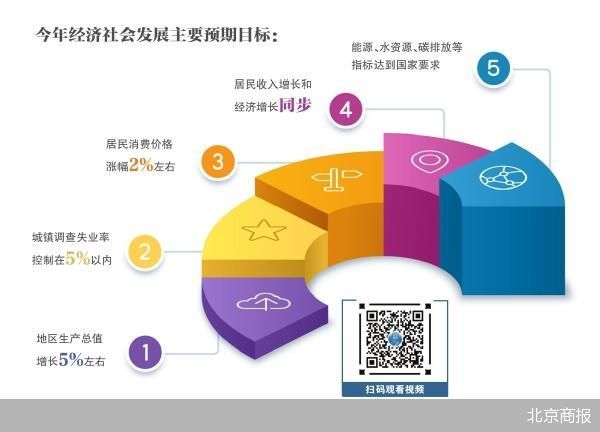
Group 1 - The core economic growth target for Beijing is set at approximately 5% for 2026, reflecting a balance between current needs and long-term goals [2] - The goal is part of a broader strategy to achieve significant progress in the "14th Five-Year Plan" period, aiming for a doubling of the economic total by 2035 compared to 2020, necessitating an average annual growth rate of around 4.5% over the next decade [2] - Employment quality, income stability, and increased government investment in public services and social security are highlighted as essential components requiring sustained economic growth [2] Group 2 - Over the past five years, Beijing's economy has crossed two trillion-yuan thresholds, with a projected growth of 5.4% in 2025, surpassing the national average by 0.4 percentage points, indicating a solid foundation for future development [3] - Key supporting conditions include deep integration of technological and industrial innovation, continuous market vitality from reforms, and a strong "Beijing Service" business environment [3] - In 2025, the industrial added value of Beijing is expected to grow by 6.5%, with total industrial output reaching 2.8 trillion yuan, while modern service sectors contribute significantly to GDP, accounting for 47.4%, an increase of 6.6 percentage points since 2020 [3] Group 3 - The central economic work conference emphasizes a focus on stability while seeking progress, enhancing quality and efficiency, and integrating existing and new policies to strengthen counter-cyclical and cross-cyclical adjustments [4] - The Beijing government has outlined seven initiatives to ensure the achievement of the economic growth target, aiming for a balance between ambitious yet realistic goals that can boost confidence and respect economic laws [4]
人民日报连发6篇“钟才平”:解读2026年经济大方向的四大信号
Sou Hu Cai Jing· 2026-01-18 11:16
Core Viewpoint - The series of articles by "Zhong Caiping" published at the beginning of 2026 aims to set the tone for the economic outlook and provide guidance for development during the critical start of the "14th Five-Year Plan" period, emphasizing confidence and clarity in policy direction [1][3]. Group 1: Economic Outlook and Policy Direction - The articles highlight the resilience and strength of the Chinese economy, asserting that it can withstand significant challenges, thereby establishing a foundational tone of "seeking progress while maintaining stability" for the year [3][4]. - The emphasis on "pragmatism" and "tailored approaches" in economic work reflects a commitment to learning from past experiences and providing precise guidance for local governance [4][6]. Group 2: Key Strategies for Economic Growth - The focus on expanding domestic demand and improving livelihoods is identified as a priority, with strategies including enhancing consumer income and optimizing investment in infrastructure and public services [6][9]. - The articles advocate for a dual approach of boosting both consumption and investment, with specific measures to increase residents' income and support new consumption trends [6][7]. Group 3: Open Economy and International Cooperation - The commitment to high-level openness is reiterated, with an emphasis on quality over quantity in international trade and investment, aiming to create a mutually beneficial environment for both domestic and foreign enterprises [7][9]. - The articles outline four key areas for enhancing openness: expanding the domestic market, deepening supply chain cooperation, optimizing the investment environment, and promoting the Belt and Road Initiative [7][9]. Group 4: Guidance for Stakeholders - The articles serve as a practical guide for individuals, businesses, and local governments, emphasizing the importance of stable expectations, accurate direction, and a realistic mindset in pursuing long-term development [9]. - Stakeholders are encouraged to focus on domestic demand and cooperative opportunities, aligning with government support for new consumption and innovative production sectors [9].

体系化学理化研究阐释 | 坚持正确工作策略和方法
Xin Lang Cai Jing· 2026-01-17 03:18
Core Viewpoint - The article emphasizes the importance of a scientific methodology in economic work, guided by Xi Jinping's economic thought, to enhance the effectiveness and foresight of economic strategies and policies [1][3]. Group 1: Methodological Importance - Methodology is essential for understanding and transforming the world, reflecting how issues are observed and addressed [1]. - The Communist Party's tradition of valuing methodological approaches in economic construction dates back to Mao Zedong, who emphasized the need for practical methods in economic work [2]. - Xi Jinping has highlighted the need for correct strategies and methods to implement economic policies effectively, especially in the face of complex domestic and international challenges [3]. Group 2: Key Methodological Principles - The principle of "seeking progress while maintaining stability" is crucial for economic work, ensuring a stable environment for development and structural adjustments [5]. - A systematic perspective is necessary to address the interconnectedness of various economic factors, requiring a comprehensive approach to problem-solving [6]. - The principle of "adapting to local conditions" is vital for economic work, emphasizing the need for tailored strategies based on regional characteristics and resources [8][9]. - Combining goal-oriented and problem-oriented approaches is essential for achieving economic development targets while addressing pressing issues [10]. - Bottom-line thinking is critical for risk management in economic activities, ensuring preparedness for uncertainties and challenges [11]. Group 3: Application of Methodology - The application of Xi Jinping's economic thought is necessary for addressing unprecedented challenges in economic work, requiring a systematic analysis of supply and demand dynamics [14]. - Emphasizing the importance of research and understanding local conditions can lead to differentiated and specialized development paths [14]. - The need for a correct view of performance is highlighted, focusing on genuine economic growth rather than superficial metrics [14].