闭环强化学习

Search documents
蔚来-SW1月交付27182辆汽车,同比增长96.1%
Zhi Tong Cai Jing· 2026-02-01 10:32
Core Viewpoint - NIO-SW (09866) reported a significant increase in vehicle deliveries, achieving a total of 27,182 vehicles delivered in January 2026, representing a year-on-year growth of 96.1% [1] Delivery Performance - The deliveries included 20,894 high-end smart electric vehicles under the NIO brand, 3,481 family smart electric vehicles under the Lada brand, and 2,807 high-end smart small cars under the Firefly brand [1] - As of January 31, 2026, the cumulative vehicle delivery reached 1,024,800 units, marking a significant milestone in the company's development [1] Technological Advancements - On January 28, 2026, the new version of the "NIO World Model (NWM)" was officially launched, gradually being pushed to over 460,000 vehicles equipped with the "Banyan" system, with plans to extend to "Cedar" and "Cedar S" models [1] - The new version incorporates complete closed-loop reinforcement learning for smart assisted driving, enhancing the driving experience in both urban and highway scenarios [1] - Improvements were also made in smart parking assistance and active safety, enhancing both technical capabilities and user experience [1] Future Outlook - The company aims to continue its focus on the research and development of core smart electric vehicle technologies and further improve the charging and battery swapping network layout [1] - The goal is to provide a better smart electric vehicle experience for a broader user base, contributing to a sustainable and improved future [1]

蔚来(09866) - 自愿公告 - 2026年1月交付更新资料
2026-02-01 10:06
香港交易及結算所有限公司及香港聯合交易所有限公司對本公告的內容概不負責,對其準確性 或完整性亦不發表任何聲明,並明確表示概不就因本公告全部或任何部分內容而產生或因倚賴 該等內容而引致的任何損失承擔任何責任。 根據不同投票權架構,我們的股本包括A類普通股及C類普通股。對於提呈我們股東大會的任 何決議案,A類普通股持有人每股可投一票,而C類普通股持有人則每股可投八票,惟法律或 《香港聯合交易所有限公司證券上市規則》或我們的組織章程大綱及細則另行規定者除外。股東 及有意投資者務請留意投資不同投票權架構公司的潛在風險。我們的美國存託股(每股美國存 託股代表一股A類普通股)於美國紐約證券交易所上市,股份代號為NIO。 NIO Inc. (於開曼群島註冊成立以不同投票權控制的有限責任公司) (股份代號:9866) 自願公告 2026年1月交付更新資料 承董事會命 蔚來集團 本公司於2026年1月交付27,182輛汽車,同比增長96.1%。有關交付包括本公司 旗下蔚來品牌的高端智能電動汽車20,894輛,本公司旗下樂道品牌的家庭智能電 動汽車3,481輛,以及本公司旗下螢火蟲品牌的智能電動高端小車2,807輛。截至 202 ...
闭环训练终于补上了!AD-R1:世界模型端到端闭环强化学习新框架(澳门大学&理想等)
自动驾驶之心· 2025-11-27 00:04
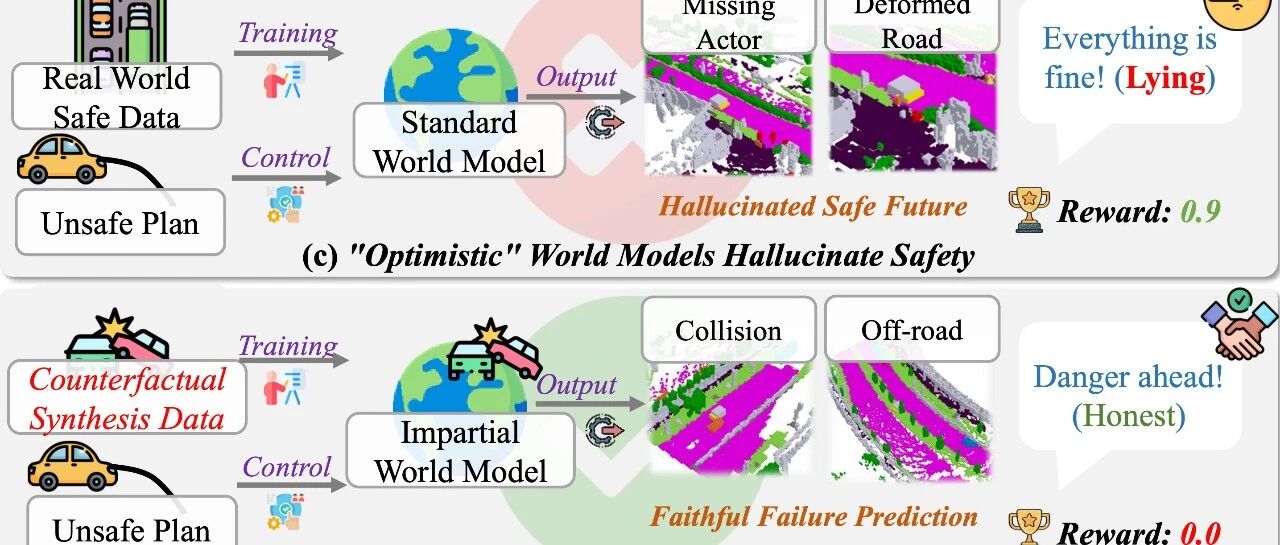
Core Insights - The article discusses the advancements in autonomous driving through the introduction of the AD-R1 framework, which utilizes an Impartial World Model to address the "optimistic bias" found in traditional world models [2][3][57] - The framework allows for closed-loop reinforcement learning, enabling autonomous vehicles to learn from imagined failures, thereby improving safety and decision-making capabilities [9][57] Group 1: Background and Challenges - End-to-end autonomous driving has transformed the industry, but challenges remain, particularly with long-tail event failures due to distribution shifts [6] - Traditional reinforcement learning methods rely on external simulators, which have limitations such as simulation-to-reality gaps and lack of interactivity [6][9] - The need for a paradigm shift towards learning 3D/4D world models as high-fidelity generative simulators is emphasized [6] Group 2: Optimizing World Models - The AD-R1 framework introduces a new approach to mitigate the optimistic bias in world models, which often fail to predict negative outcomes [2][7] - The Impartial World Model (IWM) is designed to accurately reflect the consequences of both safe and unsafe behaviors, enhancing the reliability of predictions [3][10] - A counterfactual synthesis pipeline is implemented to generate a diverse training dataset that includes reasonable collision and lane deviation scenarios [3][10] Group 3: Experimental Results - The IWM significantly outperforms traditional models in risk prediction tasks, demonstrating its ability to accurately foresee failures [47][48] - The application of the AD-R1 framework leads to notable improvements in safety and performance metrics across various baseline models, with absolute increases in planning decision metrics (PDMS) of 1.7% and 1.1% [49] - Ablation studies reveal that the introduction of counterfactual synthesis and model-level optimizations are critical for enhancing causal fidelity and overall performance [51][52] Group 4: Future Directions - Future research may focus on generating counterfactual failure samples from unlabeled data to reduce reliance on high-precision annotations [57] - Expanding the framework to more complex multi-agent interaction scenarios could further enhance the robustness of autonomous driving systems in long-tail events [57]