防御性轮动

Search documents
华尔街共识浮现?摩根大通刚划出“关键防线”,高盛也警告标普6725点为多空分水岭
华尔街见闻· 2025-11-17 10:43
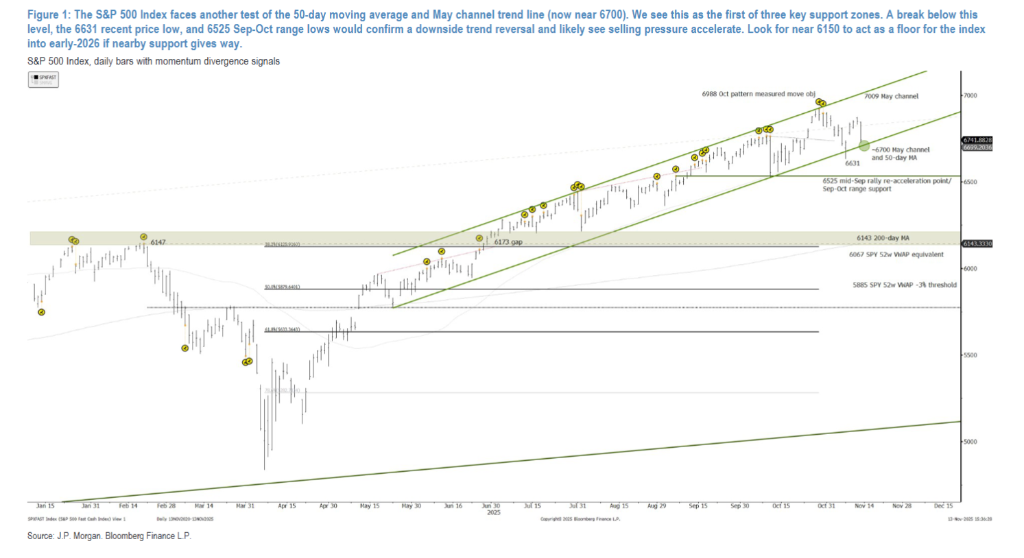
Core Viewpoint - Wall Street's top investment banks are establishing a new "bull-bear divide" as market sentiment becomes increasingly cautious [1] Group 1: Market Trends and Technical Levels - Goldman Sachs identifies 6725 points as a critical technical inflection point for the S&P 500 index; a breach could signal the end of a positive market trend that has persisted since February [2] - JPMorgan warns that the S&P 500 index faces key support levels at 6700, 6631, and 6525 points; breaking these levels could confirm a downward trend, potentially lasting until early 2026 [3][9] - The report highlights that the Nasdaq 100 and Russell 2000 indices have also breached short-term momentum thresholds, indicating a potential for significant selling pressure from algorithm-driven commodity trading advisors (CTAs) [7] Group 2: Upcoming Market Events - The market is preparing for significant events, including Nvidia's earnings report, which could lead to a market capitalization fluctuation of up to $300 billion, and the first U.S. government employment report in two and a half months [4] Group 3: Defensive Rotation and Sector Performance - There is a notable shift of funds from growth sectors to defensive sectors, with the VIX index rising above 23 for the fourth time since April, indicating increased market anxiety [11] - In the technology, media, and telecommunications (TMT) sectors, short selling has outpaced long buying, while defensive sectors like healthcare and consumer staples have seen stronger demand [11] - Despite the defensive shift, overall stock exposure has not significantly decreased, suggesting persistent market volatility [11] Group 4: Momentum Factor and Market Risks - A sharp decline in the momentum factor has been observed, with Goldman Sachs' momentum index experiencing one of its worst trading periods in a decade, raising concerns about potential instability [13] - The report indicates that despite the poor performance of the momentum factor, investor exposure remains high, which could lead to larger-scale deleveraging and asset repricing if selling continues [13]



华尔街共识浮现?摩根大通刚划出“关键防线”,高盛也警告标普6725点为多空分水岭
Hua Er Jie Jian Wen· 2025-11-17 06:53
Core Viewpoint - Wall Street's top investment banks are establishing a new "bull-bear divide" as market sentiment becomes increasingly cautious, with Goldman Sachs identifying 6725 points on the S&P 500 index as a critical technical inflection point that, if breached, could signal the end of a positive market trend lasting several months [1][2]. Group 1: Market Trends and Indicators - Goldman Sachs' report emphasizes that the S&P 500 index's 6725 points is crucial; falling below this level could mark a second negative trend since February of this year [1][2]. - JPMorgan has warned that if the S&P 500 breaches key support levels of 6700, 6631, and 6525 points, it would confirm a downward trend, potentially leading to market adjustments lasting until early 2026 [1][2]. - The Russell 2000 index is showing the most concerning breakdown pattern, indicating a bearish trend and opening up space for further declines [1][3]. Group 2: Systematic Selling Risks - The report highlights that the market's technical structure is precarious, with algorithm-driven Commodity Trading Advisor (CTA) funds likely to lead the next phase of selling [2]. - Goldman Sachs' analysis indicates that the short-term momentum thresholds for the Nasdaq 100 and Russell 2000 indices were breached last week, with CTAs expected to sell approximately 20% of their NDX and RTY positions in the coming week [2]. - A critical level for CTAs is set at 6442 points; if breached, it could trigger over $32 billion in sell orders within a week, potentially causing significant market turmoil [2]. Group 3: Defensive Sector Rotation - Evidence suggests that funds are shifting from growth sectors to defensive sectors, with the VIX index rising above 23, marking the fourth occurrence since April [5]. - In the Technology, Media, and Telecommunications (TMT) sector, short selling has outpaced long buying, while defensive sectors like healthcare and consumer staples have seen stronger demand from long buyers [5]. - Despite this defensive trend, overall stock exposure has not significantly decreased, indicating persistent market volatility [5]. Group 4: Technology Sector Concerns - There is a surge in demand for hedging against declines in large-cap technology stocks, with the implied volatility spread between the Nasdaq 100 and S&P 500 indices nearing a one-year high [7]. - Nvidia's recent volatility has been notably higher than the average for small-cap stocks, raising concerns given its market capitalization of approximately $4.6 trillion compared to the average market cap of Russell 2000 constituents at $1.7 billion [7]. - A sharp decline in momentum factors has been observed, with Goldman Sachs' momentum index experiencing one of its worst trading periods in a decade, raising concerns about potential broader market instability [7].