
防御性驾驶

Search documents
纵向端到端是自动驾驶技术的一道分水岭
自动驾驶之心· 2025-10-04 04:04
Core Insights - The article discusses the evolution of end-to-end autonomous driving technology, highlighting the shift from horizontal to vertical end-to-end systems as a new industry focus [2][3] - It emphasizes the importance of vertical end-to-end control for achieving human-like driving efficiency, particularly in speed and braking control [4][16] Group 1: Importance of Vertical End-to-End Control - Vertical end-to-end control is essential for achieving smooth acceleration and deceleration, which is a key differentiator between novice and experienced drivers [3][4] - The article defines "defensive deceleration" as the ability to adjust speed based on necessity and prediction, balancing safety and efficiency [4][12] - Current autonomous systems often prioritize navigation efficiency over vertical control, making it challenging to implement effective speed adjustments [15][16] Group 2: Challenges in Achieving Vertical End-to-End Control - Many autonomous driving systems have successfully implemented horizontal end-to-end control, but vertical control remains a significant challenge [13][16] - The noise in human driving data complicates the learning process for autonomous systems, making it difficult to distinguish meaningful speed control from random fluctuations [16][17] - Solutions to improve vertical control include data cleaning, causal reasoning, and reinforcement learning, which are being explored by leading autonomous driving teams [17]


车展季·大咖说丨元戎启行CEO周光:辅助驾驶必须对用户安全负责,AI应具备对风险的敬畏之心
Mei Ri Jing Ji Xin Wen· 2025-08-27 11:56
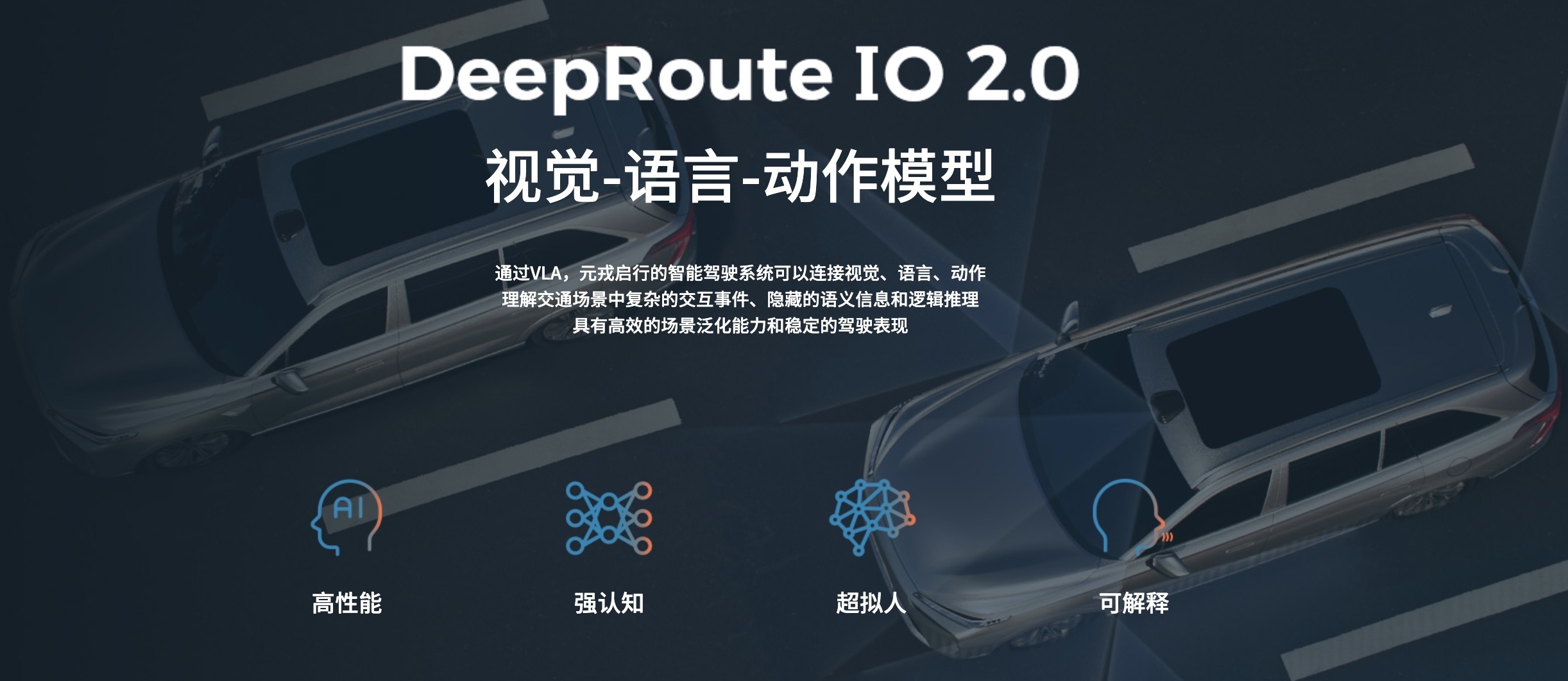
Core Viewpoint - The launch of DeepRoute IO 2.0 by Yuanrong Qixing marks a significant advancement in the autonomous driving sector, transitioning from "end-to-end" models to the more sophisticated Vision-Language-Action (VLA) model, which is better suited for complex driving scenarios [1][2]. Group 1: Technology and Development - DeepRoute IO 2.0 integrates a self-developed VLA model that enhances the ability to handle intricate road conditions compared to traditional models [1]. - The VLA model addresses the "black box" issue of conventional end-to-end models by providing effective information linkage, analysis, and causal reasoning [1][2]. - The VLA technology is expected to be adaptable for vehicles priced above 150,000 yuan, with potential to extend down to 100,000 yuan models in the future [5]. Group 2: Market Position and Competition - The competition in the autonomous driving market is intensifying, with various automakers like Xiaopeng, Li Auto, Geely, and Chery entering the VLA model space [1]. - Yuanrong Qixing's CEO, Zhou Guang, emphasizes the company's early investments in defensive driving, which provide a competitive edge in the evolving landscape of autonomous driving technology [1][2]. Group 3: Safety and Commercialization - The company has achieved significant commercial milestones, securing over 10 model partnerships and delivering nearly 100,000 vehicles equipped with urban navigation assistance systems [6]. - Zhou Guang acknowledges the heightened consumer expectations for safety in autonomous driving, indicating a need for continuous improvement despite the company's leading position in evaluations [6][9]. - The focus on "defensive driving" is central to the system's training, aiming to instill a sense of risk awareness in AI, akin to biological evolution [9]. Group 4: Future Outlook - The market for high-level assisted driving is anticipated to expand, providing Yuanrong Qixing with greater opportunities as they continue to innovate and adapt their technology [9].
X @𝘁𝗮𝗿𝗲𝘀𝗸𝘆
𝘁𝗮𝗿𝗲𝘀𝗸𝘆· 2025-07-25 15:42
Automotive Industry Perspectives - The automotive industry recognizes two types of defensive driving: physical and magical [1] - Physical defense is exemplified by driving a Cybertruck [1] - Magical defense is associated with luxury brands like Rolls Royce, Bentley, and Ferrari [1] - Both types of defensive driving are considered expensive [1]