
防止返贫

Search documents
青平:2026年乡村振兴绘就壮美画卷
Xin Lang Cai Jing· 2026-02-14 15:33
Core Viewpoint - The document outlines the importance of agricultural modernization and rural revitalization in China, emphasizing the need to prevent poverty and enhance agricultural productivity and quality as part of the broader goal of achieving a strong agricultural nation by 2026 [1][4]. Group 1: Poverty Prevention and Support - The document stresses the necessity of maintaining a bottom line to prevent large-scale poverty, advocating for a robust and regular support policy system integrated into rural revitalization efforts [1]. - By the end of 2025, over 7 million individuals at risk of poverty will be identified and supported, with significant improvements in education, healthcare, housing safety, and drinking water security for the formerly impoverished population [1]. Group 2: Technological Support and Quality Improvement - The emphasis is placed on enhancing agricultural productivity and quality through a new round of initiatives aimed at increasing grain production capacity by 100 billion jin, alongside promoting superior crop varieties and quality improvements [2]. - As of last year, significant advancements in agricultural technology have been noted, including over 300,000 agricultural drones and a mechanization rate of 76.7% for crop farming [2]. Group 3: Rural Construction and Development - The document advocates for a people-centered approach to rural construction, emphasizing the need for tailored strategies that respect the unique characteristics of each village [3]. - It highlights the importance of optimizing village layouts and construction methods based on local resources and needs, ensuring that rural development is not a one-size-fits-all approach [3]. Group 4: Long-term Commitment and Strategic Implementation - A call for sustained efforts and precise strategies is made to achieve significant progress in rural revitalization, aiming for a prosperous agricultural sector, beautiful rural areas, and wealthy farmers [4].
一号文件里的“三农”路线图
Xin Lang Cai Jing· 2026-02-06 08:35
Group 1 - The core document titled "Opinions on Anchoring Agricultural and Rural Modernization and Promoting Comprehensive Rural Revitalization" outlines a clear roadmap for rural revitalization during the 15th Five-Year Plan period, building on the achievements of the 14th Five-Year Plan [2] - The document prioritizes enhancing agricultural production capacity and quality, with a target of stabilizing grain output at around 1.4 trillion jin, indicating a shift in food security focus from merely maintaining production to improving capacity and efficiency [2] - The emphasis on integrating "good land, good seeds, good opportunities, and good methods" aims to leverage technology for increased yield and efficiency while maintaining stable sowing areas [2] Group 2 - A significant policy innovation in this year's document is the introduction of "regularized precise assistance," marking the end of a five-year transitional period and entering a new phase of poverty alleviation efforts [3] - The strategy focuses on embedding regularized assistance within the framework of rural industry, talent, culture, ecology, and organization, shifting the focus towards development-driven assistance that stimulates internal motivation and prevents large-scale poverty [3] - The document highlights the importance of increasing farmers' income, addressing the critical issue of "who grows grain, who benefits," and emphasizes protecting and incentivizing farmers through coordinated policies on pricing, subsidies, and insurance [3] Group 3 - The document sets higher requirements for rural construction, transitioning from merely ensuring availability to pursuing quality in living conditions, with a focus on enhancing convenience, comfort, and satisfaction [4] - It introduces a "regionalization" approach to encourage neighboring villages to plan and develop collaboratively, promoting efficient resource integration and complementary functions [4] - The central theme of the document is to anchor agricultural and rural modernization, ensuring food security and poverty prevention while upgrading development issues related to industrial efficiency, farmer income, and rural construction [4]


好评中国丨筑牢粮仓、巩固成果、激活乡村 绘就乡村振兴动人画卷
Xin Lang Cai Jing· 2026-01-13 13:36
Core Viewpoint - The Chinese government is committed to advancing rural revitalization, emphasizing food security and sustainable agricultural practices as foundational elements for the well-being of farmers and national development [1]. Group 1: Food Security and Agricultural Modernization - The Ministry of Agriculture and Rural Affairs has prioritized food production, shifting focus from merely increasing total output to building a modern agricultural system that emphasizes quality, efficiency, and risk resilience [1]. - Strategies include enhancing the yield of major crops and promoting high-standard farmland construction, moving away from traditional farming methods to a technology-driven approach [1]. - Initiatives such as improving disaster prevention and response capabilities and launching a new round of actions to increase grain production capacity by hundreds of billions of kilograms are aimed at creating a robust food supply system [1]. Group 2: Poverty Alleviation and Economic Empowerment - The government aims to prevent poverty recurrence through a stable and dynamic monitoring system, ensuring that support policies remain effective and targeted [1]. - Emphasis is placed on transitioning from "blood transfusion" support to "blood production" strategies, focusing on enhancing the quality and efficiency of supportive industries and employment opportunities [1]. - The goal is to empower formerly impoverished regions and individuals to sustain their economic growth and income generation independently [1]. Group 3: Infrastructure and Quality of Life Improvements - The objective for this year includes ensuring that rural areas meet modern living conditions, which encompasses not only infrastructure improvements but also equal access to education, healthcare, and cultural services [1]. - The extension of land contracts for another 30 years is seen as a crucial measure to stimulate agricultural development, providing farmers with stability and encouraging long-term investments [1]. - This stable property rights framework is essential for attracting capital, technology, and talent to rural areas, facilitating large-scale agricultural operations and modernization [1]. Group 4: Challenges and Future Directions - The government acknowledges challenges such as balancing food production with farmers' income growth, ensuring effective policy implementation at the grassroots level, and attracting young people to return to rural entrepreneurship [1]. - Despite these challenges, the direction for comprehensive rural revitalization is clear, with a vision that aims to transform the future of rural development in China [1].
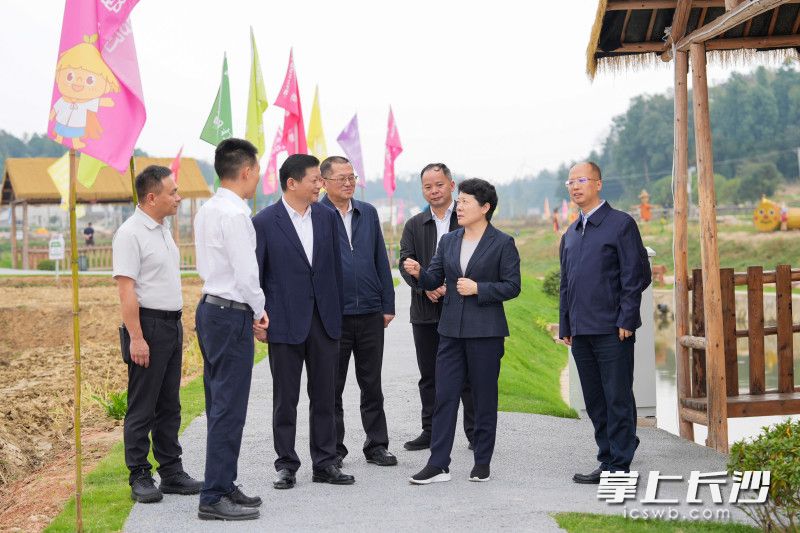
吴桂英在长沙县调研粮食安全、乡村振兴工作
Chang Sha Wan Bao· 2025-11-08 02:23
Group 1 - The core message emphasizes the importance of food security and rural revitalization, urging the implementation of effective measures to enhance agricultural efficiency, increase farmers' income, and invigorate rural areas [1][3] - The "I have hills in Kaihui" project in Kaihui Town is highlighted as an innovative model combining collective economic development and rural operation, which has generated over 680,000 yuan in dividends for 10 villages this year [3] - The establishment of a comprehensive agricultural service center in Changsha County aims to provide mechanized services to small farmers and grain producers, enhancing their productivity and engagement in modern agriculture [8] Group 2 - The Tianhua Grain Purchase and Sale Company is responsible for the entire process of policy grain acquisition, storage, and sales, emphasizing the need for effective management of reserve grains to ensure national food security [8] - The focus on grassroots governance and community services is reinforced, with an emphasis on improving medical facilities and ensuring accessible healthcare for rural residents [13] - Continuous efforts are required to prevent poverty and ensure the sustainability of poverty alleviation achievements, with a call for precise implementation of support measures [13]
福建泉州:“防贫保险”托底成效显著,5年累计赔付845万元
Zhong Guo Fa Zhan Wang· 2025-09-04 08:04
Core Insights - Fujian Quanzhou has implemented commercial insurance measures to prevent rural families from falling back into poverty, effectively addressing risks caused by illness, disasters, and accidents [1][2] - Since 2021, Quanzhou has insured 141,100 individuals under the anti-poverty insurance scheme, with a total premium payment of 7.3809 million yuan, assisting 6,700 impoverished families and completing claims of approximately 8.45 million yuan [1] Group 1 - The anti-poverty insurance initiative has provided substantial support to impoverished households, ensuring that no large-scale return to poverty occurs [1] - The insurance company promptly initiated a claims process for a family in need, providing over 35,000 yuan to alleviate their financial burden after significant medical expenses [1] - The implementation of the "anti-poverty insurance" has not only safeguarded the livelihoods of impoverished households but also contributed to rural revitalization efforts [1] Group 2 - Quanzhou plans to continuously innovate its approach to support low-income rural populations, focusing on targeted and precise assistance [2] - The city aims to enhance collaboration with insurance companies to improve claims processes and service quality, ensuring that the anti-poverty insurance policy benefits more farmers [2]