阶梯储蓄法

Search documents
3%至4%的理财“看不上”,多数国人独爱1%到2%的定期存款,为何?
Sou Hu Cai Jing· 2025-12-09 02:36
Core Viewpoint - The preference for fixed-term deposits over higher-yielding financial products among ordinary people reflects a strong emphasis on safety and stability in an uncertain economic environment [1][5][12]. Group 1: Interest Rates and Deposit Trends - The current interest rates for fixed-term deposits at major state-owned banks are significantly lower than those of certain financial products, with three-year fixed-term deposits at 1.5% compared to some financial products offering up to 4% [1][3]. - Despite the higher potential returns of financial products, the growth rate of fixed-term deposits has outpaced that of demand deposits, with personal fixed-term deposits at Industrial and Commercial Bank of China increasing by 23.26% in 2023 [3][4]. - The decline in fixed-term deposit rates has been ongoing since September 2022, with a cumulative reduction of six rounds, leading to a drop from 4% in 2019 to 1.5% currently [4][8]. Group 2: Safety and Risk Awareness - The primary reason for the preference for fixed-term deposits is the safety provided by the Deposit Insurance Regulation, which guarantees full compensation for deposits up to 500,000 yuan in case of bank failure [3][5]. - The average loss of 12% in stock funds and the experience of significant losses in financial markets have heightened risk awareness among the public, leading them to prioritize the safety of their principal [5][9]. - Fixed-term deposits, while offering lower returns, are seen as a more secure option compared to riskier investments, especially for families relying on these funds for essential needs [5][9]. Group 3: Financial Strategies and Consumer Behavior - Many individuals are adopting a "ladder savings" strategy, dividing their funds into different fixed-term deposits to maintain liquidity while benefiting from relatively higher long-term rates [6][9]. - The trend of banks now promoting fixed-term deposits as alternatives to underperforming financial products indicates a shift in the perception of fixed-term deposits' value [9][10]. - The current economic climate has led to a cautious approach among consumers, with a focus on securing their financial future rather than seeking higher returns through riskier investments [10][12].


又有银行下调存款利率
Jin Rong Shi Bao· 2025-04-24 13:00
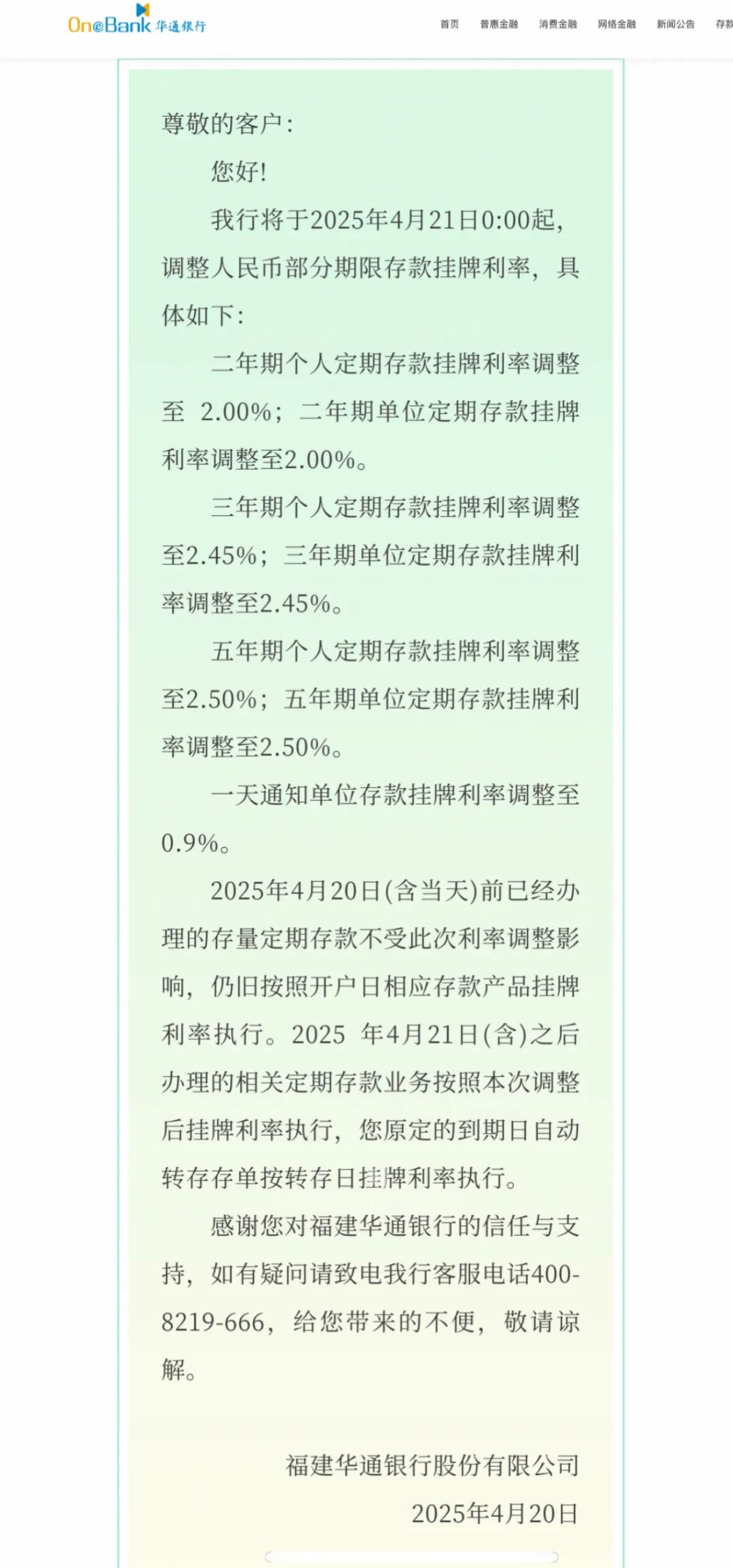
Core Viewpoint - Recent adjustments in deposit rates by private banks indicate a significant shift in the banking sector, with many institutions lowering rates to reduce funding costs and optimize deposit structures [4][5]. Group 1: Rate Adjustments - Fujian Huatuo Bank announced a reduction in deposit rates effective April 21, with 2-year, 3-year, and 5-year personal and corporate fixed deposit rates adjusted to 2.00%, 2.45%, and 2.50% respectively, marking a decrease of 25 basis points (bps) and 10 bps for the 3-year and 5-year products [1]. - Wuxi Xishang Bank's 3-year deposit rate was lowered from 2.6% to 2.5%, and the 5-year rate from 2.5% to 2.4% [2]. - The recent rate cuts are part of a broader trend, with over half of the 19 private banks surveyed reducing their deposit rates in April, particularly focusing on longer-term products [4]. Group 2: Market Dynamics - The rapid and concentrated nature of the recent rate cuts reflects the competitive landscape and varying strategies among banks, influenced by factors such as market competition and customer positioning [4]. - Private banks, traditionally known for higher interest rates to attract deposits, are now experiencing a shift due to their relatively weaker deposit absorption capabilities [4]. Group 3: Economic Context - The need to lower financing costs for the real economy has prompted banks to reduce their funding costs, particularly for medium to long-term deposits, which have more room for adjustment [5]. - Experts suggest that banks should optimize their deposit rates while enhancing financial services to support residents' investment and wealth management needs [6].