陆海统筹发展

Search documents
协同联动成形起势,打造强劲活跃增长极——聚焦省委经济工作会议⑤
Da Zhong Ri Bao· 2025-12-29 00:56
Core Insights - The Shandong Provincial Economic Work Conference emphasizes stronger regional coordinated development, focusing on strategic collaboration with provinces along the Yellow River and deep integration with the Beijing-Tianjin-Hebei and Yangtze River Delta regions [1] - The conference outlines a series of initiatives, including the implementation of the Jinan-Qingdao metropolitan area collaborative plan and a new round of actions for the breakthrough of Heze and the high-quality development of county economies [1] Group 1: Regional Development Initiatives - The Jinan-Qingdao metropolitan area is identified as a key strategy for regional integration, contributing over 20% of the province's GDP while occupying one-seventh of its land area [1] - Qingdao is expected to enhance its internal and external collaboration, focusing on technological innovation, high-end industry leadership, and open hub functions [2] - The "Chatou Heat into Jinan" project, which connects three cities and five counties, will add 100 million square meters of clean heating capacity to Jinan this winter [2] Group 2: Economic Growth and Opportunities - Heze has seen significant economic growth, with major indicators ranking among the top in the province, and is set to launch a new round of actions for its development [3] - The province is implementing the "Ten Million Project" to promote rural revitalization, with 2,070 construction areas covering over 18,000 administrative villages [3] - The Qingdao West Coast New Area is leveraging its rural revitalization areas to enhance tourism, attracting over 2.7 million visitors and generating over 220 million yuan in tourism revenue [3] Group 3: Marine Economy Development - The conference highlights the need for coordinated land-sea development and the establishment of a high-quality marine economy policy framework [4] - The Dongying Port area has experienced double-digit growth in throughput, with a focus on wind power and photovoltaic component transportation [5] - Future plans include enhancing port functions and expanding scale to better support regional economic development through industry clustering [5]
“十五五”时期,山东将进一步提高区域发展带动作用
Zhong Guo Fa Zhan Wang· 2025-12-04 05:06
Core Insights - The upcoming "15th Five-Year Plan" for Shandong Province aims to address historical positioning and new challenges, outlining development goals and tasks that reflect central requirements, contemporary characteristics, and local expectations [1] Group 1: Regional Coordination and Development - Shandong will focus on regional coordination, urban-rural integration, and land-sea planning, enhancing regional development capabilities [1] - The plan emphasizes the importance of the Shandong Peninsula urban agglomeration and aims to strengthen strategic collaboration with provinces along the Yellow River [2] - Key projects include the construction of 43 inland ports and the completion of the Long Electric Power Transmission project, which will support major commodity supply channels [2] Group 2: Urbanization and Infrastructure - The plan aims to foster modern urban agglomerations, particularly promoting the synergy between Jinan and Qingdao [3] - It includes 130 key projects focused on infrastructure connectivity and public service sharing to enhance urban development [3] - The urbanization rate in Shandong is projected to exceed 67%, with targeted support for 68 counties identified as having urbanization potential [4] Group 3: Marine Economy and Port Development - The plan highlights the development of a modern marine economy, aiming to establish a world-leading marine technology innovation center [4] - Major initiatives include the "Marine Granary" and "Blue Pharmacy" projects, focusing on high-end services in marine technology and information [4] - Shandong's coastal ports have maintained the highest cargo throughput in the country for three consecutive years, expected to reach 2.1 billion tons this year [4]
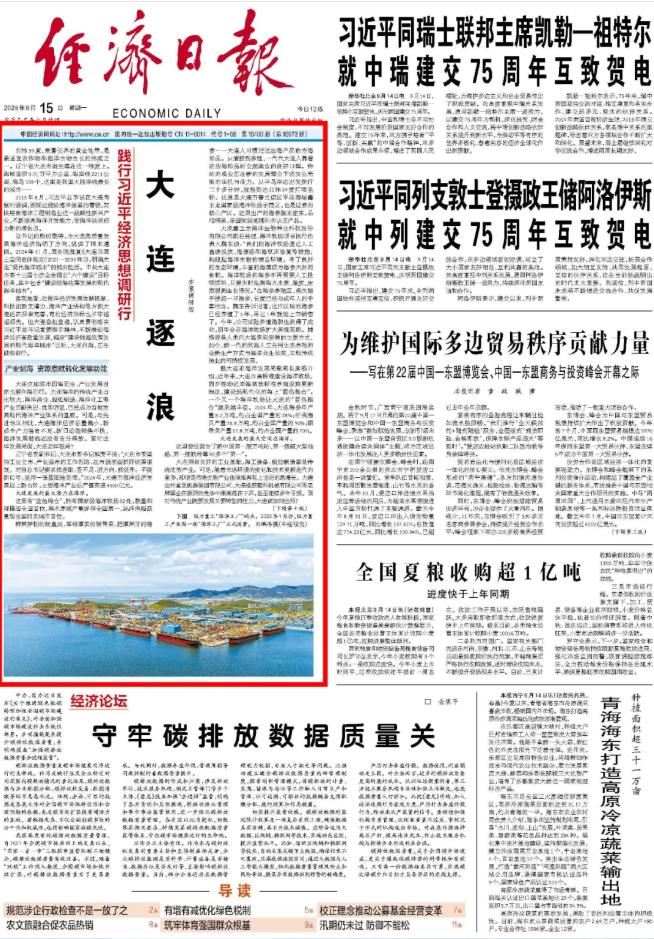
《经济日报》头版头条聚焦大连!
Jing Ji Ri Bao· 2025-09-16 01:25
Group 1 - Dalian is positioned as a modern marine city, with a focus on developing its marine economy as a new growth point, following the guidance of national leadership [7][9][38] - The city aims to achieve a total output value of over 450 billion yuan in its main marine industries by 2024 [11] - Dalian has a strong foundation in traditional marine industries such as fishing, shipbuilding, and marine chemicals, but it faces challenges in scaling up its marine economy compared to advanced regions [11][12] Group 2 - Dalian's marine resources include 32 national-level marine ranches, leading the country in sea cucumber production, with an annual output of 82,000 tons, accounting for 28% of the national total [12][13] - The city is enhancing its marine ranching practices through ecological methods, reducing reliance on artificial feeding and improving sustainability [13][21] - Dalian is also focusing on high-standard construction of marine ranches and modernizing its nearshore aquaculture facilities [13][21] Group 3 - The restructuring of traditional industries, such as the integration of Dalian Heavy Industry Group, aims to enhance competitiveness and diversify operations [15][16] - Dalian Heavy Industry Group has achieved a compound annual growth rate of over 27% in revenue since its restructuring [16] - The city is making strides in producing key components for shipbuilding, such as the world's largest methanol dual-fuel marine crankshaft, which is expected to generate over 600 million yuan in sales by 2025 [16][17] Group 4 - Dalian is advancing in marine technology, with local companies developing innovative solutions like the VDES (Very High Frequency Data Exchange System), which enhances maritime communication [22][23] - The city is home to numerous high-tech enterprises and research institutions, fostering a robust environment for marine technology innovation [27][48] - Dalian's focus on integrating technology into traditional industries is expected to drive significant advancements in marine economic development [19][48] Group 5 - Dalian's tourism sector is experiencing rapid growth, with total tourism revenue reaching 176.53 billion yuan in 2024, a year-on-year increase of 18.2% [36] - The city is shifting its tourism focus from traditional sightseeing to experiential and vacation-oriented offerings, enhancing visitor engagement [37] - Dalian's coastal areas are being developed to attract more tourists, with an emphasis on maintaining ecological integrity while promoting tourism [36][37]

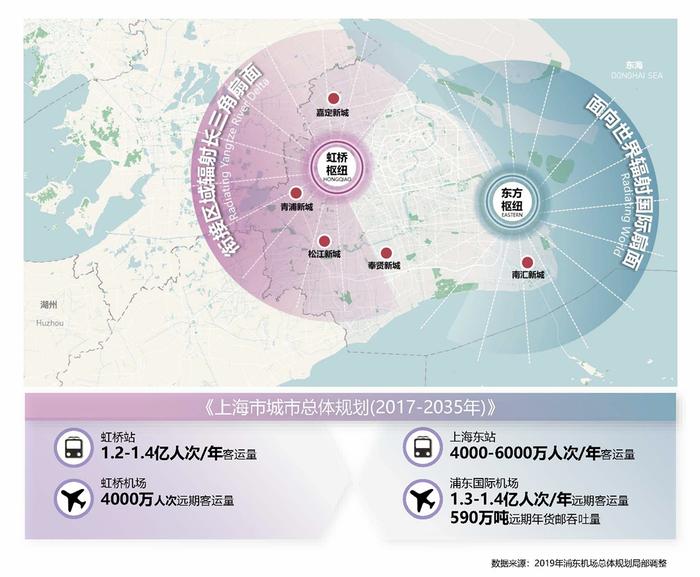
“为国际跨境流动提供最大便利”,东方枢纽大工程有了最新进展
Xin Lang Cai Jing· 2025-06-05 01:13
Core Insights - The Shanghai Oriental Hub is progressing with the first phase of the International Business Cooperation Zone expected to open by the end of this year [1] - The hub aims to become a world-class transportation center, connecting the Yangtze River Delta with global destinations [4][5] - The area is set to enhance Shanghai's role in international trade and business, with a focus on high-value industries [7][21] Planning and Development - The detailed planning for the Oriental Hub has been approved, covering an area of approximately 510 square kilometers [3] - The Shanghai East Station, part of the hub, is designed to handle 400 to 600 million passengers annually, with a total construction area of over 1.3 million square meters [4] - The hub will integrate various transportation modes, including national and regional railways, urban transit, and airport connections [4] Strategic Importance - The Oriental Hub is positioned as a key player in China's international aviation competition, with a projected annual passenger flow of 170 to 200 million [4][7] - It will serve as a center for high-tech industries, including electronic information and biomedicine, enhancing the supply chain network [7] - The hub is expected to facilitate greater international connectivity and resource integration, becoming a pivotal point for the Yangtze River Delta's development [7][8] Industry Focus - The planning emphasizes the development of three main industries: aviation, airport-related industries, and service sectors linked to high-speed rail [17][21] - The area will focus on enhancing the aviation supply chain, increasing the localization rate of the aircraft industry, and fostering innovation [19] - The International Business Cooperation Zone will attract global talent and facilitate cross-border business activities, enhancing Shanghai's international profile [15][20] Infrastructure and Connectivity - The hub will improve transit efficiency and connectivity, with plans to optimize flight schedules and reduce cargo clearance times [12] - A new management framework will allow foreign personnel to enter the business cooperation zone without traditional visa requirements, promoting ease of access [14] - The planning includes a "2+3+10" industrial layout to strengthen connections between the airport economy and surrounding industries [21]