
陈皮造假

Search documents
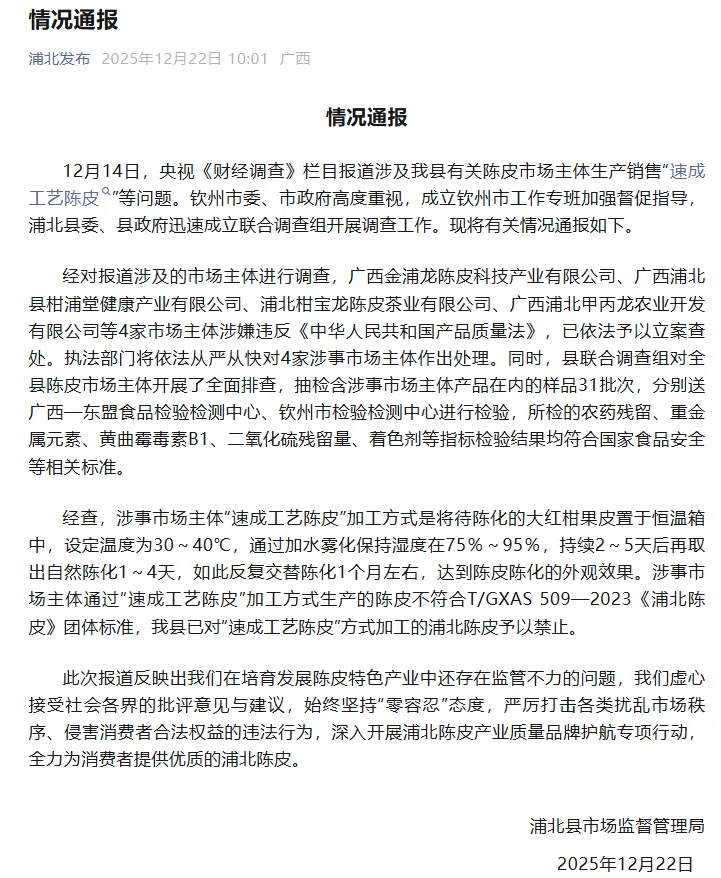
售价千元!成本仅70元?官方通报“速成工艺陈皮”问题:广西4家涉事公司已被立案查处
新浪财经· 2025-12-22 10:29
Core Viewpoint - The article highlights issues in the Chenpi market, particularly regarding the production and sale of "fast-processing Chenpi," which does not meet quality standards and poses risks to consumer rights. The local government is taking strict measures to address these violations and improve market regulation [2][3]. Group 1: Regulatory Actions - The Guangxi Pu Bei County Market Supervision Administration reported that four companies were found to violate the Product Quality Law and have been investigated and penalized [2]. - A comprehensive inspection of 31 batches of products from the involved companies was conducted, with all tested samples meeting national food safety standards [2]. Group 2: Production Methods - The "fast-processing Chenpi" method involves artificially aging the fruit peels in a controlled environment, which does not comply with the local standards for Chenpi production [3]. - The article emphasizes that genuine Chenpi requires a natural aging process of at least three years, while the fast-processing method can produce visually similar products in about one month [11][13]. Group 3: Market Dynamics - The price of fresh fruit for Chenpi production has decreased, affecting the profitability of genuine Chenpi, which can cost around 150 to 200 yuan per pound for naturally aged products, while the cost of "fast-processing" products is significantly lower [9][15]. - There is a growing trend among producers to use "fast-processing" methods to reduce costs and meet market demand, leading to a proliferation of counterfeit products [13][19]. Group 4: Geographic Misrepresentation - The article reveals that many products marketed as "New会 Chenpi" are actually sourced from Guangxi, with a stable supply chain for counterfeit products being established [21][23]. - The local market has seen a mix of genuine and counterfeit products, with some businesses openly selling misrepresented goods under the guise of geographic indicators [25][27]. Group 5: Enforcement and Future Actions - The Jiangmen City Market Supervision Administration has also initiated investigations into companies selling counterfeit products and misusing geographic indicators, with a commitment to strict enforcement and a year-long special rectification campaign [30].

售价千元!成本仅70元?官方通报“速成工艺陈皮”问题:广西4家涉事公司已被立案查处
Mei Ri Jing Ji Xin Wen· 2025-12-22 05:51
Core Viewpoint - The report highlights issues in the Chenpi market, particularly regarding the production and sale of "quick-process Chenpi," which does not meet established quality standards, prompting regulatory actions from local authorities [1][2]. Group 1: Regulatory Actions - The Guangxi Pu Bei County Market Supervision Administration has initiated investigations into four companies for violating the Product Quality Law of the People's Republic of China, leading to legal actions against them [1]. - A comprehensive inspection of the Chenpi market was conducted, with 31 batches of products tested, all of which met national food safety standards [1]. Group 2: Production Methods - The "quick-process Chenpi" method involves artificially aging the fruit peels in controlled conditions, which does not comply with the local standards for Chenpi production [2]. - The local government has prohibited the production of Chenpi using the "quick-process" method, acknowledging regulatory shortcomings in the industry [2]. Group 3: Market Dynamics - The price of fresh fruit for Chenpi production has decreased, affecting the profitability of producers, with high-quality Chenpi costing around 30 yuan per pound, while lower-quality options are priced at six to seven yuan [8]. - The cost of producing "quick-process Chenpi" is significantly lower than that of naturally aged Chenpi, leading to a trend where many producers opt for faster, cheaper methods despite the risks [12][10]. Group 4: Fraudulent Practices - There are widespread issues of mislabeling and fraudulent practices in the Chenpi market, with some products being falsely marketed as aged Chenpi, leading to significant profit margins for sellers [13][15]. - The supply chain for "quick-process Chenpi" has become well-established, with products being sold under false pretenses, including mislabeling as "New Hui Chenpi" [16][17]. Group 5: Government Response - Following media exposure of these issues, local governments in both Guangxi and Guangdong have taken steps to address the fraudulent practices, with joint enforcement actions planned to uphold the integrity of the Chenpi market [19].
央视曝光后,广西浦北凌晨通报
第一财经· 2025-12-15 00:36
Core Viewpoint - The article highlights the issues of counterfeit "Chenpi" (dried tangerine peel) in the market, particularly focusing on the production of "quick-process Chenpi" that misrepresents its age and quality, leading to consumer deception and market disruption [1][4][5]. Group 1: Investigation and Regulatory Response - The Guangxi Qinzhou Pu Bei County Market Supervision Administration has initiated a comprehensive investigation into the reported issues regarding the production and sale of "quick-process Chenpi" following a report by CCTV's "Financial Investigation" program [1]. - A joint investigation team has been formed, involving multiple departments, to address the allegations and enforce strict legal measures against any violations found [1]. Group 2: Market Dynamics and Pricing - The article reveals that the cost of producing genuine Chenpi is significantly higher than that of counterfeit versions, with natural aging requiring at least three years, while "quick-process" methods can produce similar-looking products in just one month at a much lower cost [15][17]. - The wholesale price of genuine five-year Chenpi ranges from 150 to 200 yuan per pound, while the cost of counterfeit "quick-process" Chenpi is only about 70 yuan per pound, leading to substantial profit margins for sellers [17][21]. Group 3: Supply Chain and Consumer Trust - The supply chain for counterfeit Chenpi has become well-established, with many businesses in Guangxi producing and distributing these products under false pretenses, often labeling them as authentic "Xinhui Chenpi" [25][27]. - Retailers in Guangdong's Xinhui district are reportedly purchasing these counterfeit products from Guangxi, leveraging the higher consumer trust associated with the Xinhui brand despite the products being of inferior quality [31][33]. Group 4: Regulatory Challenges and Industry Practices - The article discusses the regulatory framework intended to protect the authenticity of Xinhui Chenpi, but highlights that many companies are circumventing these regulations by mislabeling products and exploiting loopholes [40][49]. - There is a growing concern that the integrity of the Xinhui Chenpi brand is at risk due to the prevalence of counterfeit products, which are often indistinguishable from genuine items to consumers [53][55].

财经调查丨大量“工艺皮”冒充新会陈皮,央视起底陈皮跨省造假产业链
Sou Hu Cai Jing· 2025-12-14 12:59
Core Viewpoint - The report highlights issues in the Chenpi market, including false labeling of age, origin, and production methods, raising concerns about the authenticity of high-priced "aged Chenpi" [1] Group 1: Market Issues - There are allegations that 80% of the so-called Guangdong Xinhui Chenpi is actually sourced from Guangxi [1] - The raw materials for both Guangxi and Guangdong Chenpi come from the same tea branch tangerine, but due to higher costs in Xinhui, some merchants have been sourcing cheaper Guangxi tangerine peels [1] - A stable and mature counterfeit supply chain has developed in Guangxi, where large quantities of "craft peels" are labeled as "Xinhui Chenpi" and shipped to Guangdong [1] Group 2: Business Practices - Local suppliers in Guangxi have established a quick processing and supply system for different "aged" craft peels, which are then purchased by Xinhui merchants for e-commerce sales [1] - Some merchants admit that the lower prices and difficulty in identifying the origin of "craft peels" make it easier to gain consumer trust when shipping from Xinhui [1] - Despite clear geographical indications prohibiting the labeling of non-local Chenpi as "Xinhui Chenpi," there are still instances of companies violating these regulations by authorizing the use of the "Xinhui Chenpi" label [1]
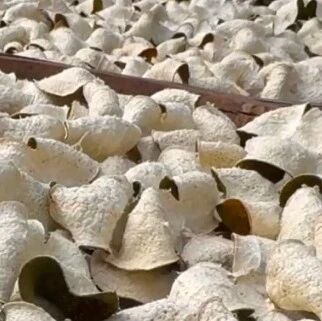
财经调查丨千元假陈皮成本仅70元!你买的高价陈皮或是“工艺皮”
Sou Hu Cai Jing· 2025-12-14 12:52
Group 1 - The article highlights issues in the Chenpi market, including false labeling of age, origin, and production methods, leading to concerns about the authenticity of high-priced "aged Chenpi" [1] - In Guangxi Pubei, a significant production area for tea branch tangerines, the cost of new tangerine peels is low, while the standard requires natural aging for over three years to be classified as Chenpi [1] - A "light processing" method is becoming popular among some Chenpi producers, allowing them to process freshly harvested tangerine peels into products resembling three- or five-year aged Chenpi in just one month [1] Group 2 - The cost of producing counterfeit "craft Chenpi" is around 70 yuan per pound, leading to high profit margins that incentivize more businesses to abandon natural aging processes [1] - In the sorting workshop of Guangxi Pubei County Ganputang Health Industry Co., large quantities of counterfeit "craft Chenpi" were observed, with color differences due to processing heat variations being labeled as different ages [1] - The wholesale price for all "craft Chenpi" is approximately 70 yuan per pound, while retail prices vary significantly, with five-year labeled products selling for 500 yuan per pound and ten-year labeled products for 1000 yuan per pound, resulting in profits exceeding ten times the cost [1]