
新会陈皮

Search documents
智汇广东土特产 赋能“广货行天下”——“广货行天下·社科一席谈”
Xin Lang Cai Jing· 2026-02-26 23:52
Core Viewpoint - The "Guangdong Goods Going Global" initiative is a significant measure for economic development in Guangdong, emphasizing the importance of cultural narratives and brand building in enhancing the competitiveness of local products [2][5][10]. Group 1: Economic Development and Strategy - The "Guangdong Goods Going Global" spring action is a key initiative for economic growth, with the social sciences community playing an essential role in providing intellectual support [2][3]. - The initiative aims to enhance the market presence of Guangdong products by focusing on optimizing the business environment and expanding both domestic and international markets [2][3]. - The social sciences community is encouraged to strengthen collaboration and identify effective strategies to contribute to the initiative's success [2][3]. Group 2: Brand and Cultural Development - The narrative surrounding Guangdong products is crucial for their market success, as it transforms them into cultural symbols that resonate with consumers [7][8]. - Successful examples, such as the rise of the New Year tangerine peel industry, demonstrate how cultural storytelling can enhance product value and market competitiveness [8]. - Building strong brands requires time, quality assurance, and consumer recognition, with a shift from merely selling products to creating emotional connections with consumers [9][10]. Group 3: Agricultural and Product Standards - The development of Guangdong's local specialties is vital for rural revitalization, with a focus on enhancing brand recognition and standardization [10][11]. - There is a need to establish a comprehensive branding system for local products, ensuring quality and protecting brand integrity through digital traceability [11][12]. - Upgrading local standards to national levels and aligning with international standards is essential for improving product quality and facilitating exports [11][12]. Group 4: Innovation and Market Expansion - The flower industry in Guangdong, with a significant cultivation area and output value, is positioned as a leading sector, but it faces challenges in the entire supply chain [12][13]. - Innovations in seed quality and digital technologies are necessary to enhance production efficiency and product quality in the flower industry [13]. - The integration of cultural elements into product marketing can enhance the appeal of local specialties, making them more competitive in the market [19][20]. Group 5: Non-material Cultural Heritage and Product Differentiation - The integration of non-material cultural heritage into local products can create unique selling propositions, differentiating them in a crowded market [18][19]. - Emphasizing the cultural significance of products, such as through storytelling and experiential marketing, can enhance consumer engagement and brand loyalty [19][20]. - Collaborative efforts to leverage cultural heritage can support rural revitalization and enhance the overall value of local products [20].
挥“农”墨于岭南大地,执“工”笔绘“两业融合”新篇
Nan Fang Nong Cun Bao· 2026-02-24 03:06
Core Viewpoint - Guangdong is focusing on high-quality development through the integration of manufacturing and service industries, aiming to transition from scale to quality leadership in its economy [11][12][13]. Group 1: Economic Strategy - Guangdong has been the "first engine" of the national economy for 37 consecutive years and is strategizing to maintain its leadership in the "14th Five-Year Plan" period [7][9]. - The 2026 Guangdong High-Quality Development Conference will emphasize the collaborative development of manufacturing and service industries [11]. Group 2: Industry Integration - The province is implementing measures to promote the deep integration of manufacturing and productive services, with a focus on transforming from "manufacturing" to "intelligent manufacturing" [25][30]. - Guangdong's agricultural sector is evolving by integrating agricultural equipment manufacturing with socialized agricultural services, enhancing production relationships and value chains [33][34]. Group 3: Talent Development - Guangdong is prioritizing "investment in people," emphasizing the integration of human resources with manufacturing to drive long-term economic development [73][75]. - The province is cultivating "new farmers" and rural leaders through various training programs, such as the "Rural CEO" training initiative [83][86]. Group 4: Cultural and Consumer Experience - The integration of manufacturing and service industries is redefining "Guangdong goods," transforming products into cultural experiences and consumption scenes [116][118]. - Industrial design is becoming a key driver for high-quality development, with initiatives like the "Mayor's Cup" Industrial Design Competition promoting innovation [120][123]. Group 5: Agricultural Innovation - The establishment of smart farms in Guangdong is showcasing the collaboration between manufacturing and technology services, with examples of fully automated agricultural processes [46][49]. - The province is leveraging modern logistics and digital marketing to enhance the agricultural value chain, as seen in the case of lychee production in Maoming [128][130].


一味陈皮入赣汤 岭南味暖江西年|家乡的广货
Nan Fang Nong Cun Bao· 2026-02-23 00:35
Core Viewpoint - The article highlights the cultural significance and culinary integration of Xinhui Chenpi (dried tangerine peel) in Jiangxi's New Year celebrations, showcasing its role in enhancing traditional dishes and beverages, thus symbolizing the fusion of Guangdong and Jiangxi flavors [3][8][30]. Group 1: Culinary Integration - Jiangxi's New Year flavors prominently feature rich soups such as stewed duck with winter bamboo shoots and chicken with mushrooms, where Xinhui Chenpi plays a crucial role in balancing the flavors [2][8]. - The process of incorporating Xinhui Chenpi into soups involves softening the peel and adding it during cooking, which enriches the broth with its unique aroma and taste [17][18]. Group 2: Cultural Significance - Xinhui Chenpi has a long history, dating back to the Song Dynasty, and was recognized as a tribute item in the Ming and Qing Dynasties, valued for its medicinal properties [9][10]. - The production of Xinhui Chenpi has evolved into a significant industry, generating over 28 billion yuan annually, and is now a representative product of Lingnan culture [13][14]. Group 3: Symbol of Connection - Xinhui Chenpi is not only a culinary ingredient but also a popular gift during New Year visits, symbolizing warmth and connection between families across regions [24][26]. - The article emphasizes that a small jar of Xinhui Chenpi serves as a cultural bridge, carrying blessings and memories between Guangdong and Jiangxi [26][30].
年轻人采买新式年货,促进代际沟通的新方式 | 马上中国年
Xin Lang Cai Jing· 2026-02-20 12:24
Core Insights - The article discusses the evolving trend of purchasing "new-style" New Year goods among young people in China, reflecting their changing lifestyles and values [1][3][4] - It highlights the shift in the responsibility of New Year shopping from older generations to younger ones, allowing for more personalized and modern choices [3][6] Group 1: Market Trends - Young consumers are increasingly opting for unique and personalized New Year goods, such as specialty food items and convenient services, indicating a shift in consumer preferences [1][4] - A survey by China Youth Daily shows that over 90% of respondents are preparing to buy "new-style" New Year goods, showcasing a significant market demand [1] Group 2: Intergenerational Communication - The process of young people taking over New Year shopping responsibilities fosters better communication and understanding between generations, as it allows for the introduction of new traditions and preferences [3][6] - The article emphasizes that new-style New Year goods serve as a medium for enhancing familial bonds and facilitating deeper conversations between parents and children [4][6] Group 3: Emotional Connection - The choice of New Year goods reflects young people's emotional states and their desire for connection with family, moving away from traditional items to those that resonate with their current lives [4][6] - The article suggests that the evolving nature of New Year goods is a response to the younger generation's need for recognition and understanding from their families [6]
中青评论:年轻人定制“新式”年货,促进代际沟通的新方式
Xin Lang Cai Jing· 2026-02-20 09:19
Core Viewpoint - The choices of young people regarding new-style New Year goods reflect their current concerns, values, and states of being [1][3]. Group 1: Market Trends - A significant number of young people have taken over the responsibility of purchasing New Year goods, becoming "new-style New Year curators" [1][3]. - Over 90% of respondents in a recent survey expressed their intention to buy "new-style" New Year goods [1]. Group 2: Generational Communication - The process of transferring the "New Year goods purchasing rights" to the younger generation allows for greater personalization and understanding between generations [3][5]. - New-style New Year goods serve as a medium for enhancing communication and connection between young people and their parents [5]. Group 3: Changing Consumption Patterns - Young consumers are increasingly willing to spend on services such as year-end cleaning, beauty treatments, and New Year dinner reservations, reflecting a desire for convenience and quality time with family [1][5]. - The shift in New Year goods from traditional local specialties to more diverse and personalized options indicates a change in lifestyle and priorities among young people [3][5].
立足商贸与制造优势 构建“广货行天下”新格局
Xin Lang Cai Jing· 2026-02-19 00:29
Core Insights - The central economic work meeting in December 2025 emphasized the importance of "domestic demand as the main driver" for economic work in 2026, with Guangdong launching the "Guangdong Goods Going Global" spring initiative to enhance the visibility and influence of local products [1] Group 1: Current Status of "Guangdong Goods" - The concept of "Guangdong Goods" has evolved from traditional products to include modern innovations such as drones, electric vehicles, and 5G smartphones, while traditional products like clothing and furniture have undergone brand rejuvenation [1] - Guangdong's foreign trade reached a record high of 9.49 trillion RMB in 2025, accounting for 20.9% of the national total and contributing 24.1% to national foreign trade growth [2] Group 2: Competitive Advantages of "Guangdong Goods" - The national open policy has provided a fundamental guarantee for the international expansion of "Guangdong Goods," aligning with central government initiatives to boost consumption and supply quality products [3] - Guangdong's manufacturing system has shown resilience amid global economic adjustments, with over 530 local enterprises participating in international trade exhibitions, highlighting their significant role in the global supply chain [3] Group 3: Strategies for Advancement - Improving product quality is essential, focusing on establishing a comprehensive quality control system and fostering "champion" enterprises in niche markets to create differentiated competitive advantages [4] - Reducing product costs through supply chain collaboration, digital transformation, and leveraging economies of scale is crucial for enhancing competitiveness [5] - Enhancing after-sales service systems to provide comprehensive support and improve brand loyalty in global markets is a priority [5] Group 4: Environmental and Market Expansion Strategies - Emphasizing green transformation to align with international environmental standards and promote sustainable development in manufacturing is vital [7] - Expanding international markets by integrating Lingnan culture into product design and marketing strategies can enhance global competitiveness [8]
陈皮星油藤亮相全国农民新春联欢,粤桂协作成果香飘三晋
Nan Fang Nong Cun Bao· 2026-02-17 09:01
Core Viewpoint - The event "Dadi Liucai・He Mei Xiangcun Qing Fengnian" showcased the collaboration between Guangdong's Jiangmen Xinhui District and Guangxi's Ningming County, highlighting the successful integration of traditional products like Chenpi and innovative offerings such as Chenpi Xingyouteng [3][10][12]. Group 1: Event Highlights - The event featured a variety of products, including Chenpi and Chenpi Xingyouteng, demonstrating the cultural heritage and collaborative achievements of Xinhui and Ningming [3][5]. - The innovative product Chenpi Xingyouteng, which combines the strengths of both regions, attracted significant attention from attendees [6][7]. Group 2: Collaborative Efforts - Xinhui District and Ningming County have deepened their collaboration through the "Newhui Chenpi + Ningming Xingyouteng" initiative, which promotes the integration of resources and capabilities [10][12]. - The partnership includes the establishment of a shared research platform, production workshops, market systems, and storage facilities, creating a comprehensive industry chain from cultivation to sales [15][16]. Group 3: Economic Impact - Since the implementation of the Chenpi Xingyouteng project, the planting area in Ningming has expanded to 60,000 acres, benefiting 12,000 farming households [17]. - The initiative has led to an average annual income increase of over 15,000 yuan per household, transitioning from "blood transfusion-style assistance" to a "blood-making-style win-win" model [18].
品牌引领,价值跃升|“四个农业”的广东实践④
Nan Fang Nong Cun Bao· 2026-02-13 02:33
Core Viewpoint - Guangdong is advancing its agricultural development through a focus on brand agriculture, which is seen as a key driver for enhancing competitiveness and breaking down barriers in agricultural product sales [8][9][12]. Brand Agriculture Development - The "14th Five-Year Plan" emphasizes the importance of brand agriculture as a means to connect various agricultural developments and enhance the core competitiveness of Guangdong products [8][9]. - Guangdong's media-driven initiatives are aimed at enhancing brand visibility and market penetration for local agricultural products [12][22]. Cultural Integration - The integration of culture into agricultural branding is exemplified by the "Father's Love Like Orchid" campaign, which connects the resilience of orchids with deep emotional ties, transforming traditional sales into a cultural experience [40][56]. - The "Year Fish" concept in Zhuhai merges traditional cultural elements with the seafood industry, leading to significant sales growth during festive seasons [58][70]. Market Expansion - Guangdong's agricultural products are increasingly penetrating national and international markets, with notable demand in regions like Beijing and Southeast Asia [19][76]. - The collaboration between Guangdong enterprises and businesses in other provinces, such as Hunan, has resulted in substantial sales agreements, exemplified by an 11 billion yuan contract for seafood products [87]. Innovative Marketing Strategies - The "Media+" initiative has led to innovative marketing strategies, including live streaming events that significantly boost product visibility and sales, as seen with the 192 million units of lychee sold during a promotional event [28][30]. - The use of social media platforms for marketing has transformed local farmers into influencers, enhancing the reach of agricultural products [35][39]. Future Outlook - Guangdong aims to continue leveraging its unique cultural heritage and innovative marketing strategies to expand its agricultural brand presence globally, with a focus on quality and cultural significance [109].
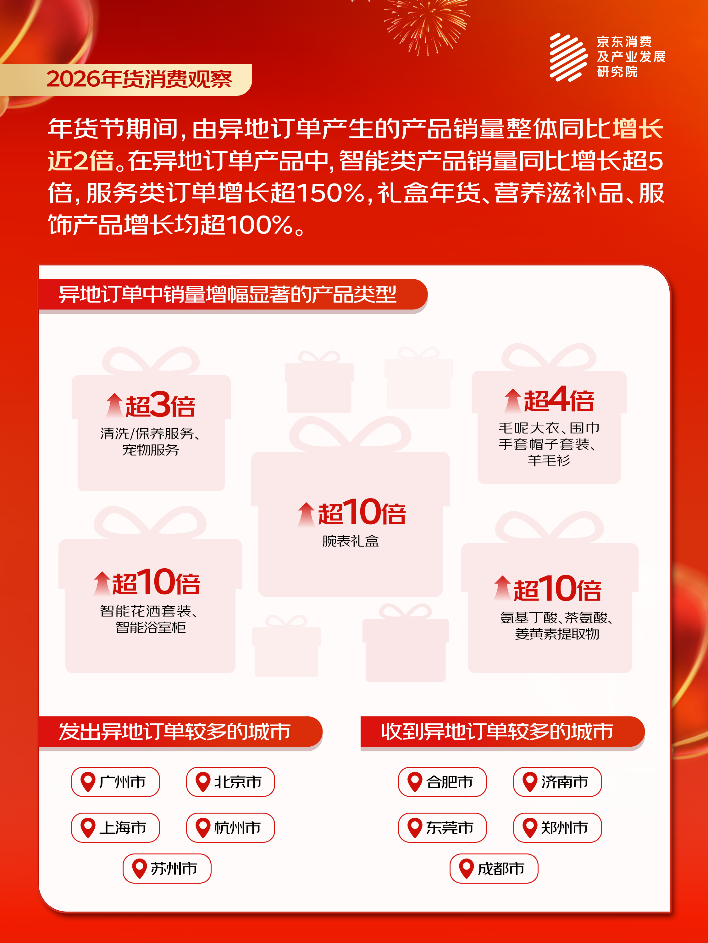
京东消费观察看“流动的年货”:异地年货订单同比增长近2倍,合肥、济南、东莞等地收到更多外省包裹
Zhong Jin Zai Xian· 2026-02-11 09:22
Core Insights - The article highlights the significant increase in cross-regional orders for traditional Chinese New Year goods, with overall sales growth of nearly 200% since the start of the festival season [4][6] - The trend reflects a shift in consumer behavior, where younger generations are sending not only traditional foods but also modern products and services to their families, indicating a blend of cultural heritage and contemporary lifestyle [2][8] Group 1: Cross-Regional Order Trends - Cross-regional orders have seen a nearly 200% increase in product sales, with specific regions like Tibet, Xinjiang, and Yunnan experiencing over 300% growth in order volume [4][6] - Major cities such as Guangzhou, Beijing, and Shanghai are the primary sources of these orders, while cities like Hefei, Jinan, and Zhengzhou are the main recipients [6][9] Group 2: Product Categories and Consumer Preferences - The diversity of products in cross-regional orders has expanded from traditional foods to include smart products and health supplements, with smart toilets and watch gift boxes seeing sales growth exceeding 1000% [2][8] - Local specialties have also gained traction, with overall sales growth of over 140%, particularly in Zhejiang, which saw a 571% increase [9][12] Group 3: Consumer Motivations and Cultural Significance - Consumers prioritize unique flavors and authenticity when selecting local specialties, with 56.6% emphasizing the importance of "authentic taste" [3][11] - The emotional connection to traditional foods and the desire to share these experiences with family are significant motivators for purchasing [15]

2026年广东省职工生态健步行活动在广州举行
Nan Fang Ri Bao Wang Luo Ban· 2026-02-09 09:14
Core Viewpoint - The event "Healthy Steps Welcoming the New Spring" in Guangdong aims to promote ecological awareness and support local agriculture through a combination of sports, culture, and tourism initiatives [1] Group 1: Event Overview - The event took place at the Huangpu Water Sound Reservoir Trail and Leisure Wetland Park in Guangzhou, attracting nearly 1,000 model workers and employee representatives [1] - Two circular routes of 5 kilometers and 10 kilometers were set up, connecting various ecological points such as Rainbow Steps and Forest Oxygen Bar, with multiple supply stations and medical points available [1] Group 2: Agricultural Support and Community Engagement - The event featured a marketplace called "Agricultural Support and Workers' Fair," showcasing 50 booths with local specialty agricultural products from various regions, including sweet potatoes from Wengyuan and red tea from Yingde [1] - Notable products included those recommended by local mayors, representing both local culture and the achievements of the "Hundred Million Project" [1] Group 3: Strategic Importance - This initiative is part of the "Guangdong Workers' Cultural and Sports Exchange" provincial demonstration project series, integrating sports with cultural, ecological, and tourism elements [1] - The event not only creates new cultural and sports activity scenarios for workers but also contributes to regional development and supports the implementation of the "Hundred Million Project" and rural revitalization strategies [1]