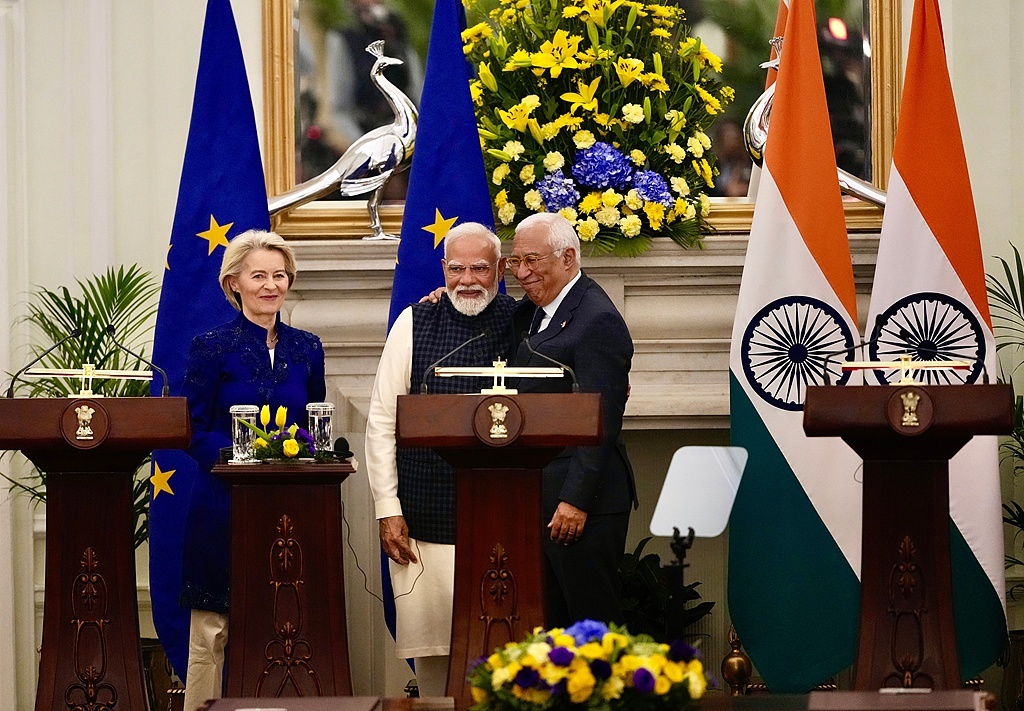
降低对美依赖

Search documents
急了?印欧签署自贸协定,美财长抨击:实在让人非常失望
Huan Qiu Wang· 2026-01-29 02:47
Group 1 - The core point of the news is the signing of a free trade agreement between India and the European Union, which has drawn criticism from the U.S. Treasury Secretary Janet Yellen [1][3] - The agreement is seen as a strategic move for both India and the EU, creating a large market covering 2 billion people, with the EU being India's largest trading partner [1][4] - The bilateral trade volume between India and the EU is projected to reach €120 billion in 2024, accounting for 11.5% of India's total trade [1][3] Group 2 - The U.S. Treasury Secretary expressed disappointment with the EU's decision to pursue this agreement, suggesting it undermines collective action regarding global issues [3] - The agreement is viewed as a response to the U.S. imposing a 50% tariff on Indian goods last year, indicating India's efforts to diversify its export markets [4] - The signing of this agreement is part of a broader trend where U.S. trade partners are seeking to reduce their dependence on the U.S. and strengthen ties with other markets [4]

印欧达成自由贸易协定
Guo Ji Jin Rong Bao· 2026-01-28 07:49
Group 1 - The India-EU Free Trade Agreement (FTA) is the largest trade deal the EU has ever reached, aimed at facilitating European automotive and industrial goods access to the Indian market [1] - The agreement is seen as a strategic move by medium powers to reduce dependence on the US amid rising global trade uncertainties and tariffs imposed by the Trump administration [1] - The EU Commission President referred to the agreement as a "mother of all agreements," emphasizing Europe's choice of cooperation and strategic partnerships in response to global instability [1] Group 2 - The FTA still requires final text completion and approval from both parties, which may take a year or longer, needing consent from the European Parliament and member states [2] - Once effective, the agreement is expected to eliminate or reduce tariffs on most goods traded between the EU and India, potentially saving the EU approximately $4.8 billion annually in tariff costs [2] - Key provisions include the reduction of Indian tariffs on EU machinery, chemicals, and pharmaceuticals, with automotive tariffs decreasing from 110% to 10% for up to 250,000 vehicles annually [2] Group 3 - Indian Prime Minister Modi stated that the agreement will boost confidence among businesses and investors in India, covering about a quarter of the global economy [3] - The agreement is expected to lower tariffs on labor-intensive products exported to Europe, which exceed $30 billion, from 4% to 26% down to zero, benefiting sectors like apparel, footwear, seafood, plastics, and jewelry [3] - India has surpassed Japan to become the world's fourth-largest economy and is projected to overtake Germany within three years [3] Group 4 - European officials anticipate that EU exports to India could double following the implementation of the agreement [4]
印欧签署自贸协定,美媒称“降低对美依赖”
Huan Qiu Shi Bao· 2026-01-27 22:43
Group 1 - The core point of the news is the signing of a free trade agreement between India and the European Union, which is seen as a new chapter in their strategic relationship and a move to reduce dependence on the United States [1][3] - The agreement covers approximately 25% of global GDP and about one-third of global trade, complementing India's previous trade agreements with the UK and the European Free Trade Association [3] - The agreement is expected to significantly boost India's manufacturing sector and expand its service industry, creating a large market covering 2 billion people [3] Group 2 - India will substantially reduce tariffs on EU products, with automotive tariffs decreasing from 110% to 10%, benefiting European car manufacturers [3] - Agricultural products have been excluded from the agreement to appease the Indian government, which views this as a non-negotiable "red line" [3] - The agreement is seen as a necessary response for India, which has been seeking alternative export markets due to punitive tariffs imposed by the United States [4]