非弹性需求

Search documents
“金价2026年最高触及5000美元,白银和铂族金属将跟随补涨”!德银大幅上调明年金价预测
Hua Er Jie Jian Wen· 2025-11-27 03:27
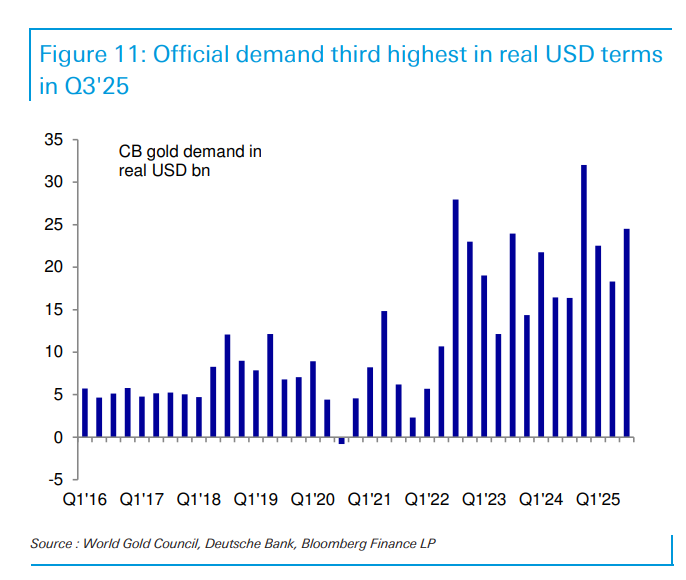
Core Viewpoint - Deutsche Bank has issued a strong bullish signal for gold, raising its average price target for 2026 from $4,000 to $4,450 per ounce, with an expected annual price range of $3,950 to $4,950 per ounce, potentially reaching $4,950, indicating a possible challenge to the $5,000 mark [1][2] Group 1: Demand Dynamics - The structural bull market for gold is driven by rigid official purchases replacing price-sensitive consumer demand, with central bank and ETF investments becoming the dominant forces in the gold market [1][2] - Official gold demand rebounded significantly in Q3, reaching 220 tons, just below Deutsche Bank's forecast of 239 tons, marking the third-highest official demand level on record in dollar terms [3][6] - Deutsche Bank anticipates that official demand will rise to 1,053 tons per year by 2026, which is crucial for their price forecast [6][9] Group 2: Supply Constraints - Global gold mining output increased by 72 tons to a record 977 tons in Q3, but this growth was easily surpassed by the increase in official and ETF demand [11] - The Grasberg mine's production interruption is significant, with expectations for a phased restart in 2026, impacting overall supply [12] Group 3: ETF Investment Trends - After four years of net outflows, ETF investors returned to the market in 2025, indicating a normalization of inflows and reinforcing the support level at $3,900 per ounce [9][10] - The short-term ETF gold sell-off has shown signs of normalization, with fluctuations between small net buying and selling [10] Group 4: Broader Precious Metals Market - The supply-demand imbalance is not limited to gold; silver, platinum, and palladium are also experiencing upward trends due to prolonged supply shortages [13] - Deutsche Bank projects a silver price of $55.1 per ounce by 2026, with expectations of continued supply deficits [13] - For platinum, investment demand is expected to rebound to 500,000 ounces in 2026, with a supply deficit similar to the past two years [13] - Palladium demand is supported by factors in the automotive industry, with a significant portion of demand still coming from catalytic converters [14]

If There's Such a Thing as a Recession-Resistant Stock, This Is It
The Motley Fool· 2025-05-30 21:15
Company Overview - AutoZone, founded in 1979, has grown from a single store to 6,500 locations in the U.S. and expanding in Mexico and Brazil [4] - The company is recognized for its strong brand and customer service, catering to both automotive repair technicians and DIY customers [3] Financial Performance - For fiscal 2024, AutoZone reported net sales of $18.5 billion, a year-over-year increase of nearly 6%, and earnings per share (EPS) rose 13% to $149.55 [5] - In the third quarter of fiscal 2025, net sales increased by 5.4% to $4.5 billion, with domestic same-store sales up 5% [5] - EPS in the latest quarter decreased by 3.6% compared to the previous year, attributed to aggressive investments in growth rather than weak demand [6] Growth Strategy - AutoZone is focusing on expanding its market share in the commercial sector by enhancing delivery capabilities, increasing sales staff, and opening "mega-hub" stores [7] - The company is committed to long-term growth despite short-term margin pressures due to these investments [7] Market Position - The automotive aftermarket, valued at over $2.3 trillion globally, is characterized by inelastic demand, making AutoZone's core business resilient even during economic downturns [9][10] - The average age of vehicles on U.S. roads has reached a record 12.8 years, indicating a growing need for maintenance and parts, which benefits AutoZone [13] Share Buyback Program - AutoZone has repurchased over $38 billion of its own shares since 1998, significantly reducing its shares outstanding [14][15] - The company has $1.1 billion remaining in its current buyback authorization, indicating a strong commitment to returning value to shareholders [15] Valuation and Future Outlook - AutoZone's forward price-to-earnings ratio is around 25, which is lower than competitor O'Reilly Auto Parts at 31, suggesting reasonable valuation [17] - The U.S. automotive aftermarket is projected to reach $617 billion by 2027, providing substantial growth opportunities for AutoZone [17]