
韩元汇率波动

Search documents
由于本币持续承压 韩国据悉将推迟兑现今年对美投资200亿美元的承诺
Xin Lang Cai Jing· 2026-01-20 12:26
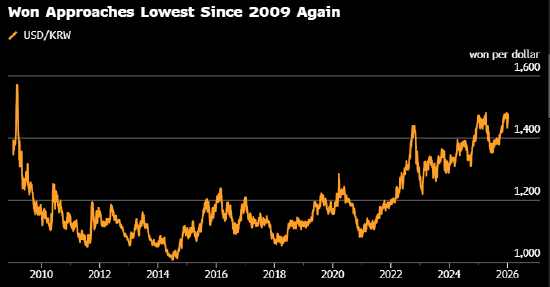
Core Viewpoint - South Korea will delay its commitment to invest up to $20 billion in the U.S. this year due to pressure on its currency, the won, and will wait for stabilization in the foreign exchange market before proceeding [1][4]. Group 1: Currency and Economic Conditions - The won has depreciated over 8% against the dollar since the second half of 2025, with policymakers' measures failing to prevent its decline to the weakest level since the global financial crisis [1][4]. - Capital outflows from both corporate and retail investors are contributing to the weakening of the won, although it is expected to stabilize eventually [1][4]. Group 2: Investment Commitments and Agreements - As part of a trade agreement, South Korea has committed to a total investment of $350 billion in the U.S., raising concerns about its ability to support such large-scale capital expenditures [1][4]. - The U.S. has agreed to allow South Korea to set an annual cap of $20 billion on dollar outflows and to adjust the timing flexibly if the foreign exchange market becomes unstable [3][6]. Group 3: Government Statements and Market Reactions - U.S. Treasury Secretary Scott Bessenet's recent comments provided some support for the won, but it is too early to assess their impact [3][6]. - Following Bessenet's remarks, the won experienced a brief rebound on January 14, but subsequently weakened again over the next two trading days [3][6]. - The South Korean Finance Ministry indicated that the $350 billion investment in the U.S. is "unlikely" to commence in the first half of 2026 [3][6].

韩国央行行长直言韩元疲软与基本面脱节
Sou Hu Cai Jing· 2026-01-15 03:46
Core Viewpoint - The Bank of Korea, led by Governor Lee Chang-yong, is actively addressing the recent volatility of the Korean won and is implementing measures to stabilize the foreign exchange market amid depreciation pressures [1] Group 1: Currency Policy and Measures - The Bank of Korea has collaborated with the Ministry of Welfare and the National Pension Service (NPS) to conduct foreign exchange hedging operations to stabilize the foreign exchange market [1] - If the foreign exchange market remains unstable, the central bank will not agree to an annual outflow of $20 billion in investment funds to the United States [1] - The government is expected to make a statement later regarding the U.S. trade agreement and the foreign exchange market [1] Group 2: Economic Context and Implications - The recent depreciation of the won is primarily influenced by geopolitical risks and an increase in residents' overseas investments, which has intensified capital outflow pressures [1] - Despite the depreciation, Lee emphasized that the weakness of the won does not reflect the fundamental aspects of the Korean economy, which currently has ample dollar reserves [1] - The weakening won may lead to inflationary pressures, potentially prompting an interest rate hike of about 200 to 300 basis points if the policy rate is to stabilize the foreign exchange market [1]
野村:韩国央行降息周期终结 经济过热风险或倒逼加息
智通财经网· 2025-12-16 08:13
Group 1: Economic Outlook - The Bank of Korea's interest rate cut cycle is likely over, with expectations to maintain rates until 2026, leaning towards potential rate hikes due to stronger economic growth [1][2] - Economic growth is anticipated to exceed potential growth rates, driven by robust domestic consumption, a recovery in the construction sector, and a global semiconductor upcycle [1][2] - The consumer price index (CPI) in South Korea rose by 2.4% year-on-year in November, surpassing economists' median forecast of 2.3% [2] Group 2: Currency and Market Dynamics - South Korea is expected to generate over 50 trillion KRW in new liquidity by 2026, which may flow into real estate or asset markets, despite increased overseas investments by households and institutional investors [3] - The Korean won has depreciated over 4% since the fourth quarter, with the USD/KRW exchange rate reported at 1475.5, raising concerns for the government regarding currency stability [3][4] - The National Pension Service (NPS) is expected to play a more significant role in stabilizing the currency, transitioning from a passive dollar buyer to an active market regulator [4]
韩国对美出口额暴跌超40%
Sou Hu Cai Jing· 2025-10-14 07:15
Core Insights - South Korea's exports to the United States have sharply decreased by over 40% year-on-year in the first ten days of this month, marking a significant decline in trade relations [1] - The U.S. has fallen from being South Korea's second-largest export market to the third-largest since the implementation of new U.S. tariff policies in July [1] - The recent fluctuations in the South Korean won's exchange rate have raised concerns, prompting the Ministry of Economy and Finance and the Bank of Korea to issue a joint statement emphasizing their vigilance and monitoring of market trends [1] Export Market Dynamics - The U.S. has historically been a key market for South Korean exports, but recent tariff policies have negatively impacted this relationship [1] - The decline in exports to the U.S. reflects broader challenges in South Korea's trade environment [1] Currency Fluctuations - The South Korean won has experienced significant volatility, which is a critical factor affecting export performance [1] - The joint statement from the Ministry of Economy and Finance and the Bank of Korea indicates a proactive approach to managing currency fluctuations, marking the first verbal intervention in over a year and a half [1]
韩元跌幅扩大至0.7%,韩国股市回吐涨幅
news flash· 2025-06-10 05:37
Group 1 - The South Korean won has depreciated by 0.7%, leading to a reversal in the gains of the South Korean stock market [1]