
外汇市场稳定

Search documents
韩国称美国外汇报告表明韩元单边走势是不适当的
Xin Lang Cai Jing· 2026-01-29 23:25
Group 1 - The South Korean Ministry of Finance stated that the U.S. Treasury report indicates the depreciation of the Korean won by the end of 2025 is "inconsistent with South Korea's strong economic fundamentals," suggesting that the U.S. Treasury acknowledges the inappropriate unilateral trend of the won [1][2] - The South Korean government will continue to maintain close communication with the U.S. Treasury to enhance mutual understanding and trust regarding the foreign exchange market, aiming to ensure stability in the foreign exchange market [1][2]
坚韧的人民币:全球交易占比跃至8.6%,套保比例首破30%大关
Sou Hu Cai Jing· 2026-01-17 00:19
Core Viewpoint - The Chinese foreign exchange market demonstrates remarkable stability amidst global financial turbulence, with the National Foreign Exchange Administration projecting a balanced supply and demand for 2025, supported by strong data indicating resilience and vitality [1][3]. Group 1: Market Performance Indicators - The share of the Renminbi in global foreign exchange trading has risen to 8.6%, with the corporate foreign exchange hedging ratio reaching 30% for the first time, and the total trading volume of the Chinese foreign exchange market climbing to $42.6 trillion [1]. - China's economic total is expected to reach approximately 140 trillion RMB by 2025, reflecting a growth of about 40% over five years, providing a solid foundation for the foreign exchange market [3]. Group 2: Structural Changes and Policy Support - The high-tech industry saw a year-on-year increase of 9.2% in value added for the first eleven months, indicating a rapid growth of new productive forces that enhance China's economic growth potential and boost international investor confidence in Renminbi assets [3]. - The foreign exchange management department plans to introduce 28 policy measures by 2025 to support foreign trade and facilitate investment, significantly promoting cross-border trade and investment activities [3]. Group 3: Market Dynamics and Risk Management - The increasing diversity of market participants, including domestic and foreign financial institutions, along with a richer array of foreign exchange derivatives offered by banks, has lowered the barriers for enterprises to hedge against risks [3]. - The reform of the Renminbi exchange rate formation mechanism and the improvement of macro-prudential management tools serve as dual pillars for maintaining foreign exchange market stability [5]. Group 4: Future Outlook - The Renminbi has become the fastest-growing currency in terms of global transaction share, reflecting a substantial increase in its international usage and recognition [5]. - The Renminbi exchange rate has shown unexpected elasticity amidst significant fluctuations in major economies' monetary policies, indicating a more resilient Chinese foreign exchange market that can effectively manage risks for domestic and international entities [5].

中国人民银行:2025年人民币对美元升值4.4%,国债收益率稳定
Sou Hu Cai Jing· 2026-01-15 15:02
Group 1 - The central bank's vice governor, Zou Lan, stated that the financial market is operating smoothly, with measures in place to maintain stability in the foreign exchange market [1] - The Chinese yuan has appreciated by 4.4% against the US dollar, indicating a positive trend in currency valuation [1] - The bond market is also reported to be stable, with the yield on the representative 10-year government bonds remaining around 1.8% to 1.9% [1] Group 2 - The central bank emphasizes the importance of managing expectations and maintaining a balance in foreign exchange supply and demand [1] - Market confidence has been effectively boosted, leading to increased trading activity [1]
无意通过汇率贬值获取国际贸易竞争优势!汇率风险管理仍是重点
Bei Jing Shang Bao· 2026-01-15 13:42
Core Viewpoint - The press conference highlighted the effectiveness of monetary and financial policies in supporting the high-quality development of the real economy, with a focus on the stability and resilience of China's foreign exchange market in 2025 and expectations for 2026 [1][3]. Group 1: Foreign Exchange Market Performance - In 2025, China's foreign exchange market achieved a record trading volume of $42.6 trillion, with the corporate foreign exchange hedging ratio rising to 30%, both marking historical highs [1][4]. - The RMB/USD exchange rate surpassed 7 yuan by the end of 2025, reflecting a 4.3% appreciation for onshore RMB and a 4.9% appreciation for offshore RMB throughout the year [6][10]. - The foreign exchange market maintained a basic balance in supply and demand, with banks' total foreign exchange settlement and sales showing a surplus of $1.966 billion in 2025 [5][8]. Group 2: Policy Measures and Support - The State Administration of Foreign Exchange (SAFE) introduced 28 measures across three key areas to support stable foreign trade development, deepen cross-border investment and financing reforms, and aid the construction of free trade pilot zones [4][7]. - Financial institutions are encouraged to enhance their foreign exchange risk management services and develop more flexible and cost-effective hedging products for enterprises [1][7]. - The government aims to promote a neutral approach to foreign exchange risk management, providing enterprises with better tools and strategies for hedging against currency fluctuations [7][10]. Group 3: Outlook for 2026 - The foreign exchange market is expected to operate stably in 2026, supported by a solid economic foundation and ongoing high-level opening-up policies [8][10]. - The People's Bank of China (PBOC) will continue to ensure that the RMB exchange rate remains stable at a reasonable and balanced level, while also allowing for two-way fluctuations [9][10]. - Analysts predict that the RMB/USD exchange rate will fluctuate around the 7.0 to 7.2 range in 2026, influenced by external geopolitical factors and adjustments in developed economies' interest rates [10].
央行:2025年人民币对一篮子货币保持基本稳定
Sou Hu Cai Jing· 2026-01-15 07:39
Core Viewpoint - The People's Bank of China (PBOC) indicates that the financial market is operating smoothly, with measures in place to maintain stability in the foreign exchange market and bolster market confidence [1] Group 1: Foreign Exchange Market - The PBOC emphasizes comprehensive policies to ensure stability in the foreign exchange market and strengthen expectation management [1] - The supply and demand in the foreign exchange market are reported to be fundamentally balanced [1] - The RMB is expected to remain stable against a basket of currencies, with an appreciation of 4.4% against the US dollar projected for 2025 [1] Group 2: Bond Market - The bond market is described as developing steadily and healthily, with the representative 10-year government bond yield stabilizing around 1.8% to 1.9% recently [1] Group 3: Capital Market - Confidence in the capital market has been effectively boosted, leading to increased trading activity [1]
韩国央行行长直言韩元疲软与基本面脱节
Sou Hu Cai Jing· 2026-01-15 03:46
Core Viewpoint - The Bank of Korea, led by Governor Lee Chang-yong, is actively addressing the recent volatility of the Korean won and is implementing measures to stabilize the foreign exchange market amid depreciation pressures [1] Group 1: Currency Policy and Measures - The Bank of Korea has collaborated with the Ministry of Welfare and the National Pension Service (NPS) to conduct foreign exchange hedging operations to stabilize the foreign exchange market [1] - If the foreign exchange market remains unstable, the central bank will not agree to an annual outflow of $20 billion in investment funds to the United States [1] - The government is expected to make a statement later regarding the U.S. trade agreement and the foreign exchange market [1] Group 2: Economic Context and Implications - The recent depreciation of the won is primarily influenced by geopolitical risks and an increase in residents' overseas investments, which has intensified capital outflow pressures [1] - Despite the depreciation, Lee emphasized that the weakness of the won does not reflect the fundamental aspects of the Korean economy, which currently has ample dollar reserves [1] - The weakening won may lead to inflationary pressures, potentially prompting an interest rate hike of about 200 to 300 basis points if the policy rate is to stabilize the foreign exchange market [1]
韩国央行行长:如果想通过政策利率来稳定外汇市场 利率必须上调约200至300个基点
Sou Hu Cai Jing· 2026-01-15 03:27
Core Viewpoint - The Bank of Korea has removed references to potential interest rate cuts in its policy statement, indicating a shift in monetary policy stance amid concerns over inflation and currency stability [1] Group 1: Monetary Policy - The weakening of the Korean won may lead to inflationary pressures, but it is unlikely to trigger a financial crisis [1] - Market expectations for excessive interest rate cuts have diminished [1] - To stabilize the foreign exchange market through policy rates, interest rates may need to be raised by approximately 200 to 300 basis points [1] Group 2: Currency and Reserves - South Korea possesses ample dollar reserves, which provides a buffer against currency fluctuations [1] - There are many willing to lend US dollars, but few are willing to sell them [1]
韩元走弱“偏离基本面”!韩国央行行长誓言捍卫汇率稳定
Zhi Tong Cai Jing· 2026-01-02 03:41
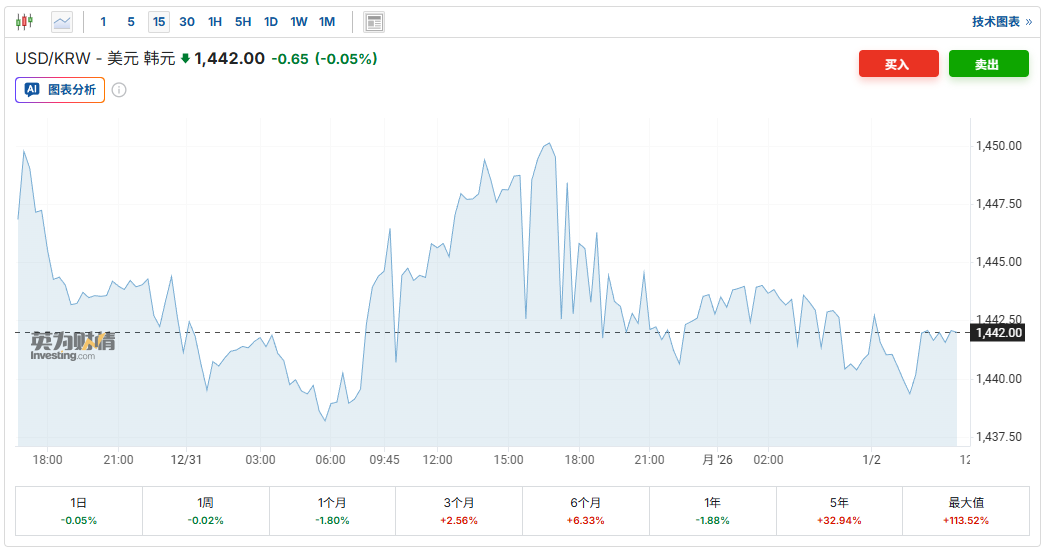
Group 1 - The Bank of Korea Governor Lee Chang-yong stated that the recent depreciation of the Korean won does not reflect the true strength of the South Korean economy and vowed to oppose any investment decisions that may threaten the stability of the foreign exchange market [1] - Concerns over foreign capital outflows and additional U.S. investments as part of tariff negotiations are exacerbating pressure on the won, with the USD/KRW exchange rate recently exceeding 1400 [1] - The South Korean authorities have implemented measures to support the won, including tax incentives and easing foreign exchange controls to increase dollar liquidity domestically [3] Group 2 - The South Korean government announced a new tax incentive plan for repatriated investment accounts to encourage overseas investment capital to return to the domestic market, including a temporary tax exemption on capital gains from selling overseas stocks [4] - The government plans to support major brokerages in launching forward sales products for individual investors to manage foreign exchange risk better [4] - The Bank of Korea maintained the benchmark interest rate at 2.5% and slightly raised economic growth and inflation forecasts, indicating a stable inflation outlook for the new year, although a weaker won could increase inflationary pressures [4]
韩国当局亮明捍卫本币“坚定决心” 韩元延续涨势至11月初以来新高
Zhi Tong Cai Jing· 2025-12-26 06:41
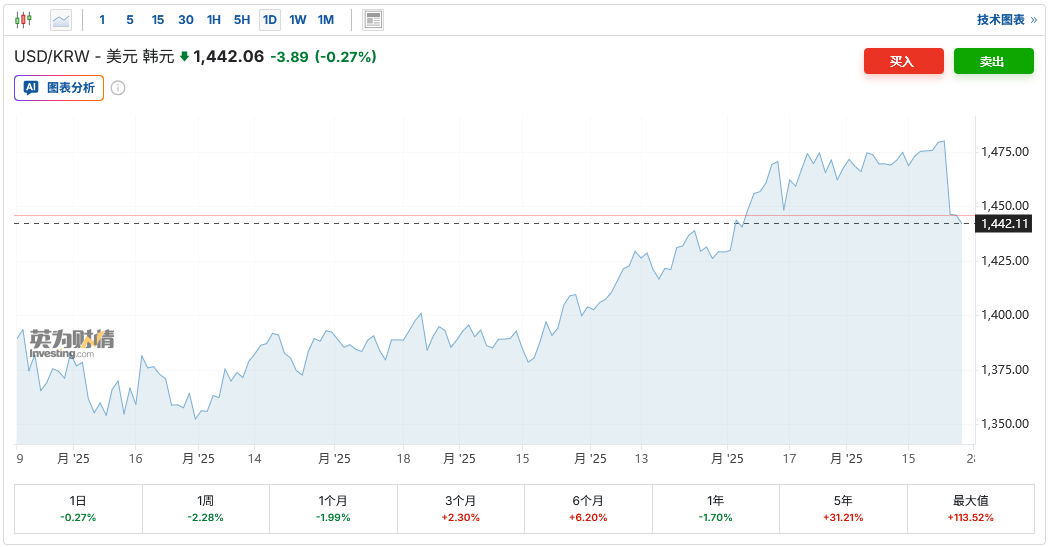
Core Viewpoint - The South Korean authorities are taking decisive actions to stabilize the won, which has recently depreciated significantly against the dollar, reaching its lowest levels since the 2009 financial crisis. The government is implementing various measures to support the currency and prevent further depreciation [3][4]. Group 1: Currency Performance - The Korean won has strengthened against the US dollar, reaching its highest level since early November, with the dollar to won exchange rate dropping by 0.27% to 1442.06, and a weekly decline of 2.28% [1][3]. - The won had previously depreciated to 1485 won per dollar, marking a significant decline of approximately 8% against the dollar in the second half of the year, making it the worst-performing currency in Asia [3]. Group 2: Government Actions - The South Korean government has expressed its commitment to addressing the won's weakness, indicating that excessive depreciation is not beneficial. The Bank of Korea and the Ministry of Finance have held multiple meetings to discuss the issue [3]. - The government is implementing new tax measures to stabilize the foreign exchange market, including a temporary tax exemption for individual investors who convert overseas stock sale profits into won for domestic investments [4]. - The Bank of Korea has signed a $65 billion currency swap agreement with the National Pension Service to increase dollar liquidity domestically and has decided to temporarily exempt financial institutions from foreign exchange stability taxes starting next month [4]. Group 3: Market Sentiment and Forecast - Analysts note that the won is highly sensitive to negative news, with external factors affecting its performance. The currency is expected to remain within a range of 1470 to 1480 won per dollar unless other factors influence a decline [5]. - The recent interventions by the South Korean authorities, including verbal interventions and market measures, have had a positive impact on the won's performance, aided by a recovery in risk appetite and a weaker dollar [3].
韩国央行在非例行委员会会议后宣布汇市稳定措施
Xin Lang Cai Jing· 2025-12-19 07:25
Core Viewpoint - The Bank of Korea convened an extraordinary committee meeting to discuss measures for stabilizing the foreign exchange market [1] Group 1: Measures Announced - The Bank of Korea and the Ministry of Finance jointly announced that the foreign exchange stability tax for banks will be waived for six months [1] - The Bank of Korea will pay interest on excess foreign exchange reserve deposits held by financial institutions for six months [1] Group 2: Purpose of Measures - The measures are aimed at addressing the short-term imbalance in foreign exchange supply and demand [1]