首席风险官制度

Search documents
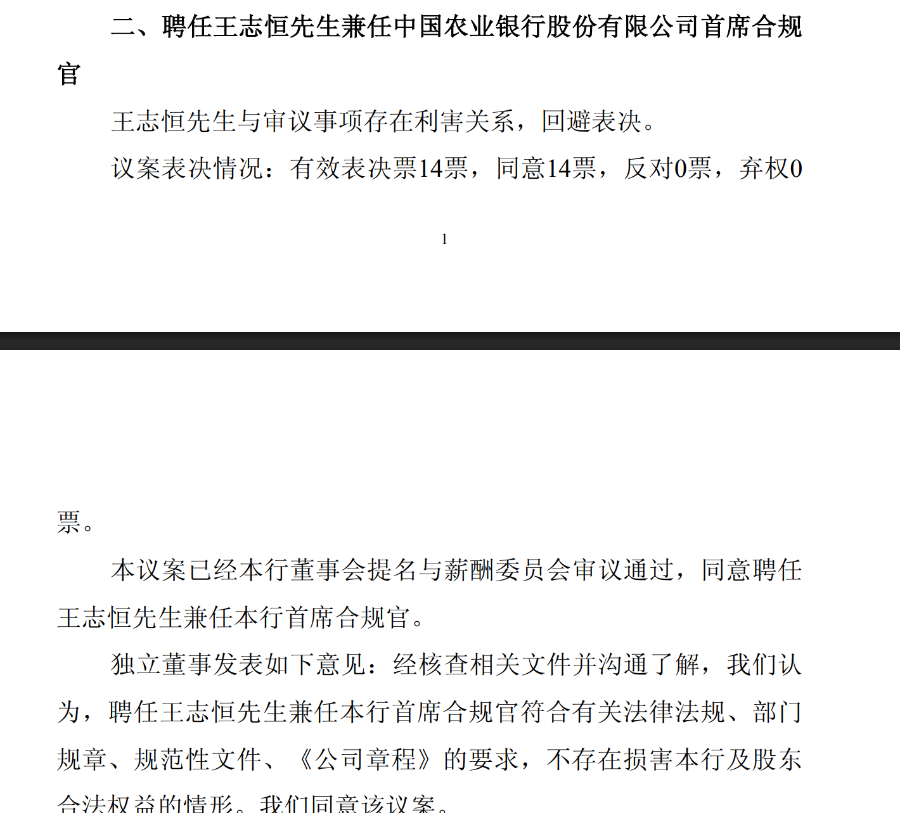
凸显合规治理 农行、中行“高配”首席合规官
2 1 Shi Ji Jing Ji Bao Dao· 2026-02-27 09:12
Group 1 - The core viewpoint of the articles is the establishment of the Chief Compliance Officer (CCO) position by major Chinese banks, reflecting a heightened emphasis on compliance and internal control within the banking sector [1][2][6] - Agricultural Bank of China and Bank of China have appointed their respective presidents as CCOs, marking the first time these banks have created this position [1][2] - The appointments are in response to the regulatory requirements set forth by the National Financial Regulatory Administration's "Compliance Management Measures for Financial Institutions," which mandates the establishment of a CCO at the headquarters of financial institutions [2][6] Group 2 - The "Compliance Measures" came into effect on March 1, 2025, with a one-year transition period, leading to a wave of CCO appointments across various banking institutions [2][6] - Other banks, such as Industrial Bank and Ping An Bank, have also appointed CCOs, indicating a broader trend in the industry [2] - The role of the CCO is distinct from that of the Chief Risk Officer (CRO), with the CCO focusing on compliance with laws and regulations, while the CRO manages substantive risks [4][5] Group 3 - The CCO position is expected to enhance compliance governance and integrate compliance requirements into business processes and decision-making, thereby influencing the corporate culture and sustainable development of the banking industry [6] - The qualifications for the CCO include a bachelor's degree and significant experience in finance and compliance, reflecting the importance of expertise in this role [5][6] - The establishment of the CCO role is seen as a significant restructuring of internal governance and risk management within banks, driven by regulatory changes and the evolving risk environment [6]



过渡期收官在即,银行业首席合规官密集就位, 如何推进从“被动遵循”到“主动治理”?
Mei Ri Jing Ji Xin Wen· 2026-01-09 10:52
Core Insights - The banking industry is undergoing a restructuring wave in risk and compliance systems due to tightening regulatory rules and a complex risk environment [1] - A surge in appointments of Chief Risk Officers (CROs) and Chief Compliance Officers (CCOs) is expected by the end of 2025 and early 2026, with over 20 banks and branches already approved for related positions since early 2025 [1] - The implementation of the "Compliance Management Measures for Financial Institutions" mandates the establishment of CCOs at the headquarters level, who will be senior management personnel directly reporting to the board [1] Group 1: Appointment Trends - Nearly 10 banks have intensified their hiring for compliance roles in the past month, with institutions like Ping An Bank and Minsheng Bank announcing relevant appointments [1] - The first approved CCO in the banking sector post-implementation of the new measures is Yang Hong from Huaxia Bank, while Zhou Wei from Shixing Dazhong Village Bank is the first CCO for a rural bank [2] Group 2: Governance Models - Two governance models are emerging: "one person holding multiple roles" and "independent separation" for CCOs and CROs [2][3] - The "one person holding multiple roles" model is prevalent among smaller banks, allowing for unified decision-making in risk and compliance management [3] - The "independent separation" model is more suitable for larger banks, enhancing professional checks and balances within risk management and compliance [3] Group 3: Talent and Recruitment - The establishment of CCO and CRO positions presents new challenges in talent acquisition, with a preference for candidates possessing a combination of frontline business experience, cross-regional vision, and professional qualifications [4] - Some banks are adopting market-based recruitment strategies for CCOs, requiring candidates to have over eight years of experience in finance or legal compliance [5] - Salary levels for CCO positions are rising, with some banks offering monthly salaries between 100,000 to 130,000 yuan [5] Group 4: Compliance Management Evolution - The number and amount of penalties in the banking sector remain high, with 6,521 penalties totaling 2.641 billion yuan in 2025, a 44.95% increase from 2024 [5] - Effective compliance management is evolving from a "cost center" to a "value protection center," crucial for mitigating credit, market, and liquidity risks [5] - Future compliance governance is expected to become more institutionalized and refined, with a focus on clear responsibilities and the need for composite compliance talents [6] Group 5: Role of Chief Compliance Officers - The role of CCOs is pivotal in the compliance system, requiring capabilities in business insight, regulatory interpretation, execution, and cross-departmental collaboration [6] - As the transition period for CCO appointments concludes, the emphasis will be on ensuring these compliance leaders effectively facilitate a shift from passive regulatory adherence to proactive compliance governance [6]
过渡期收官在即,银行业首席合规官密集就位,如何推进从“被动遵循”到“主动治理”?
Mei Ri Jing Ji Xin Wen· 2026-01-09 10:51
Core Viewpoint - The tightening of regulatory rules and the complexity of the risk environment are driving a restructuring wave in the banking industry's risk and compliance systems [1][7]. Group 1: Appointment Trends - A surge in appointments for Chief Risk Officers (CROs) and Chief Compliance Officers (CCOs) is expected from late 2025 to early 2026, with nearly 10 banks increasing related personnel configurations in the past month [1][7]. - Since the beginning of 2025, over 20 banks and branches have had relevant qualifications approved by regulators [1][7]. - The trend is influenced by the impending expiration of a one-year transition period set by the "Financial Institutions Compliance Management Measures," which requires financial institutions to establish a CCO at their headquarters [1][7]. Group 2: Governance Models - The banking sector exhibits two governance models for CCOs and CROs: "one person holding both positions" and "independent separation" [2][9]. - The "one person holding both positions" model is prevalent, particularly in smaller banks, allowing for unified decision-making in risk and compliance management [2][9]. - Conversely, the "independent separation" model is more common in larger banks, enhancing professional checks and balances within the risk control system [3][10]. Group 3: Talent Acquisition and Challenges - The demand for composite talents is rising, with banks favoring candidates with extensive experience in finance or legal compliance [11][12]. - Some banks are adopting market-based recruitment methods for CCOs, breaking traditional selection models [11]. - Salary levels for CCO positions are increasing, with some banks offering monthly salaries between 100,000 to 130,000 yuan [11]. Group 4: Compliance Management Evolution - Effective compliance management is evolving from a "cost center" to a "value guardian," playing a crucial role in mitigating credit, market, and liquidity risks [12][13]. - The future of compliance governance in the banking industry is expected to become more institutionalized and refined, with clearer responsibilities and a focus on composite compliance talents [12][13]. - The core competencies for CCOs are expected to include deep business insight, precise regulatory interpretation, efficient execution, and strong cross-departmental collaboration [13].