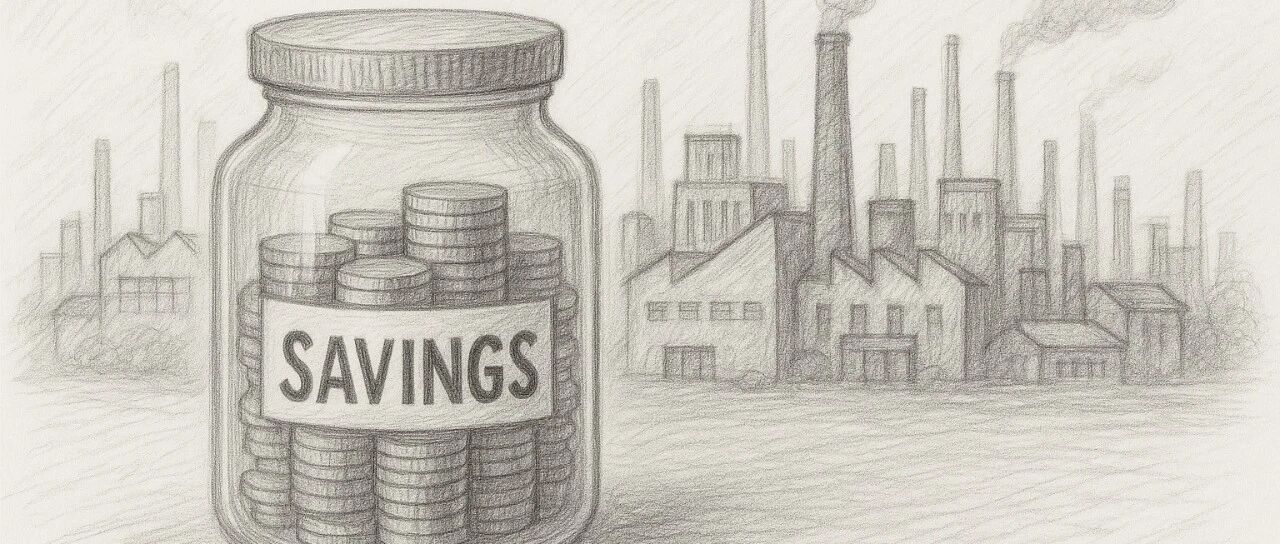
高储蓄—高投资模式

Search documents
中国的高储蓄模式,是奇迹还是陷阱?
伍治坚证据主义· 2025-09-26 07:30
Core Viewpoint - The article discusses the evolution of China's economic model, emphasizing the "high savings - high investment" approach that has driven rapid GDP growth but has also led to structural imbalances and reliance on exports [2][3][4]. Group 1: Economic Growth and Investment Model - China's economic growth has been characterized by a high savings rate, which has facilitated significant investments in infrastructure and manufacturing, resulting in an average GDP growth rate exceeding 10% from the 1990s to the 2000s [2][3]. - Despite the rapid GDP growth, the increase in household income has lagged behind, with annual growth rates of 6-7%, leading to a situation where savings are high but consumption remains low [2][3]. Group 2: Structural Imbalances and Export Reliance - The high savings rate has resulted in insufficient domestic consumption, forcing China to rely on exports to absorb excess production capacity, with a current account surplus reaching 10% of GDP around 2007 [3][4]. - The article references the concept of "beggar-thy-neighbor" policies, highlighting that one country's surplus necessitates another's deficit, which has implications for international trade dynamics [3][4]. Group 3: Challenges of Overcapacity and Market Competition - China's investment model has undergone three significant shifts: large-scale infrastructure projects, a real estate bubble, and a focus on renewable energy manufacturing, each leading to overcapacity and intense price competition [4][5]. - The competitive landscape in sectors like solar energy and electric vehicles has resulted in unsustainable pricing strategies, where companies prioritize survival over profitability, reminiscent of historical economic challenges faced by other nations [4][5]. Group 4: Future Economic Directions - The article outlines three potential paths for China's economic future: continuing to expand trade surpluses, reducing output to lower investment, or significantly increasing domestic consumption to stimulate demand [5][6]. - The challenge lies in transitioning to a model that enhances consumer spending without exacerbating unemployment or economic slowdown, a feat that has historically been difficult for many nations [5][6]. Group 5: Global Economic Rebalancing - The ongoing dynamics of savings, investment, and consumption extend beyond economics, touching on social equity and global order, with the U.S. and Europe unwilling to perpetually absorb China's excess production [6]. - The concept of "decoupling" or "de-risking" reflects a new arrangement where more countries share the burden of China's overcapacity while China increases its own consumption, a process fraught with potential friction [6].