高精度

Search documents
真回暖,难扭亏!芯海科技:冲刺高端,连亏3年,有息负债率飙升至41%
市值风云· 2026-03-12 10:14
Core Viewpoint - The semiconductor industry is experiencing a price surge driven by increased AI demand, affecting various chip manufacturers, including MediaTek, which is planning to raise prices as well [3][4]. Group 1: Company Overview - Chipsea Technology, established in 2003, operates in the semiconductor design sector, focusing on high-precision ADCs, MCUs, and AIoT chips, utilizing a Fabless model that emphasizes R&D over manufacturing [4][5]. - The company has faced significant revenue fluctuations, with a revenue of 702 million yuan in 2024, projected to grow by 20.82% to 849 million yuan in 2025 [5][6]. Group 2: Financial Performance - The net profit attributable to shareholders has shown a concerning trend, with a loss of 143 million yuan in 2023 and an increased loss of 173 million yuan in 2024, narrowing to a loss of 106 million yuan in 2025 [6][8]. - The gross margin improved to 35.5% in the first three quarters of 2025, up by 7 percentage points from the low in 2023, indicating a positive shift in profitability [10]. Group 3: R&D Investment - R&D expenses have surged, reaching nearly 300 million yuan in 2024, nearly six times the 50 million yuan spent in 2019, constituting about 30% of revenue even in a recovering year [14][15]. - The high R&D expenditure is essential for maintaining competitiveness in the semiconductor industry, particularly in ADC and automotive-grade chip development [17][31]. Group 4: Market Dynamics - The semiconductor market is characterized by intense competition, with major players like STMicroelectronics and NXP dominating the MCU and ADC segments, making it challenging for Chipsea Technology to gain market share [18][19]. - The company has been focusing on high-end products, including automotive-grade MCUs and AIoT chips, but these segments are still in the early stages of development and have not yet significantly contributed to overall revenue [23][26]. Group 5: Cash Flow and Debt - The company has experienced negative cash flow, with a cumulative outflow of 670 million yuan since 2020, necessitating reliance on external financing to sustain operations [29][30]. - As of September 2025, the company had a high interest-bearing debt ratio of 41.4%, indicating increasing financial pressure due to ongoing R&D investments [30][31].



江淮汽车申请基于多平台协同的汽车遮阳帘压力测试方法专利,实现低成本、高精度、智能化的遮阳帘压力测试
Jin Rong Jie· 2026-01-17 06:48
Group 1 - The core viewpoint of the news is that Anhui Jianghuai Automobile Group Co., Ltd. has applied for a patent for a pressure testing method, system, and application for automotive sunshades based on multi-platform collaboration, indicating innovation in automotive component testing technology [1] Group 2 - Anhui Jianghuai Automobile Group Co., Ltd. was established in 1999 and is located in Hefei City, primarily engaged in the automotive manufacturing industry [2] - The company has a registered capital of approximately 218.4 million RMB [2] - The company has invested in 48 enterprises and participated in 5,000 bidding projects, showcasing its active involvement in the industry [2] - The company holds 946 trademark registrations and 5,000 patent records, indicating a strong intellectual property portfolio [2] - Additionally, the company possesses 672 administrative licenses, reflecting its compliance and operational capabilities [2]

凌云股份:力传感器正在朝着低成本、高精度、智能化的方向发展
Zheng Quan Ri Bao Wang· 2025-12-09 13:12
Group 1 - The core viewpoint of the article highlights that Lingyun Co., Ltd. (600480) is focusing on the development of force sensors towards low cost, high precision, and intelligence [1] - The industry is experiencing a common trend of cost reduction due to technological advancements and the expansion of industrial scale [1] - The company is committed to continuous cost optimization through modular design and automated production methods [1]

研判2025!中国半导体流量计行业产业链、市场规模及重点企业分析:行业发展支撑中国芯片精密制造,驱动半导体产业工艺升级[图]
Chan Ye Xin Xi Wang· 2025-10-08 00:42
Core Insights - The semiconductor flowmeter industry in China is experiencing rapid growth, with a projected market size of 1.23 billion yuan in 2024, reflecting a year-on-year increase of 9.82% [1][10]. Industry Overview - Semiconductor flowmeters are critical components designed for high-precision flow measurement and control in semiconductor manufacturing, ensuring the monitoring and regulation of gas and liquid flow [2]. - Key features include high precision (±0.5% FS or better), corrosion resistance, wide measurement range (from sccm to slm), and fast response times (in milliseconds) [2]. Industry Value Chain - The upstream of the semiconductor flowmeter industry includes sensors (e.g., heating elements, temperature sensors, differential pressure sensors, ultrasonic sensors, Coriolis sensors), control and execution modules (e.g., microprocessors, algorithm chips), and structural components (e.g., aluminum alloy, stainless steel) [4]. - The midstream involves the manufacturing of semiconductor flowmeters, while the downstream applications are primarily in semiconductor manufacturing equipment [4]. Market Size - The demand for high-precision and high-performance semiconductor flowmeters is increasing due to the expansion of chip manufacturing and packaging testing in China's semiconductor industry [1][10]. Key Companies' Performance - The competitive landscape of the semiconductor flowmeter industry is characterized by leading companies like Beijing Huacheng Electronics and Qingdao Xinsen Micro-Nano, which are achieving significant market share and technological advancements [10]. - Companies are focusing on vertical integration to enhance their competitive advantages and are increasingly adopting a "technology + service" dual-driven model [10]. Industry Development Trends 1. **Technological Innovation**: The industry is expected to focus on high precision, intelligence, and miniaturization, with advancements such as MEMS technology and AI algorithms to improve flow control accuracy and efficiency [12][13]. 2. **Domestic Substitution**: Policy support is driving domestic companies to enhance R&D capabilities and product performance, leading to increased competitiveness against imported products [13]. 3. **Green Manufacturing**: The semiconductor flowmeter industry is shifting towards green manufacturing and circular economy practices, optimizing designs to reduce energy consumption and improve resource efficiency [14][15].

研判2025!中国液位变送器行业分类、产业链、市场规模、重点企业分析及未来前景展望:液位变送器应用场景广泛,国内竞争日益加剧[图]
Chan Ye Xin Xi Wang· 2025-07-24 01:33
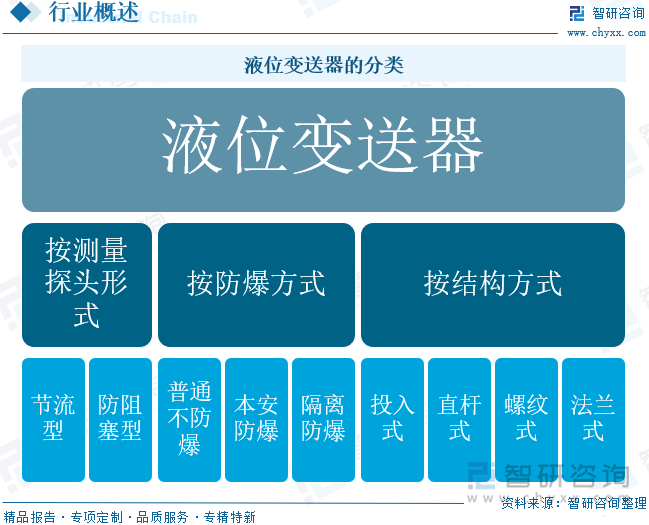
Industry Overview - The liquid level transmitter is a core component of modern industrial automation systems, known for its simple structure, easy installation, and precise measurement, making it indispensable in industrial production, storage, and monitoring [1][15] - The importance of liquid level transmitters has increased due to the continuous improvement of industrial automation levels, the growing demand for refined production processes, and the reliance on high-precision liquid level monitoring in emerging industries such as new energy and intelligent manufacturing [1][15] - The Chinese liquid level transmitter market is projected to reach approximately 17.2 billion yuan in 2024, indicating a year-on-year growth trend [1][15] Application Fields - The main application fields for liquid level transmitters include the petrochemical industry and water treatment, where complex processes and high safety standards drive the demand for high-precision monitoring [1][15][13] - The rapid expansion of the water treatment industry, driven by environmental policies, has significantly increased the demand for liquid level transmitters [1][15] Market Dynamics - The liquid level transmitter industry is characterized by a competitive landscape where foreign brands dominate the high-end market, while domestic companies like Chuan Yi Co. and Mai Ke Sensor are gradually expanding their market share through cost-effectiveness [17][19] - The industry is witnessing an increase in concentration, with leading companies building competitive barriers through technological research and development and channel construction [17] Key Companies - Chuan Yi Automation Co., Ltd. focuses on industrial automatic control systems and reported a revenue of 6.75 billion yuan in 2024, reflecting a year-on-year growth of 2.3% [19] - Mai Ke Sensor Co., Ltd. specializes in manufacturing industrial process measurement and control instruments, including pressure sensors and liquid level transmitters [21] - Other notable companies include Shenzhen Yunmin Instrument Co., Ltd., which offers a range of liquid level transmitters and pressure sensors, and Shanghai Yuanwang Liquid Level Meter Co., Ltd., a pioneer in liquid level measurement instruments [21][19] Industry Challenges - The liquid level transmitter industry faces challenges such as environmental corrosion, interference from impurities and suspended particles, limitations in measurement accuracy, and insufficient long-term stability [23][24][25][26] Future Trends - The industry is expected to move towards higher precision, driven by the increasing demands of industrial automation for measurement accuracy [27] - Smart technology integration will be a key trend, with IoT and AI enabling liquid level transmitters to perform data analysis and autonomous decision-making [28] - Integration design will promote multifunctional and compact liquid level transmitters, reducing reliance on peripheral components and enhancing overall system reliability [29]