
高股息防御属性

Search documents
通用磨坊股价震荡上行,机构关注高股息防御属性
Jing Ji Guan Cha Wang· 2026-02-11 16:46
Market Performance - General Mills (GIS.N) experienced a fluctuating upward trend in stock price from February 6 to 11, 2026, with a cumulative increase of 0.79% and a volatility of 4.18% [1] - The stock price dropped by 1.03% to $47.87 on February 6, with a trading volume of $292 million, but saw three consecutive days of gains from February 9 to 11, closing at $48.75 [1] - The average daily trading volume during this period was approximately $174 million, with a turnover rate of 0.84% [1] - The broader U.S. packaged food sector saw a slight decline of 0.15%, while the Dow Jones index rose by 1.35%, indicating that General Mills outperformed its industry peers [1] Institutional Ratings - As of February 2026, 23 institutions maintained stable ratings for General Mills, with 30% rating it as buy/overweight and 57% as hold [2] - The target price range for the stock is between $46 and $63, with an average target price of $52.00 [2] - Some institutions highlight the company's high dividend yield of 5.01% and reasonable valuation (TTM P/E ratio of 10.48) as defensive attributes within the consumer sector, although growth in North American retail sales remains a key concern [2] Financial Analysis - The most recent financial report for General Mills was for Q4 of fiscal year 2025, released on December 18, 2025, with no new financial events reported in the past week [3] - Q4 revenue was $4.861 billion, reflecting a year-over-year decline of 7.2%, while net income attributable to shareholders was $413 million, down 48.1% year-over-year, primarily due to a decline in North American retail business and non-cash impairment charges [3] - The market focus is on the guidance for fiscal year 2026, with the company emphasizing growth through supply chain optimization and expansion in the pet food segment [3]
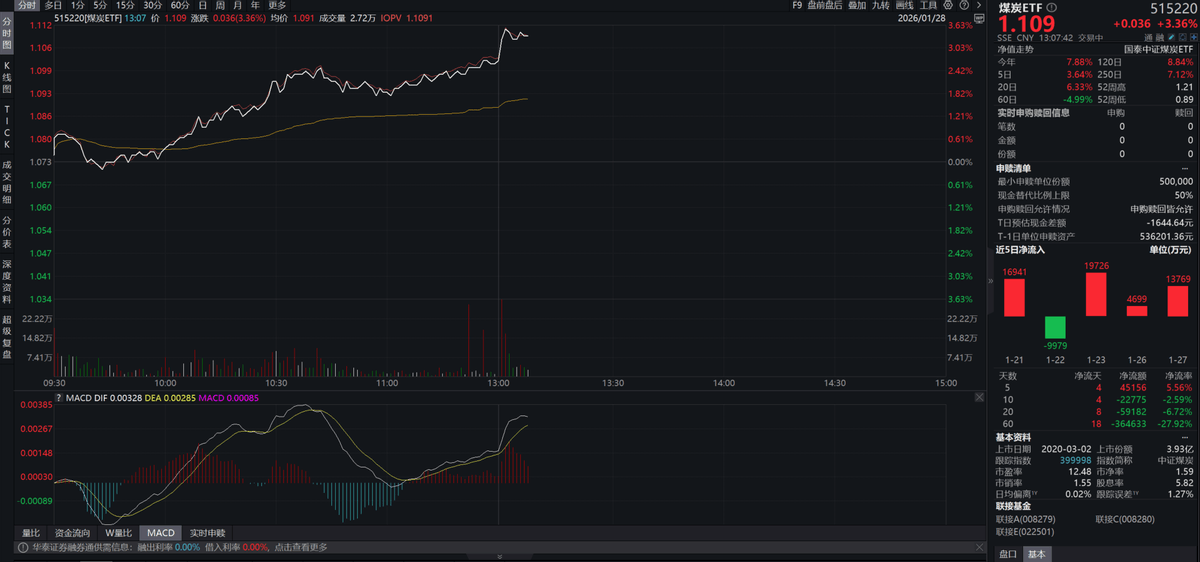
“红利+成长”双轮驱动,煤炭ETF(515220)大涨超3%
Sou Hu Cai Jing· 2026-01-28 05:58
Core Viewpoint - The coal sector is experiencing a fundamental shift in investment logic, transitioning from a focus on cyclical price fluctuations to a dual-driven model of "dividend + growth," supported by long-term supply constraints, high dividend yields, and resilient macro demand [3][4]. Group 1: Market Performance - On January 28, the A-share market saw a rebound, with the coal sector performing strongly; the coal ETF (515220) rose over 3%, currently holding nearly 8 billion yuan in assets, with net inflows exceeding 450 million yuan over the past five days [1][5]. - The top ten constituent stocks of the coal ETF all experienced gains, indicating a broad-based rally within the sector [5]. Group 2: Supply-Side Dynamics - The coal supply side is under strict control due to policies aimed at limiting excessive production capacity, leading to a long-term tightening of the supply-demand balance [6][7]. - The current supply rigidity is a key pricing foundation for the coal industry, with policies aimed at eliminating ineffective capacity and ensuring stable production levels [7]. - Capital expenditure in the coal sector has peaked, with investments primarily focused on maintaining existing capacity rather than expanding, indicating limited future supply growth [7]. Group 3: Demand-Side Factors - Despite long-term pressures from energy transition, short-term demand for coal is supported by economic recovery expectations, seasonal heating needs, and downstream inventory replenishment [8]. - The macroeconomic outlook for 2026 suggests stable growth, which is expected to support industrial electricity demand and, consequently, coal consumption [8]. - Seasonal demand for heating during winter has been highlighted, with recent cold weather increasing electricity loads and boosting demand for thermal coal [8]. Group 4: Investment Characteristics - The coal sector has a dividend yield exceeding 6% over the past 12 months, making it an attractive "bond-like" asset in a declining risk-free interest rate environment [9][10]. - State-owned enterprises in the coal sector are motivated to enhance shareholder returns through increased dividends and improved investor communication, potentially catalyzing valuation recovery [10]. Group 5: Market Opportunities - The coal sector is seen as a "scarce asset" with significant defensive value, particularly in the context of low interest rates and a scarcity of stable income-generating assets [10]. - The coal sector is gaining attractiveness as funds rotate from other commodity sectors that have seen substantial price increases, positioning coal as a value opportunity [11]. Group 6: Investment Tools - The coal ETF (515220) is the only coal-themed ETF in the market, covering leading companies across the coal industry chain, with a scale of nearly 8 billion yuan and good liquidity, making it an ideal tool for investors looking to capitalize on the sector's growth [12][13][15]. - Investors are encouraged to consider systematic investment or gradual accumulation of the ETF to leverage the long-term investment opportunities presented by the coal sector's "dividend + growth" dynamics [16].

中证1000ETF(159845)下跌0.39%,近五个交易日资金净流入6.42亿元
Sou Hu Cai Jing· 2025-12-10 05:45
Market Performance - The A-share market saw a collective decline in the three major indices, with the Shanghai Composite Index dropping by 0.75% [1] - The CSI 1000 ETF (159845) decreased by 0.39%, while other broad indices such as the SSE 50 and CSI 300 fell by 0.83% and 0.82% respectively [1] - Among the top 50 weighted stocks in the CSI 1000 ETF, Xingyuan Material rose by 6.82%, Jibite increased by 3.28%, and Yahua Group gained 3.27%, while Chunzhong Technology and Jucheng Co. saw declines of 6.03% and 5.87% respectively [1] Industry Performance - In the major sectors of the CSI 1000 ETF, the electronics sector fell by 1.36%, power equipment decreased by 1.55%, pharmaceuticals dropped by 0.43%, and computers also declined by 1.55%, while machinery equipment remained flat with a slight increase of 0.02% [1] Fund Flow and Liquidity - The CSI 1000 ETF (159845) experienced a net inflow of 642 million yuan over the past five trading days, bringing its latest scale to 45.476 billion yuan, with a monthly growth of 688 million yuan [1] - The trading volume for the day reached 715 million yuan, with an average daily trading volume of 1.116 billion yuan over the past week, indicating good liquidity [1] Regulatory Environment - The chairman of the CSRC recently indicated a willingness to "moderately open up capital space and leverage limits" for high-quality securities institutions, which has sparked market discussions [2] - This regulatory approach aims to strengthen classified supervision and support superior institutions while maintaining a reasonable leverage range for the securities industry [2] Economic Outlook - Dongguan Securities noted that with enhanced economic resilience and improved corporate profitability, a dual drive of fundamentals and liquidity may become the main theme of the market [2] - Sectors with low valuations, strong dividend defensive attributes, certain earnings growth, and robust technology characteristics are expected to be favored by the market [2]