
煤炭ETF(515220)

Search documents
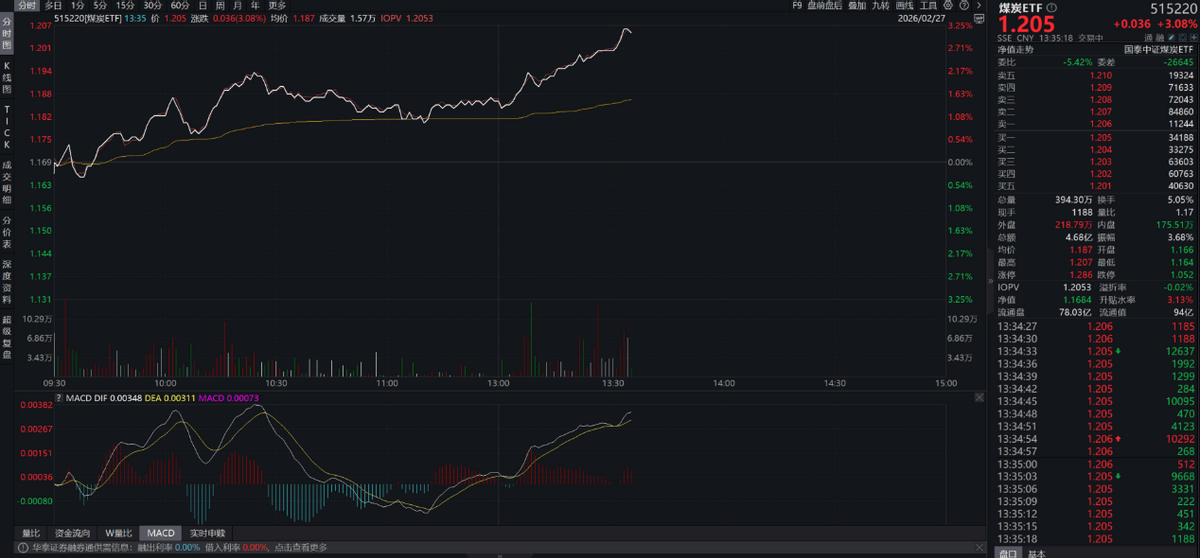
良性供给助节后煤价乐观,煤炭板块大涨,煤炭ETF(515220)涨超3%
Mei Ri Jing Ji Xin Wen· 2026-02-27 06:53
Core Viewpoint - The coal sector is experiencing a significant increase, with the coal ETF (515220) rising over 3% due to optimistic coal prices supported by healthy supply conditions following the holiday season [1]. Supply and Demand - The coal industry saw an unexpected reduction in inventory before the holiday, contributing to a positive outlook for coal prices post-holiday [1]. - Domestic supply has been low, with the average daily operating rate of coal mines being at its lowest in three years from New Year's Day to the Spring Festival [1]. - Import supply remains constrained, with coal shipping volumes maintaining a four-year low as of February 2026 [1]. - Demand was bolstered by a cold wave in January, leading to rare proactive inventory replenishment before the holiday [1]. Inventory and Pricing - Overall inventory levels have improved, with port inventories significantly declining and reaching their lowest levels in three years [1]. - International energy prices have risen, with Brent crude oil futures surpassing $70 per barrel during the Spring Festival, driven by geopolitical tensions that are pushing energy supply prices upward [1]. - The interconnectedness of global energy markets suggests that coal prices are likely to receive stronger support post-holiday [1]. Coal ETF and Index - The coal ETF (515220) tracks the CSI Coal Index (399998), which focuses on coal mining and processing sectors, selecting representative listed companies as index samples [1]. - The index employs an equal-weight distribution strategy to ensure balanced weight among constituent stocks, effectively diversifying risk [1]. - It dynamically reflects the overall performance of the coal industry, aiming to represent the comprehensive trends of related listed company securities [1].
煤炭ETF(515220)涨1.45%,半日成交额3.12亿元
Xin Lang Cai Jing· 2026-02-27 06:19
Group 1 - The coal ETF (515220) increased by 1.45% to 1.186 yuan, with a trading volume of 312 million yuan as of the midday close [1] - Major holdings in the coal ETF include China Shenhua (+0.29%), Shaanxi Coal (+0.60%), Yanzhou Coal (+1.53%), China Coal (+3.29%), Shanxi Coking Coal (+1.12%), Huayang Co. (+1.55%), Meijin Energy (+2.99%), Lu'an Environmental Energy (+2.61%), Huaibei Mining (+0.52%), and Pingmei Shenma (+0.92%) [1] - The coal ETF's performance benchmark is the CSI Coal Index return, managed by Guotai Fund Management Co., with a return of 173.17% since its inception on January 20, 2020, and a return of 6.21% over the past month [1]






海外供给扰动叠加库存低位,煤炭ETF(515220)大涨超3%
Sou Hu Cai Jing· 2026-02-27 06:09
Core Viewpoint - The coal sector is at a pivotal point driven by multiple resonating logics, with overseas supply disturbances, particularly from Indonesia, playing a crucial role in price dynamics and domestic demand improvement [3][4]. Group 1: Overseas Supply Disturbances - Indonesia's policy changes regarding coal export approvals and production quotas have led to tighter supply, significantly impacting international coal prices and reducing the competitiveness of imported coal [4]. - The supply contraction from Indonesia has exceeded market expectations, becoming a primary driver for the recent rise in international coal prices [4]. - The linkage of global energy prices, influenced by geopolitical factors, has created upward price expectations for thermal coal, shifting market focus towards overseas supply rather than domestic demand fluctuations [4]. Group 2: Domestic Supply Constraints - Domestic coal supply is facing increasing constraints, with a notable reduction in production capacity due to seasonal factors and regulatory measures aimed at safety and environmental standards [5]. - The capacity utilization rate in key production areas has decreased, with a reported drop of 3.12 percentage points to 84.43% as of February 11, attributed to pre-holiday shutdowns of private mines [5]. - The coal industry is transitioning towards high-quality development, with major state-owned enterprises planning to increase their stakes in listed companies, reflecting confidence in the sector's stability and growth potential [5]. Group 3: Inventory and Price Dynamics - Port inventories are at historically low levels, with significant declines reported in both northern and southern ports, indicating a clear supply contraction effect [7]. - As of February 14, northern port inventories were at 2,415.9 million tons, down 46.3 million tons week-on-week, while southern ports reported a decrease of 168.9 million tons [7]. - Coal prices have shown stability with upward adjustments, with Qinhuangdao's thermal coal price reaching 718 yuan/ton, reflecting a week-on-week increase of 23 yuan/ton [8]. Group 4: Demand Resilience - Post-holiday resumption of work is driving steady growth in iron and steel production, with daily average iron output reported at 230.56 million tons, up 1.92 million tons week-on-week [9]. - Despite a seasonal decline in electricity consumption, heating demand remains robust, supporting overall coal demand [9]. - The coking coal market shows resilience, with stable prices and a focus on monitoring iron production and domestic coal mine resumption [9]. Group 5: Investment Opportunities - The coal ETF (515220) presents a dual logic for investment, combining high dividend yields with price elasticity driven by overseas supply disturbances [10]. - Leading coal companies maintain high dividend rates and stable cash flows, positioning them as attractive investments in a declining interest rate environment [10]. - The ETF encompasses major players in thermal coal, coking coal, and coal power, offering both defensive attributes and potential for price recovery amid low inventories and stable prices [10].

海外供给扰动叠加库存低位,煤炭板块迎来结构性修复窗口,煤炭ETF(515220)盘中涨超3.2%
Mei Ri Jing Ji Xin Wen· 2026-02-24 04:29
Group 1 - The core catalyst for the current coal market is the overseas supply disruptions, particularly from Indonesia, which significantly impacts global coal trade dynamics [2] - The coal sector is experiencing a structural repair window due to low inventory levels and supply constraints, leading to a notable increase in coal ETF (515220) prices [1][3] - The domestic coal supply is tightening due to seasonal reductions in production and ongoing maintenance at state-owned mines, resulting in a decrease in port inventories [3] Group 2 - The coal sector is supported by dual logic: high dividend yields providing a safety margin and overseas supply disruptions creating price elasticity [4] - The market is shifting focus from domestic demand fluctuations to overseas supply elasticity, which is becoming a critical variable for price assessments [2] - The coal industry is transitioning from a phase of rapid expansion to one of high-quality development, with increased industry concentration enhancing the profitability stability of leading companies [3]
煤炭ETF(515220)跌1.12%,半日成交额3.03亿元
Xin Lang Cai Jing· 2026-02-13 05:56
Group 1 - The coal ETF (515220) experienced a decline of 1.12%, closing at 1.151 yuan with a trading volume of 303 million yuan [1] - Major holdings in the coal ETF showed mixed performance, with China Shenhua down 2.42%, Shaanxi Coal and Chemical Industry down 2.44%, and Yanzhou Coal Mining down 0.80%, while Shanxi Coking Coal increased by 0.28% [1] - The coal ETF's performance benchmark is the CSI Coal Index return, managed by Guotai Asset Management, with a return of 172.28% since its inception on January 20, 2020, and a return of 6.49% over the past month [1]
资源品向好,煤炭板块上扬,煤炭ETF(515220)涨超0.6%
Mei Ri Jing Ji Xin Wen· 2026-02-12 08:06
Group 1 - The coal sector is experiencing an upward trend, with the coal ETF (515220) rising over 0.6% as of February 12 [1] - Northeast Securities highlights the establishment of policy guidance for the intelligent transformation of coal mines, emphasizing that large-scale and intelligent coal mines are key measures for capacity optimization [1] - The intelligentization of coal mines involves integrating modern technology with coal development, creating a smart system characterized by comprehensive perception, real-time interconnection, analytical decision-making, autonomous learning, dynamic forecasting, and collaborative control [1] Group 2 - The coal mine intelligentization market in China is projected to reach 586.8 billion yuan by 2024, with expectations to grow to approximately 1.41 trillion yuan by 2030 [1] - Currently, the penetration rate of intelligentization in coal mines is about 21.09%, with most existing intelligent coal mines at a primary stage of development [1] - Since 2016, supply-side reforms have gradually eliminated outdated production capacity, leading to a significant decrease in the number of coal mines and a notable increase in average output per mine [1] Group 3 - Capital expenditures of coal enterprises are significantly positively correlated with previous profits, and the sustained high profitability in recent years is expected to support high levels of capital expenditure, ensuring orders related to intelligentization [1] - Coal remains a dominant energy source in China, serving as a pillar of the country's energy system [1] - The coal ETF (515220) tracks the CSI Coal Index (399998), which selects listed companies primarily engaged in coal mining, processing, and related equipment manufacturing, covering areas such as thermal coal and coking coal to reflect the overall performance of related listed companies [1]
2月11日盘后播报
Sou Hu Cai Jing· 2026-02-11 10:49
Market Overview - The A-share market experienced a slight increase followed by a decline, with the Shanghai Composite Index rising by 0.09% to 4131.98 points, while the Shenzhen Component Index fell by 0.35%, and the ChiNext Index dropped by 1.08% [1] - Overall market trading volume was below 2 trillion yuan, decreasing by over 100 billion yuan compared to the previous trading day [1] - More than 3200 stocks in the market declined, indicating a weak risk appetite [1] Sector Performance - The cyclical sectors showed strong performance, with non-ferrous metals, chemicals, and oil and gas leading the gains [1] - The Mining ETF (561330) rose by 2.93%, the Gold Stocks ETF (517400) increased by 2.62%, and the Chemical ETF (516220) gained 2.20% [1] - The coal sector also performed well, with the Coal ETF rising by 1.40%, supported by short-term supply-demand catalysts and long-term valuation support due to weakening dollar credit [2] Investment Opportunities - The non-ferrous sector's long-term outlook remains positive, driven by resource nationalism and supply-demand conflicts, with expectations for upward elasticity after recent volatility [1] - Investors are advised to focus on the only coal ETF (515220) for potential investment opportunities [2] - The film sector faced adjustments, with the Film ETF (516620) declining by 5.80%, attributed to rapid gains and potential overextension in expectations [2] - The bond market has been recovering, with the 10-year Treasury ETF (511260) rising by 0.87% over the past 20 days, driven by unexpected bank deposits and allocation strength [2]
印尼供给扰动催化煤价上行,煤炭ETF(515220)涨超1%
Mei Ri Jing Ji Xin Wen· 2026-02-11 05:59
Group 1 - The core viewpoint of the article indicates that Indonesia's RKAB has tightened preliminary reviews, leading some miners to suspend coal exports and market transactions while awaiting the latest government approval results [1] - The supply disruption is expected to have a greater impact on thermal coal than on coking coal, as Indonesian coal is primarily low-calorie coal extracted through open-pit mining [1] - In the short term, this supply disruption is likely to drive a rebound in domestic thermal coal spot prices, showing a significant short-term boost [1] Group 2 - In the annual dimension, under different assumptions, China's imports of Indonesian coal may decline by 24.11 to 50.89 million tons [1] - Future supply-side factors to monitor include the resumption of work in major production areas after the Spring Festival, as well as changes in Indonesian miners' export capacity and willingness [1] - The coal ETF (515220) has exceeded 9 billion yuan, tracking the CSI Coal Index (399998), with the coal sector showing a high dividend yield; as of the end of 2025, the tracked index's dividend yield over the past 12 months is over 6%, highlighting its allocation value in the context of declining risk-free interest rates [1]
供给侧改革催化煤炭供需向好,煤炭ETF(515220)涨超0.8%
Mei Ri Jing Ji Xin Wen· 2026-02-10 23:00
Group 1 - The core viewpoint of the article highlights the positive impact of supply-side reforms on coal supply and demand, leading to a rise in the coal ETF (515220) by over 0.8% [1] - Northeast Securities points out that the establishment of goals for intelligent transformation in coal mines is a key measure for optimizing capacity, with a focus on large-scale and intelligent mining [1] - Intelligent mining integrates modern technologies such as artificial intelligence and industrial IoT with coal development, creating smart systems that enhance safety and efficiency [1] Group 2 - The market size for intelligent mining is projected to reach 586.8 billion yuan by 2024, with expectations to grow to approximately 1.41 trillion yuan by 2030 [1] - By 2024, it is anticipated that 907 intelligent mining faces will be established in China, with an intelligent penetration rate of about 21.09%, most of which are still in the initial stages [1] - Since the supply-side reform in 2016, outdated production capacity has been gradually eliminated, resulting in a significant reduction in the number of coal mines and a notable increase in average output per mine [1] Group 3 - The coal ETF (515220) tracks the CSI Coal Index (399998), which selects listed companies involved in coal mining and processing to reflect the overall performance of coal-related securities [1] - The index exhibits a high industry concentration while also demonstrating certain diversification characteristics [1]
稳住了,然后呢?
Xin Lang Cai Jing· 2026-02-05 07:27
Market Overview - The spring market has experienced a pause with significant corrections in gold and silver prices, leading to a wide fluctuation in global markets. However, the market quickly stabilized after the initial downturn, with COMEX gold recovering to 5000 points and the Shanghai Composite Index stabilizing around 4100 points [1][13]. - Affected by overseas uncertainties, A-shares saw a substantial adjustment but rebounded on February 3, demonstrating strong market resilience [2][13]. Long-term Opportunities - The new productive forces are becoming the engine for economic growth, with an increasing share of "new economy" stocks in the market. AI is expected to see application results this year, alongside sectors like innovative pharmaceuticals and energy storage entering a favorable cycle [3][14]. - A-shares are attractive in terms of valuation compared to major global markets, with low foreign capital positions and the establishment of mechanisms for long-term domestic funds entering the market. The trend of "deposit migration" among residents may continue in a low-interest-rate environment [3][14][15]. - Policy emphasis on expanding domestic demand and stimulating consumption is expected to translate into systematic improvements in corporate profitability. Following the Spring Festival, policy catalysts are anticipated to accelerate, potentially leading to better index performance post-holiday [15]. Sector Focus - The market is expected to focus on cyclical price increases, with sectors like oil and petrochemicals, food and beverage, AI, and semiconductors continuing to see positive trends. The construction materials sector may benefit from major projects under the 14th Five-Year Plan [15]. - Investors are encouraged to consider broad-based products like the CSI A500 ETF (159338) for exposure to industry leaders, as well as a tech + dividend "barbell" strategy as a satellite approach [4][15]. Commodity Market Insights - The gold market has faced its largest drawdown in 40 years but has quickly rebounded, indicating that the bull market is likely not over yet. Historical context suggests that significant narrative shifts are required to signal the end of a bull market [5][16]. - From a macro perspective, a super cycle in commodities is anticipated this year, with fundamental factors driving long-term trends. The black and chemical sectors, currently at relatively low levels, may offer better value post-adjustment [8][17]. Investment Strategies - For investors concerned about market volatility, "fixed income plus" products are recommended. These strategies focus on safety and stability while allowing for some equity exposure to capture market gains [19][20]. - An example is the Guotai Helix 6-month holding mixed fund, which combines high-grade credit bonds for the fixed income portion and a flexible allocation to equities, aiming for a balanced approach to risk and return [20][21].