100%自主可控芯片

Search documents
芯片大战,再次爆发
水皮More· 2025-09-15 09:26
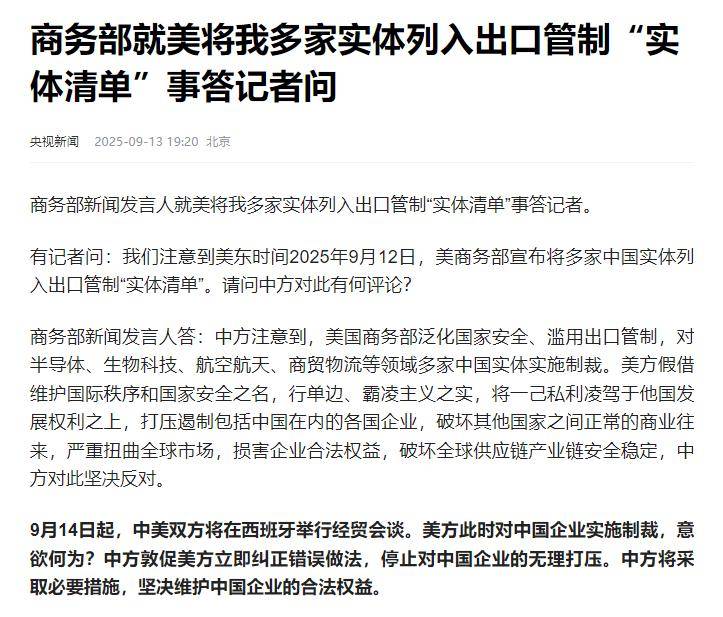
Core Viewpoint - The article discusses the new round of competition between China and the United States in the semiconductor sector, particularly focusing on the implications of the U.S. adding 23 Chinese companies to its export control entity list, which includes several semiconductor firms [4][5][8]. Semiconductor Industry Impact - Among the 23 companies listed, 13 are related to semiconductors and integrated circuits, including notable firms like Fudan Microelectronics and Shanghai Hualing Integrated Circuit [7]. - The U.S. Department of Commerce's announcement indicates that these semiconductor companies will be unable to access supplies from the overseas industry chain, effectively cutting off their supply [8]. - The article highlights the significance of analog chips, which are crucial for processing continuous signals and are widely used across various sectors, including consumer electronics and automotive [11]. Market Opportunities - The U.S. anti-dumping investigation may create market opportunities for domestic analog chip companies such as Sanan Optoelectronics, Nanjing Semiconductor, and others, as it raises the import costs and barriers for U.S. analog chips [12]. - The article suggests that the current geopolitical climate may allow Chinese companies to gain a competitive edge in the semiconductor market, potentially leading to a more self-sufficient industry in the next decade [12]. Strategic Signals - The ongoing competition signals a broader trend of decoupling in core technology sectors, with China beginning to establish its own market barriers to foster domestic growth [12]. - The article posits that within ten years, China may achieve parity with the U.S. in the semiconductor field, as non-100% self-controlled chips will gradually be replaced by fully autonomous solutions [12]. Upcoming Negotiations - A significant upcoming meeting between Chinese and U.S. officials is scheduled to discuss trade issues, including unilateral tariffs and export controls, indicating ongoing diplomatic efforts despite the competitive landscape [14][16].


芯片大战,再次爆发
Sou Hu Cai Jing· 2025-09-13 14:22
Core Insights - A new round of competition has erupted between China and the U.S. in the semiconductor sector, particularly following the U.S. Department of Commerce's decision to place 23 Chinese companies on an export control entity list [1][2][5]. Group 1: Impact on Semiconductor Companies - Among the 23 companies listed, 13 are related to semiconductors and integrated circuits, including notable firms like Fudan Microelectronics and Shanghai Hualing Integrated Circuit [4]. - The U.S. export controls will prevent these semiconductor companies from obtaining supplies from the global supply chain, effectively cutting them off [5]. - The announcement of anti-dumping investigations by China's Ministry of Commerce indicates a potential retaliatory measure against U.S. restrictions, which could lead to increased market opportunities for domestic semiconductor firms [8][10]. Group 2: Market Opportunities for Domestic Firms - The anti-dumping investigation may benefit several domestic companies such as Sanan Optoelectronics, Nanjing Microelectronics, and others, as it raises the cost and barriers for importing U.S. analog chips [11]. - China is the largest consumer market for electronic products and imports over 300 billion yuan worth of analog chips annually, with a significant portion coming from the U.S. [10]. - The shift towards domestic production and the potential for increased market share for local firms could lead to a more competitive landscape in the semiconductor industry [12]. Group 3: Future Trends and Negotiations - The ongoing competition signals a broader trend of decoupling in core technology sectors, with China beginning to assert its capabilities in response to U.S. actions [12]. - Upcoming negotiations between Chinese and U.S. officials will address unilateral tariff measures and export controls, indicating a potential for dialogue despite the competitive tensions [13]. - The expectation is that both countries may eventually reach a trade agreement, suggesting a complex interplay between competition and cooperation in the semiconductor sector [14].