
数字芯片

Search documents
板块内部分化,电子化学品表现优异
Yin He Zheng Quan· 2026-03-13 13:56
Investment Rating - The report maintains a "Recommended" rating for the electronic industry [1] Core Insights - The electronic sector is experiencing structural differentiation, with electronic chemicals performing exceptionally well [1] - The semiconductor equipment sector has seen a significant pullback, but the long-term outlook remains positive due to high industry demand [3] - The semiconductor materials and electronic chemicals sectors show strong resilience, driven by rising prices in storage chips and strategic value in upstream materials [3] - The integrated circuit packaging and testing sector has a negative performance this week, but expansion expectations remain unchanged [3] - The analog chip design sector has shown excellent performance, with major companies planning to raise prices, indicating a structural recovery [3] - The digital chip design sector has faced a decline, but upcoming product launches from major companies may act as a catalyst for growth [3] Summary by Sections Semiconductor Equipment - The sector has experienced a notable pullback, but the long-term growth logic remains strong, supported by stable performance expectations from domestic semiconductor equipment companies [3] Semiconductor Materials & Electronic Chemicals - This sector has demonstrated strong resilience, with strategic value highlighted by recent price increases from major electronic materials companies [3] Integrated Circuit Packaging and Testing - Despite a decline in performance, expansion plans for packaging and testing firms remain intact, with new facilities expected to enhance capabilities [3] Analog Chip Design - The sector has performed well, with price increases anticipated from leading companies, indicating a healthy recovery driven by demand in AI data centers [3] Digital Chip Design - The sector has seen a decline, but upcoming product launches are expected to provide a boost, with a shift towards inference computing in AI infrastructure [3] Investment Recommendations - The report suggests focusing on companies such as Cambrian, Haiguang Information, Zhongwei Company, Northern Huachuang, Tuojing Technology, Anji Technology, Dinglong Co., and Changdian Technology due to their strong positioning in the market [3]
近50家芯片大厂最新业绩:谁在赚钱,谁还在复苏?
芯世相· 2026-02-14 04:07
Core Viewpoint - The semiconductor industry is expected to recover in 2025, with significant revenue growth driven by rising storage prices and increasing demand from data centers, leading to improved performance for major chip manufacturers [3][4]. Group 1: Semiconductor Sales and Growth - Global semiconductor sales are projected to reach $791.7 billion in 2025, a 25.6% increase from $630.5 billion in 2024, with further growth expected towards $1 trillion in 2026 [3]. - The recovery is attributed to strong demand from emerging technologies such as AI, IoT, 6G, and autonomous driving [3]. Group 2: Chip Design and IDM - Texas Instruments (TI) is expected to achieve approximately $17.68 billion in revenue for 2025, reflecting a 13% year-over-year growth, with significant contributions from industrial and automotive sectors [6]. - STMicroelectronics (ST) anticipates a revenue decline of 11% to around $11.8 billion, with Q4 showing slight improvement driven by personal electronics [8]. - NXP's revenue is projected at $12.27 billion, down 3%, with automotive and industrial sectors remaining stable [10]. - Renesas reported a revenue drop of 2% to 1.3212 trillion yen, marking its first loss in six years due to significant impairment losses [12]. - Microchip Technology expects growth in both year-over-year and quarter-over-quarter sales, with a projected revenue of $1.186 billion for Q3 2026 [12]. - Qorvo's revenue exceeded expectations at $993 million, with an 8.4% year-over-year increase [12]. - Infineon's revenue is projected at €14.662 billion, down 2%, but with strong demand in AI driving growth [14]. Group 3: Memory Chips - Samsung's revenue is expected to reach 333.6059 trillion won (approximately $233.8 billion), a 10.9% increase, with the semiconductor division achieving 130.1 trillion won in revenue [29]. - SK Hynix anticipates a record revenue of 97.15 trillion won (approximately $681.6 billion), a 47% increase year-over-year [31]. - Micron's revenue is projected to rise from $25.11 billion to $37.38 billion, with HBM chip capacity sold out for 2026 [33]. - GigaDevice expects a revenue increase of approximately 25% to 9.203 billion yuan [35]. Group 4: Wafer Foundry - TSMC's revenue is projected to reach approximately 3.8 trillion new Taiwan dollars (around $122.42 billion), a 31.6% increase, with advanced processes contributing significantly [47]. - UMC expects a slight revenue increase of 2.3% to 237.55 billion new Taiwan dollars, with a focus on mature process technologies [49]. - SMIC anticipates a record revenue of $9.3268 billion, a 16.2% increase, with improved profitability driven by increased wafer sales [51]. Group 5: Testing and Packaging - ASE Group's revenue is expected to reach 645.388 billion new Taiwan dollars, an 8.4% increase, with advanced packaging services contributing significantly [57]. - Amkor's revenue is projected at $6.71 billion, a 6% increase, with strong performance in advanced packaging and computing business [59]. Group 6: Equipment - ASML's total net sales are expected to reach €32.667 billion, a 15.6% increase, with a record order backlog reflecting strong demand for AI-related technologies [61]. - Lam Research anticipates a record year with significant growth driven by advanced process technologies [63]. Group 7: Distribution - WPG Holdings expects a revenue of 999.12 billion new Taiwan dollars, a 13.4% increase, driven by AI and high-performance computing demand [66]. - WPG's revenue is projected to exceed 1 trillion new Taiwan dollars, marking a significant milestone [68].



特朗普政府以“国家安全”为由 强制剥离中资背景半导体收购案
制裁名单· 2026-01-03 02:16
Group 1 - The article discusses the U.S. government's decision to force the divestment of semiconductor-related assets from HieFo, a California-based optical chip manufacturer, citing national security concerns without providing evidence [1] - HieFo is required to complete the divestment of assets acquired from Emcore within 180 days, with strict oversight from the Committee on Foreign Investment in the United States (CFIUS) [1] - The divestment affects a transaction valued at approximately $3 million, which was completed in April 2024, effectively reversing the acquisition [1] Group 2 - The U.S. government has been increasingly imposing unilateral restrictions on Chinese companies in the semiconductor sector under the guise of national security, with measures intensifying from both the Trump and Biden administrations [2] - China has expressed strong opposition to the U.S. actions, arguing that they disrupt global supply chains and hinder industry development, calling for dialogue to resolve differences [2] - The Chinese government warns that if the U.S. continues its current approach, it will take decisive measures to protect its legitimate rights and interests [2]

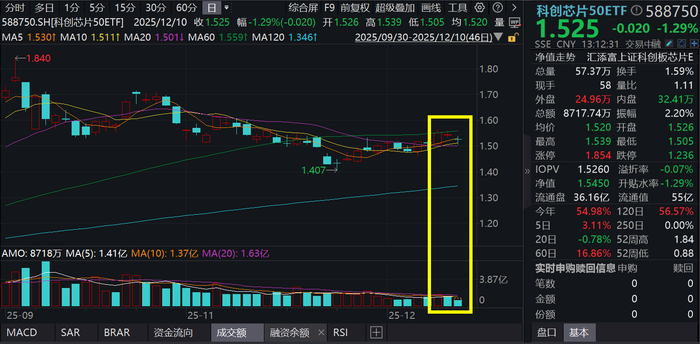
重大资产重组宣布终止,海光信息探底回升!科创芯片50ETF(588750)一度跌2%,盘中溢价频现
Xin Lang Cai Jing· 2025-12-10 05:57
Core Viewpoint - The A-share market experienced fluctuations, particularly in the computing hardware sector represented by the Sci-Tech Chip 50 ETF (588750), which saw a decline of over 1% as of 13:13 on December 10, indicating active buying despite the downturn [1][3]. Market Performance - The Sci-Tech Chip 50 ETF (588750) faced a decline, with major component stocks like Langqi Technology and Huahong Semiconductor dropping over 3% due to the termination of the merger with Zhongke Shuguang [3]. - Haiguang Information's stock fell over 5% at one point but later narrowed its losses to around 1% in the afternoon session [3]. - The index's top ten component stocks predominantly showed negative performance, with declines ranging from 0.44% to 3.53% [3]. Industry Developments - The first MUSA Developer Conference by Moore Threads is scheduled for December 19-20, aiming to outline a comprehensive strategy centered on MUSA and introduce a new GPU architecture, which may boost confidence in domestic GPU chip technology [4]. - Despite short-term volatility in the semiconductor sector, the long-term growth drivers remain intact, with AI innovation and domestic substitution being the core catalysts [5]. Long-term Growth Logic - The semiconductor sector is witnessing a shift in growth momentum from consumer electronics to automotive applications, with analog chips expected to maintain a broad market space due to trends in smart and electric vehicles [5]. - AI computing chips are identified as the primary growth engine, with leading companies like Cambrian and Haiguang benefiting from the surge in AI server demand, leading to increases in both revenue and profit [5]. Index Characteristics - The Sci-Tech Chip 50 ETF (588750) focuses on the "high-end" upstream and midstream segments of the chip industry, showcasing strong growth potential under the current market conditions [6][8]. - The index is expected to achieve a net profit growth rate of 94% in the first three quarters of 2025, with an annual forecast of 100%, significantly outperforming its peers [8]. Comparative Analysis - The Sci-Tech Chip index is characterized by a higher "chip content" and greater elasticity compared to other semiconductor indices, reflecting its focus on core chip segments [6][9]. - The index has demonstrated a maximum increase of 187.69% since September 2024, with superior risk-adjusted returns compared to other indices in the sector [9].

中国银河证券:自主可控逻辑强化 半导体设备表现卓越
智通财经网· 2025-12-09 05:33
Core Viewpoint - The semiconductor industry is performing relatively well due to multiple factors such as the AI wave, domestic substitution, and technological innovation, supporting the long-term development logic of the semiconductor sector [1] Semiconductor Equipment - The U.S. House of Representatives has introduced H.R.6207, the "Chip Equipment Quality Act," which prohibits chip factories receiving U.S. subsidies from using 12 types of semiconductor equipment from China. This legislation reflects China's rapid progress in semiconductor equipment and reinforces the logic of self-sufficiency, serving as an important emotional catalyst for the sector's rise [1] Semiconductor Materials & Electronic Chemicals - Rongda Photosensitive has revealed that some of its photoresist products have achieved performance indicators that can replace certain Japanese products and have been applied in bulk among some customers. Domestic substitution is a strong theme throughout the sector, especially in critical areas like photoresists and electronic specialty gases [2] Integrated Circuit Packaging and Testing - The extreme pursuit of computing power and bandwidth by AI chips has made advanced packaging a necessity rather than an option. Developments from TSMC and Intel highlight that advanced packaging is a bottleneck for AI chip production and a key enabling factor, with its strategic value continuously increasing. Additionally, the rising demand for memory chips is directly boosting the demand for memory packaging and testing services [3] Analog Chip Design - The analog chip design sector has shown relative stability, with domestic industries advancing in capacity building, technological breakthroughs, and capital support. In the long term, the market space for analog chips remains broad, especially in key areas like automotive electronics, industrial control, and high-end power management, which are worth continuous attention [4] Digital Chip Design - NVIDIA has announced a $2 billion investment in leading EDA company Synopsys, which may reshape chip design processes and intensify technological competition. The upcoming listing of Moore Threads on the Sci-Tech Innovation Board on December 5, 2025, signifies domestic capital's recognition of high-end GPU design companies and strengthens market expectations for growth in AI computing power and domestic chip substitution [5]

历时半年争议收购告吹,国科微弃购中芯宁波后如何破亏损困局?
Xin Lang Cai Jing· 2025-12-01 03:41
Core Viewpoint - The acquisition of SMIC's subsidiary by Guokewai has failed after six months of controversy, with both companies announcing the termination of the asset transaction due to inability to reach an agreement within the expected timeframe [1] Group 1: Acquisition Details - Guokewai aimed to acquire SMIC Ningbo to create a dual-driven system of "digital chip design + analog chip manufacturing," intending to enhance production capabilities in high-end filters and MEMS, and expand into downstream markets like smartphones and smart connected vehicles [3][12] - The acquisition faced skepticism from the market due to limited synergy between Guokewai's digital chip design and SMIC Ningbo's analog chip manufacturing, raising doubts about the effectiveness of integration [3][4] Group 2: Financial Performance and Challenges - SMIC Ningbo has been operating at a significant loss since its establishment in 2016, with projected revenues of 213 million yuan, 454 million yuan, and 108 million yuan for 2023, 2024, and Q1 2025, respectively, while net losses are expected to be -843 million yuan, -813 million yuan, and -150 million yuan during the same periods [6] - Guokewai's financial situation is also concerning, with a revenue drop of over 50% to 1.978 billion yuan in 2024 and a net profit decline of approximately 90% to 7.4054 million yuan in the first three quarters of 2025 [8][12] Group 3: Strategic Implications - The termination of the acquisition allows Guokewai to avoid the risks associated with integrating a loss-making entity while still facing pressure to improve its own financial performance [12] - Guokewai is focusing on adjusting its business strategy, reducing low-margin product sales, and increasing R&D investment, which accounted for 43.6% of its revenue in the first half of 2025 [12]


半导体三季度业绩综述暨11月投资策略:盈利能力继续提高,看好存储和自主可控产业链
Guoxin Securities· 2025-11-05 14:05
Group 1 - The semiconductor industry has shown a significant performance improvement, with a 46.59% increase in the semiconductor index from the beginning of 2025 to October 31, outperforming the CSI 300 index by 28.65 percentage points [3][22]. - In Q3 2025, the semiconductor revenue grew by 11.0% year-on-year, with notable growth in digital chip design (+35.0%) and semiconductor equipment (+32.4%) [5][48]. - The net profit attributable to the parent company in Q3 2025 increased by 80.4% year-on-year, with integrated circuit manufacturing showing an extraordinary growth of 6819% [5][58]. Group 2 - The gross margin for the semiconductor sector in Q3 2025 was 30.0%, reflecting a 2.8 percentage point increase from the previous quarter, while the net margin was 11.3% [5][67]. - The global semiconductor sales reached $208.4 billion in Q3 2025, marking a 25.1% year-on-year increase and a 15.8% quarter-on-quarter increase [7]. - The report highlights a positive outlook for the storage sector, with expected price increases for DRAM and NAND Flash in Q4 2025, suggesting a favorable environment for domestic storage manufacturers [10]. Group 3 - The report indicates that over half of the 146 A-share semiconductor companies have achieved new quarterly revenue highs in 2025, driven by AI and domestic supply chain improvements [10][41]. - The analysis of fund holdings shows that the proportion of semiconductor stocks in active funds increased to 12.56% in Q3 2025, indicating a growing interest in the sector [3][36]. - The report recommends focusing on companies benefiting from the rise of domestic chip design and high-end chip trends, such as SMIC and Hua Hong Semiconductor [10][11].

“十五五”锚定科技自立,半导体板块活跃 | 投研报告
Zhong Guo Neng Yuan Wang· 2025-10-27 02:06
Core Viewpoint - The semiconductor sector continues to show steady growth driven by AI computing demand and expectations from the "14th Five-Year Plan" [2] Group 1: Market Overview - The Shanghai Composite Index (CSI 300) experienced a fluctuation of 2.04% this week, while the electronic sector rose by 3.6% and the semiconductor industry increased by 2.71% [2][3] - Within the semiconductor sector, semiconductor equipment saw a rise of 1.31%, while semiconductor materials and electronic chemicals experienced declines of -0.76% and increases of 1.9%, respectively [2][3] - The integrated circuit packaging and testing industry had a slight increase of 0.08%, with analog chip design and digital chip design rising by 1.27% and 3.97%, respectively [2][3] Group 2: Semiconductor Equipment - The semiconductor equipment sector maintained strong performance, with capital focusing on the "14th Five-Year Plan" for technological independence, leading to increased visibility of orders for leading equipment companies [2][3] - Short-term demand for etching and thin-film deposition equipment is robust due to AI computing needs, while long-term domestic substitution logic is reinforced under the "14th Five-Year Plan" [2][3] Group 3: Semiconductor Materials & Electronic Chemicals - The electronic chemicals sector showed active performance, particularly in sub-sectors like photoresists, driven by the "14th Five-Year Plan" emphasizing supply chain security and self-sufficiency [3] - High-end products such as KrF/ArF photoresists and CMP polishing liquids are key focus areas, with demand for advanced semiconductor precursors and specialty gases increasing due to capacity expansions in HBM and advanced logic chips [3] Group 4: Integrated Circuit Packaging and Testing - The packaging and testing sector is steadily rising, with advanced packaging being a core market focus [3] - The "14th Five-Year Plan" elevates technological independence to a strategic support level for national development, providing clear direction for transitioning to advanced packaging technologies like 2.5D/3D and Chiplet [3] Group 5: Analog Chip Design - The analog chip sector is showing stable performance and is in a mild recovery phase, aided by anti-dumping investigations that create a more favorable competitive environment for domestic companies [3] - Long-term deployments in energy internet, industrial digitalization, and automotive intelligence provide continuous and stable market demand for analog chips [3] Group 6: Digital Chip Design - The digital chip design sector, particularly AI computing chip stocks, is performing strongly, with the "14th Five-Year Plan" placing digital economy and AI development at its core [4] - The demand for high-performance computing chips is driven by cloud model training and edge AI applications, with domestic companies like Huawei and others enhancing market confidence in self-sufficient computing [4] Group 7: Investment Recommendations - The semiconductor sector is experiencing structural trends under the resonance of the "14th Five-Year Plan" and AI industry trends, with equipment and materials benefiting from domestic substitution strategies [4] - Key companies to monitor include Cambrian, Haiguang Information, Zhongwei Company, Northern Huachuang, Tuojing Technology, Anji Technology, Dinglong Co., and Changdian Technology [4]
深圳并购新政:制造中国的英伟达
3 6 Ke· 2025-10-24 08:10
Core Viewpoint - Shenzhen aims to double its total market capitalization from less than 10 trillion to 20 trillion yuan by 2025, completing 200 mergers and acquisitions (M&A) and creating 20 companies with a market value of 100 billion yuan each, which is seen as an aggressive target requiring a significant bull market to achieve [1][2][5]. Group 1: Market Conditions and Goals - The current total market capitalization of listed companies in Shenzhen is approximately 8.5 trillion yuan, necessitating a 2.35 times increase within three years, equating to an annual compound growth rate of about 30% [1][2]. - Achieving 200 M&A deals implies a shift towards smaller, high-frequency transactions rather than large-scale mergers, indicating a focus on creating a normalized M&A ecosystem [2][5]. - The goal of creating 20 companies with a market value of 100 billion yuan each means that the existing 22 leading companies with a market cap over 500 billion yuan must all double in value [2][3]. Group 2: Strategic Intent and Industry Focus - The Shenzhen plan emphasizes supporting leading companies in conducting upstream and downstream M&A to enhance supply chains and improve key technological capabilities, aiming to create domestic industry giants similar to Apple and Nvidia [3][5][10]. - The focus industries include integrated circuits, artificial intelligence, new energy, and biomedicine, with encouragement for emerging sectors like synthetic biology and quantum information [10][11]. Group 3: M&A Environment and Financing - The current M&A environment is favorable due to many companies being unable to meet performance targets, leading to a willingness to negotiate prices for acquisitions [6][7]. - The plan introduces innovative financing mechanisms, including non-resident M&A loans and specialized loans for technology companies, to facilitate acquisitions [9][12]. - A "project library" will be established to match suitable M&A targets with companies, addressing the issue of information asymmetry in the market [13][15]. Group 4: Exit Strategies and Market Dynamics - The plan positions M&A as a primary exit strategy for private equity and venture capital, equal to IPOs, thus legitimizing M&A as a viable route for investment returns [19][20]. - The ongoing systemic crisis in the venture capital ecosystem highlights the need for effective exit strategies, as many firms face difficulties in recovering investments [16][17].

半导体需求周期向上,芯片ETF(512760)涨超2.3%
Mei Ri Jing Ji Xin Wen· 2025-10-21 05:29
Core Insights - The semiconductor sector is experiencing an upward demand cycle, with AI emerging as a core growth driver [1] - The demand for analog chips has bottomed out, while digital chip AioT demand is surging, and power semiconductor profitability is improving [1] - Manufacturing utilization rates are recovering, equipment performance is strong, and there is a notable differentiation in materials [1] Industry Trends - Open-source models like DeepSeek are lowering deployment barriers, driving demand for SoC chips [1] - The demand for TWS earbuds and smartwatches is increasing, leading to a short-term shortage of DDR4, with prices rising by 18-23% in Q2 [1] - AI is driving growth in HBM and DDR5 demand [1] Investment Focus - The chip ETF (512760) tracks the China Semiconductor Index (990001), which focuses on the Chinese semiconductor industry, covering key areas such as semiconductor equipment, materials, and integrated circuit design [1] - The index's constituent stocks are concentrated in the upstream semiconductor supply chain, reflecting the trend of domestic substitution [1] - The weight allocation emphasizes companies with high technical barriers and strong policy support, aiming to reflect the overall performance of publicly listed companies related to semiconductor chips [1]