3DGS技术

Search documents
36氪首发丨峰瑞资本投了家智能硬件公司,做空间三维重建,创始人为前群核科技副总裁
3 6 Ke· 2026-03-23 01:36
Core Insights - Hangzhou Zhuma Innovation Technology Co., Ltd. has completed a multi-million angel round financing led by Fengrui Capital, with funds primarily allocated for R&D team recruitment, product mass production preparation, and initial marketing promotion [1] Company Overview - Zhuma Innovation was established in November 2025, focusing on consumer-grade 3D reconstruction and spatial intelligence products. The founder and CEO, Zhang Ji, has over 20 years of experience in the 3D graphics industry [1] - The company aims to fill the market gap in consumer-grade 3D reconstruction, as industrial-grade equipment is expensive and complex, while mobile AR applications are limited [2] Technology and Product Development - The core technology of Zhuma Innovation is 3D Gaussian Splatter (3DGS), which allows for high-fidelity reconstruction and real-time rendering, significantly lowering hardware barriers [2] - The first product, "Pebble," is a professional-grade 3DGS camera targeting overseas home designers and independent game developers, priced competitively compared to traditional industrial equipment [2] - The second product will be a "spatial memory camera" for general consumers, enabling users to capture and replay 3D memories of events [2] Strategic Vision - The company has a clear development path: short-term focus on the Pebble product, mid-term expansion into mainstream markets, and long-term establishment of a "hardware + software + community" business ecosystem [3] - The goal is to create a new content category rather than just a hardware product [4] Investor Perspectives - Investors believe that 3DGS technology has the potential to become a foundational technology for consumer markets, with Zhuma's team having strong technical capabilities and deep understanding of spatial design [5][6] - The expectation is for Zhuma to penetrate various fields such as space design, gaming, AR/VR, and physical AI, ultimately creating groundbreaking products [6]

首个基于3DGS的VLN具身学习数据集,群核科技联合浙大开源SAGE-3D
具身智能之心· 2025-12-25 04:01
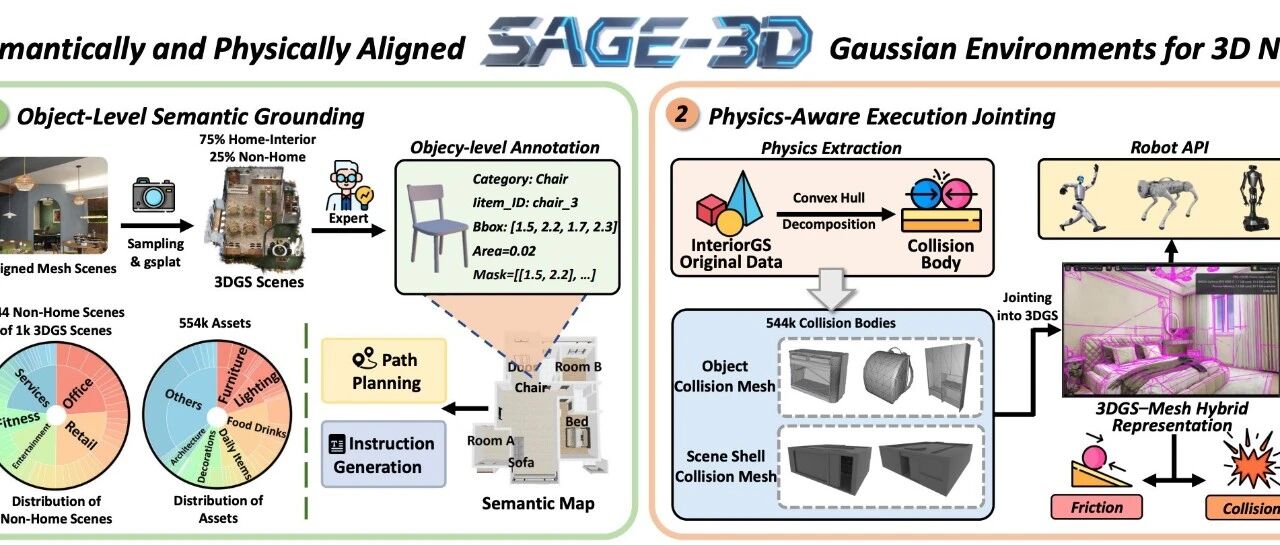
Core Insights - The article discusses the advancements in embodied intelligence, particularly focusing on the SAGE-3D dataset and its implications for visual language navigation (VLN) tasks. It highlights the transition of 3DGS technology from a mere rendering tool to a functional navigation environment that incorporates semantic and physical attributes, enabling robots to understand and interact with their surroundings effectively [2][3][30]. Group 1: 3DGS Technology and Its Limitations - Embodied data is recognized as a core asset in robotics, with the ability to generate high-quality data being crucial for competitive advantage [2]. - 3DGS technology generates realistic 3D point cloud models from real scenes but lacks essential physical information such as area, size, and geometric structure, limiting its application in navigation tasks [2][9]. - The introduction of the SAGE-3D dataset addresses the limitations of traditional 3DGS by providing a navigable environment that includes physical collision detection, allowing robots to interpret complex instructions and navigate safely [3][10]. Group 2: SAGE-3D Dataset and Its Features - SAGE-3D consists of two main components: the InteriorGS dataset, which includes 1,000 finely annotated indoor scenes with over 554,000 object instances, and the SAGE-Bench, a benchmark for VLN tasks with 2 million trajectory-instruction pairs [13][14]. - The dataset supports a hierarchical instruction generation framework that combines high-level semantic goals with low-level action commands, enhancing the robot's ability to follow complex instructions [18][22]. - SAGE-3D's hybrid representation of 3DGS allows for high-fidelity rendering while embedding physical properties, enabling robots to interact with their environment without issues like mesh penetration [22][30]. Group 3: Performance and Evaluation - Models trained on SAGE-3D, such as NaVILA-SAGE, demonstrate superior performance in VLN tasks, achieving a success rate of 0.46, significantly higher than traditional models [21][23]. - The SAGE-Bench platform introduces new evaluation metrics that capture the nuances of navigation performance, such as continuous success rates and collision penalties, providing a more comprehensive assessment of model capabilities [27][29]. - The SAGE-3D dataset shows strong generalization capabilities, with models trained exclusively on it outperforming baseline models in unseen scenarios, indicating its effectiveness in real-world applications [26]. Group 4: Future Implications - The advancements represented by SAGE-3D redefine the application boundaries of 3DGS technology, paving the way for more complex outdoor scenarios and multi-robot collaboration [30][31]. - The integration of semantic and physical capabilities into 3DGS not only enhances robot navigation but also supports the development of more sophisticated embodied intelligence systems [31].

最近前馈GS的工作爆发了,我们做了一份学习路线图......
自动驾驶之心· 2025-12-13 02:04
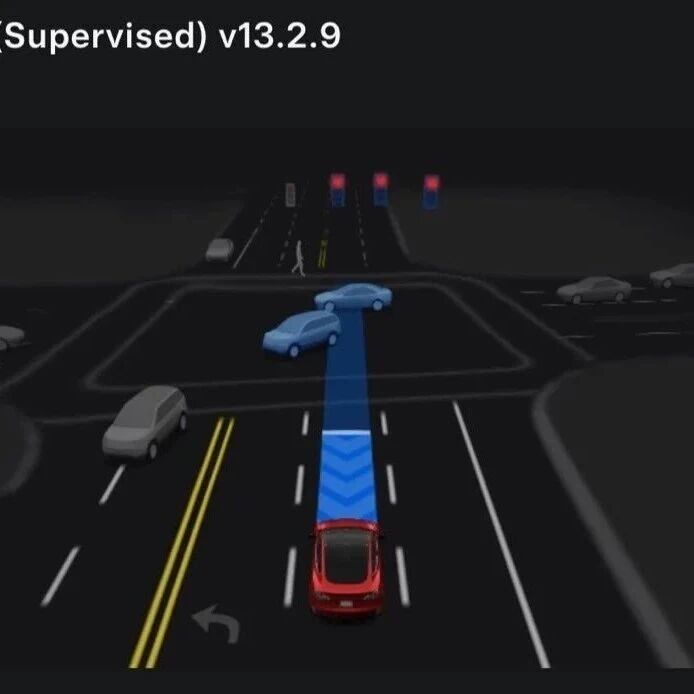
Core Insights - The article highlights the advancements in 3D Gaussian Splatting (3DGS) technology, particularly its application in autonomous driving, and emphasizes the need for structured learning pathways in this rapidly evolving field [2][4]. Group 1: 3DGS Technology and Developments - Tesla's introduction of 3D Gaussian Splatting at ICCV has garnered significant attention, indicating a shift towards feed-forward GS algorithms in the industry [2]. - The rapid iteration of 3DGS technology includes static reconstruction (3DGS), dynamic reconstruction (4DGS), and surface reconstruction (2DGS), showcasing the need for effective learning resources [4]. Group 2: Course Offering - A comprehensive course titled "3DGS Theory and Algorithm Practical Tutorial" has been developed to provide a structured learning roadmap for newcomers, covering essential theories and practical applications [4]. - The course is designed to help participants understand point cloud processing, deep learning, real-time rendering, and coding practices, with a focus on hands-on experience [4]. Group 3: Course Structure - The course consists of six chapters, starting with foundational knowledge in computer graphics and progressing to advanced topics such as feed-forward 3DGS and its applications in autonomous driving [8][9][10][11][12]. - Each chapter includes practical assignments and discussions to enhance understanding and application of the concepts learned [8][9][10][11][12]. Group 4: Target Audience and Prerequisites - The course is aimed at individuals with a background in computer graphics, visual reconstruction, and programming, particularly those interested in pursuing careers in the 3DGS field [17]. - Participants are expected to have a foundational understanding of probability, linear algebra, and programming languages such as Python and PyTorch [17].