95后人才吸引力

Search documents
95后人才吸引力,深圳连续3年霸榜!
Shen Zhen Shang Bao· 2025-12-12 08:23
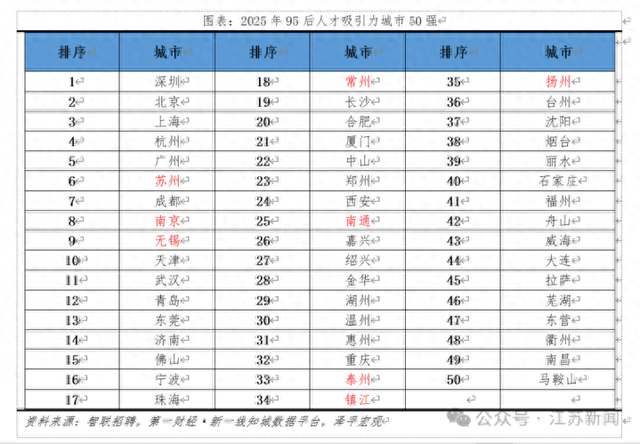
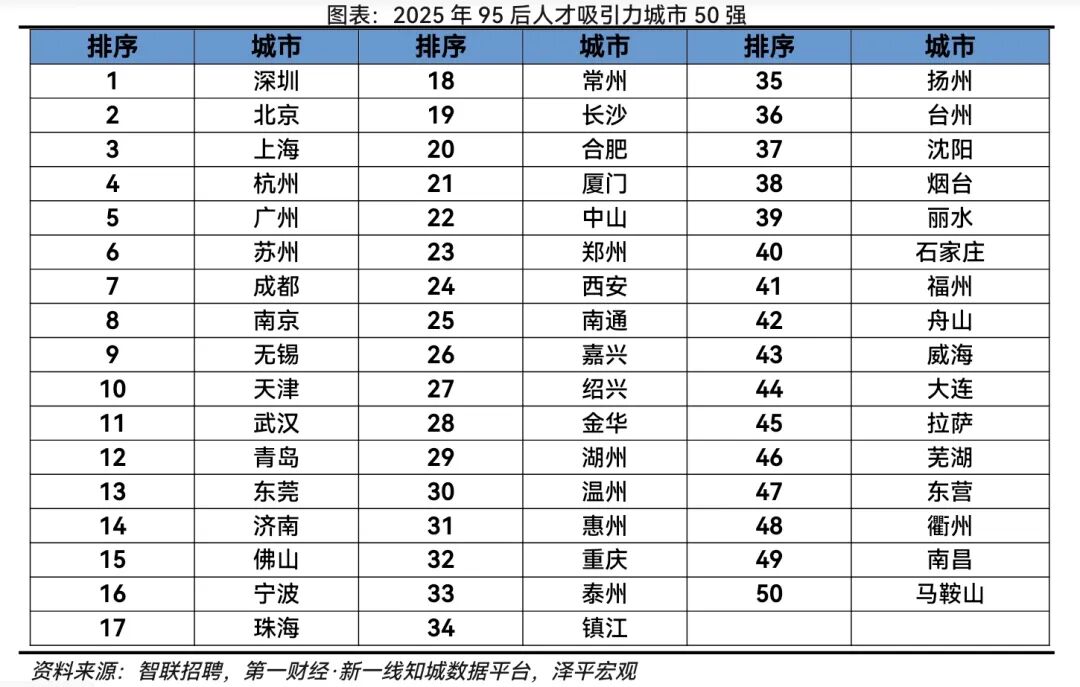
Core Insights - The report highlights that Shenzhen has ranked first in the talent attraction index for post-95s for three consecutive years, attributed to its innovative industry structure and talent-friendly environment [1][2]. Group 1: Talent Attraction Rankings - The top three cities for attracting post-95 talent are Shenzhen, Beijing, and Shanghai, followed by Hangzhou, Guangzhou, Suzhou, Chengdu, Nanjing, Wuxi, and Tianjin in the top ten [2]. - Shenzhen's net inflow of post-95 talent is approximately 1 percentage point higher than the national average for overall talent flow [2]. Group 2: Factors Contributing to Shenzhen's Success - Shenzhen has implemented policies to create a talent-friendly environment, including the introduction of regulations for attracting domestic talent and establishing a "Shenzhen Talent Day" on November 1 each year [3]. - The city is home to over 25,000 national high-tech enterprises and more than 4,000 innovation carriers, contributing to its reputation as "China's Silicon Valley" [3]. Group 3: Talent Demographics and Preferences - The total talent pool in Shenzhen exceeds 7 million, with over 26,000 high-level talents, and it ranks among the top three cities for attracting post-95 individuals with master's degrees or higher [4]. - Post-95 talent shows a preference for emerging industries, particularly in IT, communication, electronics, and the internet, which aligns well with Guangdong's industrial structure [6]. Group 4: Regional Insights - Seven cities in Guangdong, including Guangzhou, Dongguan, Foshan, Zhuhai, Zhongshan, and Huizhou, are among the top 50 cities for attracting post-95 talent [5]. - Shenzhen, Zhuhai, Foshan, Zhongshan, and Dongguan rank in the top ten for the number of patents granted per million people, indicating strong regional innovation vitality [7].

95后人才吸引力城市排名 深圳连续三年位居榜首
Nan Fang Du Shi Bao· 2025-12-11 14:12
Core Insights - The report titled "China City Talent Attraction Ranking" indicates that post-95 talent is increasingly drawn to eastern regions, particularly the Yangtze River Delta and Pearl River Delta city clusters, with Shenzhen ranking first for three consecutive years [1][2] Talent Attraction Trends - Post-95 talent prefers economically developed eastern cities, focusing on work-life balance, innovation environment, and cultural industries, rather than solely on salary [2] - Shenzhen's net inflow of post-95 talent exceeds the national average by 1 percentage point, attributed to its low residency threshold and a talent-friendly urban environment [5] City Rankings - Shenzhen ranks first, followed by Beijing and Shanghai, with Hangzhou rising to fourth place and Tianjin entering the top ten for the first time [2] - The top ten cities for post-95 talent inflow include Beijing, Shanghai, Shenzhen, Hangzhou, Nanjing, Guangzhou, Chengdu, Suzhou, Wuhan, and Tianjin, collectively accounting for 41.8% of the total, a decrease of 1 percentage point from last year [3] High-Education Talent - Major cities like Beijing, Shanghai, and Shenzhen attract high-education talent, with a combined share of 19%, although this has decreased by 0.2 percentage points compared to last year [3] - Stronger second-tier cities like Hangzhou and Nanjing are showing greater talent attraction than first-tier cities like Guangzhou [3] Income and Innovation - The cities with the highest disposable income include Shanghai, Beijing, Suzhou, and Hangzhou, with many located in the Yangtze River Delta, indicating a high standard of living [3] - In terms of innovation, Shenzhen, Suzhou, and Zhuhai lead in patent grants per million people, showcasing strong innovation vitality in Guangdong and Jiangsu provinces [4]
中国城市95后人才吸引力排名出炉!江苏三市位列前十
Sou Hu Cai Jing· 2025-11-30 07:44
Core Insights - The report by Zhilian Recruitment and Zeping Macro highlights the importance of attracting young talent, particularly those born after 1995, to drive economic and social development in China [1][2] Group 1: Talent Attraction Rankings - The top three cities attracting post-95 talent are Shenzhen, Beijing, and Shanghai, followed by Hangzhou, Guangzhou, Suzhou, Chengdu, Nanjing, Wuxi, and Tianjin in the top ten [1][2] - Jiangsu province stands out with eight cities in the top 50, including Suzhou, Nanjing, and Wuxi, indicating strong competition for talent in this region [2] Group 2: Talent Characteristics and Preferences - Post-95 talent tends to prefer economically developed eastern regions, with a notable inclination towards first-tier and strong second-tier cities for high-education opportunities [2][6] - The report indicates that cities like Beijing, Shanghai, and Shenzhen collectively attract 19% of high-education talent, although this figure has decreased by 0.2% compared to the previous year [4] Group 3: Income and Innovation - The cities with the highest disposable income include Shanghai, Beijing, Suzhou, and Hangzhou, with Suzhou and Hangzhou surpassing Guangzhou and Shenzhen in wealth [5] - In terms of innovation, cities like Shenzhen, Suzhou, and Zhuhai lead in patent grants per million people, showcasing strong innovative capabilities in Guangdong and Jiangsu provinces [5] Group 4: Regional Trends - There is a clear trend of post-95 talent moving towards the eastern regions, with a net inflow of 17%, which is higher than the national average of 13% [6] - The report emphasizes that the five major city clusters, including the Yangtze River Delta and Pearl River Delta, are the most attractive for young talent, contributing significantly to the economy [6] Group 5: Policy Recommendations - The report suggests that cities should respect the natural flow of population and industry towards advantageous regions and enhance their comparative advantages to attract talent [7]