A股定价权更替

Search documents
万亿资金涌入这三个方向!
Ge Long Hui· 2025-11-13 07:39
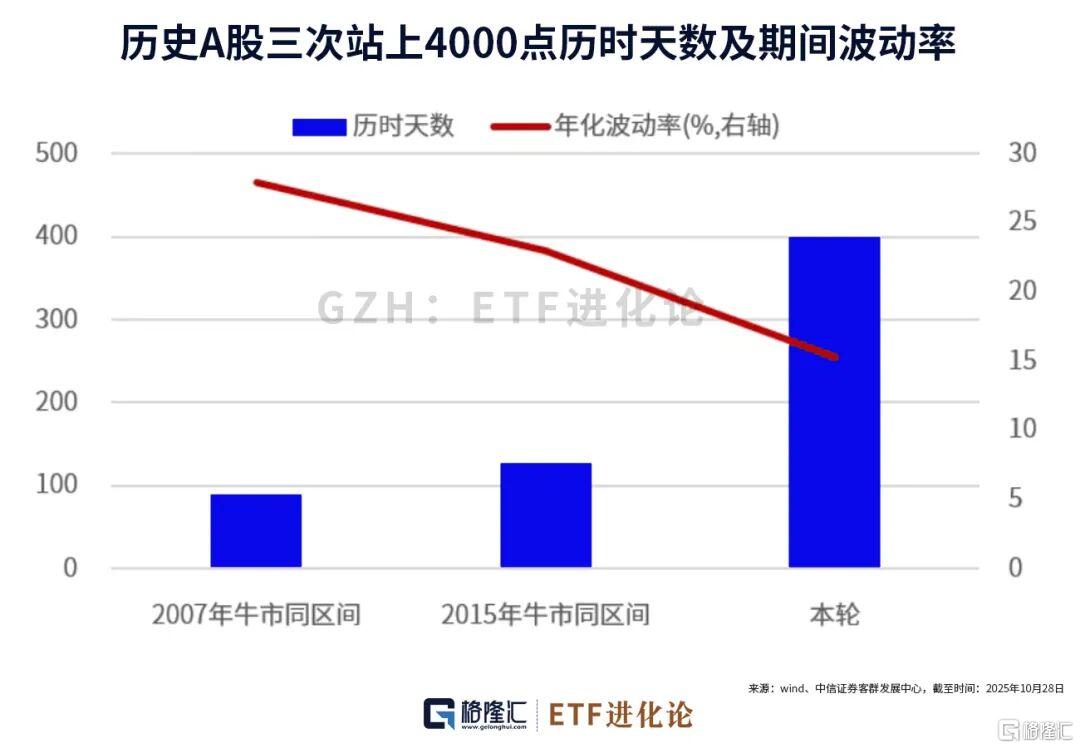
Core Viewpoint - The Shanghai Composite Index has reached the 4000-point mark for the first time in 10 years, indicating significant changes in the A-share market as it approaches the end of 2025 and the commencement of the next five-year plan in China [1] Group 1: Major Changes in the Market - Change One: Slow Bull Market - The Shanghai Composite Index rose from 2748 points on September 24, 2022, to surpass 4000 points on October 28, 2023, taking 400 days with an annualized volatility of 15.28%. In comparison, previous surges in 2007 and 2015 took only 89 and 127 days, respectively, with higher volatilities of 27.94% and 23.01% [1] - Change Two: Shift in A-share Pricing Power - By Q3 2024, the scale of passive equity funds, particularly stock ETFs, has surpassed that of actively managed equity funds for the first time, with the current ETF market reaching 5 trillion yuan, indicating a significant shift in pricing power within the A-share market [4] - Change Three: Leading Themes in the Current Market - The current bull market is primarily driven by sectors such as communication, electronics, and power equipment, reflecting a broader trend towards technological self-sufficiency and the global AI wave, alongside the narrative of revaluation of Chinese assets [5] Group 2: Fund Flows and Investment Trends - Significant Capital Inflows - Since September 24, 2022, the ETF market has seen a net inflow of 1.17 trillion yuan, with major inflows directed towards core A-share assets, technology innovation, and cyclical sectors [11][12] - Performance of Key ETFs - The Double Innovation Leader ETF tracking the Sci-Tech Innovation 50 Index has risen by 57.63% this year, while the Tianhong Growth ETF tracking the ChiNext Index has increased by 45.78% [8] - Year-End Capital Rotation - Following six months of continuous growth, A-shares have seen a rotation of capital, with significant inflows into ETFs tracking sectors like technology, securities, and consumer goods, particularly in the context of the upcoming "15th Five-Year Plan" [14][18]